DoD Removes Latest KIA from Official List of Casualties
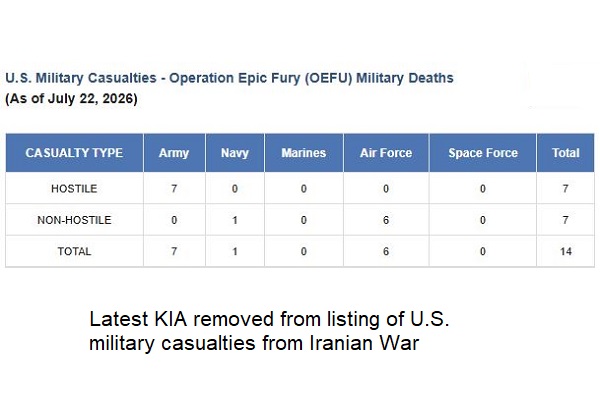
The Pentagon has removed the names of four service members who died in Jordan and Iraq in the past week from the official list of casualties from Operation Epic Fury.
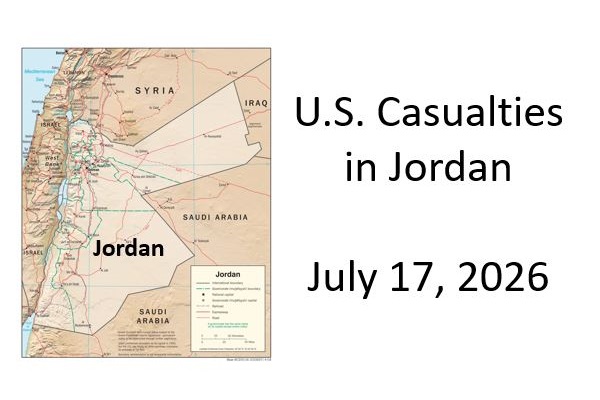
U.S. Central Command (CENTCOM) has reported that three U.S. service members in Jordan were killed in action. Four American service members were medically evacuated to Jordanian hospitals. They have since been discharged. One service member was killed in Iraq.
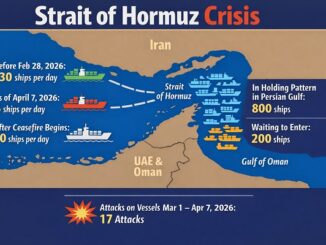
The United States launched strikes against more than 80 Iranian military targets after attacks on commercial shipping in the Strait of Hormuz. Washington also revoked temporary sanctions relief, signaling a return to economic pressure as tensions with Tehran escalate once again.
An AH-64 Apache helicopter went down in the waters off the coast of Oman on June 8, 2026. The two crewmen were rescued by a Task Force 59 naval drone. This is the first publically known rescue of downed airmen by an naval drone.
This past week, Iran attacked U.S. naval vessels, commercial shipping, and facilities in the United Arab Emirates. The “Freedom Project” has been suspended. A 30-day ceasefire is under consideration. Iran continues to resist giving up its control of the Strait of Hormuz, enriched urainian, or its nuclear program.
This update on Operation Epic Fury provides an update on the ceasefire, negotiations, the naval blockades, economic impact, and CENTCOM briefing to the president. The war cost thus far: $25 billion, crude oil up to $124/barrel, carrier leaves Middle East, and an effort to form a coalition named “Maritime Freedom Construct”.
Video and Transcript: Secretary of War Pete Hegseth and Chairman of the Joint Chiefs of Staff U.S. Air Force Gen. Dan Caine conduct a press briefing about Operation Epic Fury at the Pentagon, Washington, D.C., April 24, 2026.
An update on Operation Epic Fury – the U.S. – Iran conflict. While a ceasefire is still in effect there is a blockade of the Strait of Hormuz by both Iran and the U.S. Negotiations are at a impasse and there are significant economic impacts around the globe.
Operation Epic Fury update covering U.S. naval blockade measures, Strait of Hormuz disruptions, mine countermeasure deployments, and global economic impacts. Analysis of maritime security conditions, Iran’s remaining missile capability, and strategic implications of ongoing ceasefire negotiations in April 2026.
The Global Autonomous Reconnaissance Craft (GARC) serves as a solution for conducting high-speed, autonomous operations in contested military environments. The GARC naval drone is now in use by the U.S. Navy in the Middle East region in support of Operation Epic Fury.
Analysis of Operation Epic Fury developments on April 12, 2026, including ceasefire talks, U.S. and Iranian military activity, strike operations, maritime security conditions in the Strait of Hormuz, diplomatic signaling, and escalation indicators. Assessment of regional force posture, strategic risk trends, and implications for stability, energy markets, and ongoing conflict dynamics.
On April 7, 2026, the United States and Iran agreed to a two-week long ceasefire that will provide the time to come to an agreement to end the Iran War. The agreement is contingent on Iran fully reopening the Strait of Hormuz.
An operational update on Epic Fury – Monday’s press conference, negotiations, air strikes, downed U.S. aircraft, Strait of Hormuz, intelligence, and more about the Iran War.
On April 4, 2026, a Weapons Systems Officer (WSO) of a F-15E Strike Eagle that was shot down over Iran on April 3, 2026, was rescued by American forces.
An update brief on Operation Epic Fury – the War in Iran. Events, tactics, strategy, drones, air strikes, Future operations in the Strait of Hormuz and on Kharq Island.
Copyright © 2026 | WordPress Theme by MH Themes