
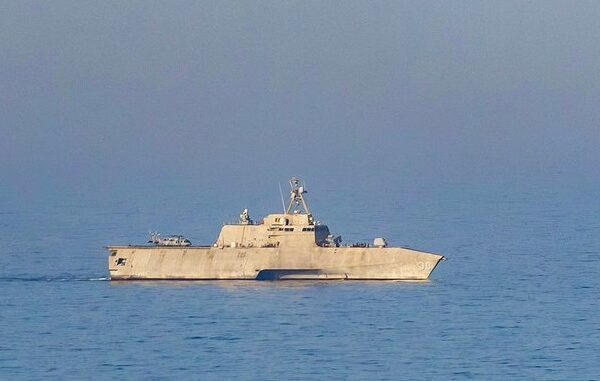
Top Photo: Littoral Combat Ship USS Canberra (LCS 30) in Persian Gulf, photo posted by US Central Command on X, 18 April 2026.
Executive Summary
The ceasefire talks a week ago did not yield an agreement; but some progress was made on some points. Another talk session could take place soon. Israel and Lebanon held talks as well, a very rare event, with the result of a ten-day ceasefire. On Saturday, the Iranian navy told ships over radio that the Strait of Hormuz is now shut down again. There are effectively two separate blockades of the Strait of Hormuz; one by Iran and the other by the U.S. According to U.S. intelligence and military officials Iran still maintains the ability to attack Gulf states and U.S. interests and bases in the region.

Key Developments
- Iraqi militias are probably responsible for some of the drone attacks against Gulf states.
- European countries may have a plan to clear mines from Strait of Hormuz.
- Two Avenger class mine-hunters have departed Japan and are deploying to the Middle East.
- On Friday, April 17, 2026, Iran said it has “reopened” the strait; but then on Saturday closed it again.
- Iranian Sepah (IRGC) Navy opened fire on an Indian-flagged vessel.
- U.S. blockade of Iranian ports continues.
- Iran retains significant residual missile and drone capability.
- Economic effects expanding beyond energy markets into aviation and fertilizer supply chains.
- Ceasefire ends on April 21, Pakistan working new talks.
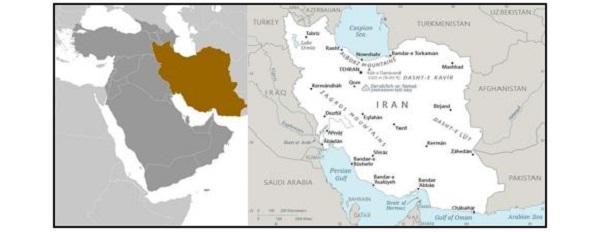
Click here for a larger physiography map of Iran that opens in a new tab.
Operational Overview
The most significant development in recent days has been the failure of ceasefire negotiations between the United States and Iran held in Islamabad, Pakistan on April 11, 2026. Following Iran’s rejection of elements of the U.S. proposal, the United States initiated a naval blockade targeting vessels engaged in commercial activity with Iranian ports and began preparatory operations to ensure freedom of navigation through the Strait of Hormuz.
Open-source reporting indicates that U.S. intelligence estimates that Iran retains approximately 40% of its pre-war arsenal of long-range attack drones, as well as 60% of its ballistic and cruise missile launcher capacity. “For Iran, Flexing Control Over Waterway is New Deterrent”, New York Times, April 18, 2026. (subscription)
Two U.S. Navy destroyers sailed into the Persian Gulf as a preliminary move to establish security to protect shipping and navy assets that will conduct mine sweeping operations. European nations are forming a task force to conduct mine clearing operations.
The U.S. and Iran entered a two-week ceasefire in combat operations April 8, and the U.S. initiated a naval blockade in the Persian Gulf for ships that have been doing business with Iran, April 13.
Pentagon Briefing – 16 April 2026. Secretary of Defense had some words of wisdom for the Iranian leaders during a press briefing at the Pentagon on Thursday, April 13, 2026. “Hegseth Urges Iran to ‘Choose Wisely’ During Epic Fury Ceasefire, Blockade”, Department of Defense, April 16, 2026.
The briefing video is here (37 minutes): https://www.war.gov/Multimedia/Videos/videoid/1002784/
The briefing transcript is here: Briefing Transcript
Maritime Situation and Strait of Hormuz
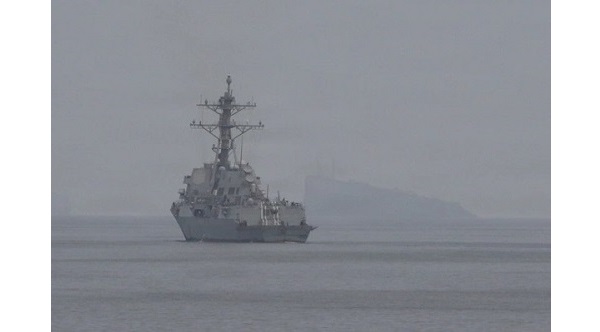
Photo: Navy Destroyer in Persian Gulf supporting mine clearance operation during Operation Epic Fury. (CENTCOM, April 11, 2026)
Iran announced on April 17 that the Strait of Hormuz would remain open for the duration of the ceasefire period ending April 21. However, on April 18 Iranian naval forces indicated via maritime communications that the strait was again restricted, highlighting the unstable and reversible nature of the current maritime environment.
U.S. Central Command stated that since commencement of the U.S. blockade, 23 ships (as of 18 April 2026) have complied with direction from U.S. forces to turn around. American forces are enforcing a maritime blockade against ships entering or exiting Iranian ports and coastal areas.
U.S. Central Command (CENTCOM) forces began setting conditions for clearing mines in the Strait of Hormuz, April 11, as two U.S. Navy guided-missile destroyers entered the conflict area. The USS Frank E. Peterson (DDG 121) and USS Michael Murphy (DDG 112) transited the Strait of Hormuz to provide force protection and maritime security for anticipated mine countermeasures (MCM) operations. While these destroyers are not dedicated minesweepers, they provide air defense, surface warfare capability, and command-and-control support for follow-on MCM forces.
Two Avenger-class mine countermeasure vessels have departed Sasebo, Japan and are deploying toward the Middle East. Until last year, the Navy had four of these Avenger-class mine-hunters based in the Persian Gulf, but in January they were transported back to the states. The four ships were replaced by three Independence-class Littoral Combat Ships (LCS). Of those three, two were in Southeast Asia when Operation Epic Fury kicked off. The migration of U.S. Navy minesweeping assets west from the Pacific indicates preparations are underway for a major de-mining operation. “Flurry of Navy Minesweepers Appear to be Heading Toward the Middle East”, The War Zone, April 13, 2026.
The USS Gerald Ford (CVN-78), which was recently in the Eastern Mediterranean, has transited the Suez Canal along with two destroyers. The Ford is now in the Red Sea. It is currently over 300 days at sea, surpassing the record for the longest deployed aircraft carrier since the end of the Cold War. The Ford was initially in the Red Sea in March but went to the eastern Mediterranean for repairs after a fire caused significant damage to the ship. It will remain CENTCOM’s AOR until the USS George H.W. Bush (CVN-77) arrives on station. The Bush is currently taking the long way to the region around the Cape of Good Hope in Southern Africa.
U.S. forces in the Indo-Pacific Command area of responsibility will be pursuing “dark fleet vessels” that had left Iran before the U.S. blockade was set up. Dark fleet vessels are those illicit or illegal ships evading international regulations, sanctions, or insurance requirements.
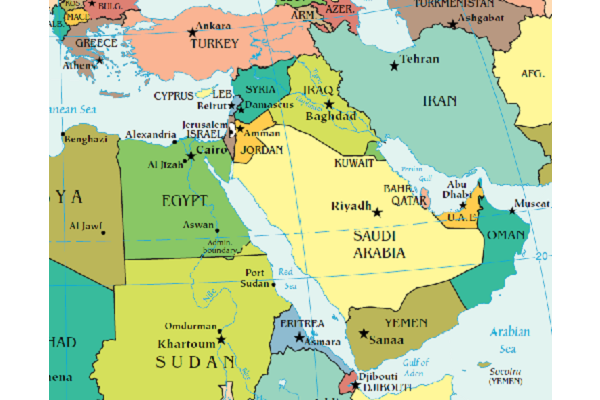
Bab al-Mandab Strait. The Houthis are warning Israel and the United States that it may take action to shut the strait between Yemen and the Horn of Africa. See map of Yemen (NSI).
Economic Implications
Airlines. Regional carriers such as Qatar Airways and Emirates have reduced flight frequencies due to increased insurance costs and regional security risks. Aviation insurers have raised premiums significantly as conflict risk increases across key transit corridors linking Europe and Asia.
Global Food Security. The economic impact of Operation Epic Fury is not limited to gas and oil. It also extends to the agricultural centers around the world that depend on nitrogen fertilizer that increases the yield of many crops. Between 40 to 50 percent of global seaborne urea trade originates from the Middle East, with much of it transiting the Strait of Hormuz. Urea is a concentrated, easy-to-transport fertilizer that is critical to global food security. “A Closed Strait of Hormuz Risks a Global Food Security Crisis”, War on the Rocks, April 13, 2026.
Saudi Arabia has restored the full pumping capacity of its East-West pipeline to 7 million barrels a day, bypassing the Strait of Hormuz. This is almost equivalent to four oil tankers passing through the Strait of Hormuz. The oil will go out through one of the Red Sea ports on the coast of Saudi Arabia. (gCaptain, April 13, 2026)
The U.S. Department of the Treasury’s Office of Foreign Assets Control (OFAC) is issuing a license authorizing the delivery and sale of crude oil and petroleum products of Russian Federation Origin loaded on vessels as of April 17, 2026. This action will hopefully stabilize world energy prices. Of course, the money Russia makes will go a long way to funding the Ukraine War.
Reference: BCA’s Iran Conflict Daily Dashboard. Real-time charts on the Hormuz crisis, energy, and macro risk. https://www.bcaresearch.com/collection/bcas-iran-conflict-daily-dashboard
Commentary, Analysis, and Opinion
Trump and the Strait Blockade. Trump’s Hormuz blockade gambit trades strategy for spectacle, pushing the region closer to a wider war while choking off the very diplomacy that could still keep this crisis from exploding. Retired SF general Don Bolduc provides his opinion in “Implications of the Trump Administration’s Decision to Blockade the Strait of Hormuz”, SOFREP, April 14, 2026.
Tactical Success, Strategic Failure. Ryan Evans asked what are the durable changes in Iran’s relationship to the U.S. and its neighbors were the air strikes over the past several weeks on Iran supposed to achieve. Many see the current conflict with Iran as going well for the United States. At the tactical level, it is going extremely well. However, tactical success and operational excellence does not mean the strategic objectives were achieved. Currently, energy markets are in turmoil, economic impacts have been felt around the world, the Strait of Hormuz is shut down, Iran’s regime is still in power, Iran still has control of its nuclear material, Iran is still supporting its proxy groups, Iran still possess residual missile and drone inventories, and Washington is looking for a way out. However, the conflict is not over yet. “Tactical Success, Strategic Failure? Washington Walks the Path to Defeat in Iran”, War on the Rocks, April 14, 2026.
References
Operation Epic Fury Daily Timeline (National Security Info)
https://www.national-security.info/events/epic-fury/timeline-epic-fury.html
Past Articles by SOF News on Operation Epic Fury
https://sof.news/tag/epic-fury/
Past Articles by SOF News on Iran
https://sof.news/tag/iran
Operation Epic Fury – U.S. Central Command Updates
https://www.centcom.mil/OPERATIONS-AND-EXERCISES/EPIC-FURY/
OEFU Casualty Tracker
https://dcas.dmdc.osd.mil/dcas/app/conflictCasualties/oefu
ISW Daily Iran Update. The Institute for the Study of War provides a daily summary of the events taking place in the Iran War. https://understandingwar.org/analysis/middle-east/
Interactive Map: U.S. and Israeli Strikes on Iran, by the Institute for the Study of War and Critical Threats.
https://storymaps.arcgis.com/stories/089bc1a2fe684405a67d67f13bd31324
Interactive Map: Maritime Attacks. The Washington Institute map includes detailed descriptions of attacks and incidents, data on each vessel, and geopolitical analysis in the Middle East region from 2017.
https://www.washingtoninstitute.org/menamaritime/
Iran Country Profile by National-Security.Info. Maps, reports, and references.
https://www.national-security.info/country/iran.html
