
Updates on drones including latest technology and use in conflicts around the world. An executive summary, key events, and curated articles.
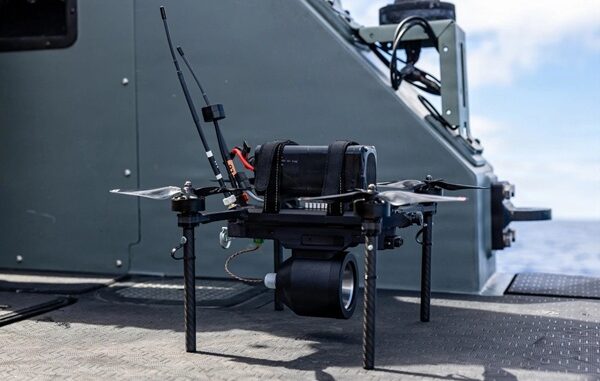
Image: A Neros Archer first-person view attack drone rests aboard a Multi-Mission Reconnaissance Craft-B during maritime training off the coast of Okinawa, Japan, Sept. 18, 2026. U.S. Marines with 3rd Battalion, 7th Marine Regiment, forward deployed with 4th Marine Regiment, 3rd Marine Division, as part of the Unit Deployment Program, and 3rd Reconnaissance Battalion, 3rd Marine Division, conducted the training as a proof of concept for employing small unmanned aircraft systems from maritime platforms in support of sea-to-shore operations. (U.S. Marine Corps photo by Lance Cpl. Oscar Ocampo)
Executive Summary
Drone warfare continued to expand across domains during September, with developments in aerial, ground, maritime, and undersea autonomous systems. The U.S. military is institutionalizing these capabilities through new specialties, force structures, training, and experimentation, highlighted by 1st Special Forces Command’s inaugural Best Drone Team Competition. Lessons from Ukraine continue to shape U.S. and allied approaches to logistics, artificial intelligence, electronic warfare, and autonomous operations, while increasingly sophisticated drone use by criminal organizations demonstrates how rapidly these technologies are spreading beyond conventional militaries.
Curated Articles
The topics listed below are presented with descriptions and with links to the online article.
- USAF looking for guns systems for overseas bases
- Drones for ferrying blood supplies
- New U.S. Army drone MOS
- 160th SOAR lands on sea drone
- Commanding autonomous aircraft
- Video – Guerrilla Sky
- Ukraine’s Nemesis drone hunters
- Fiber-Optic drones and ambush tactics
- UK’s AI-drone developers
- Ukrainian drones for logistics
- Submersible drone captured by Iran
- 116th MBCT deploys to CENTCOM
- Cartels and drones
- Drones and defending Taiwan
- Drones and War Injuries
- Armed Uncrewed Undersea Vehicle
Featured Topic
This articles featured topic is about the 1st Special Forces Command’s Drone Competition. The SF Command brought together 15 teams from across the Special Forces Groups, the 75th Ranger Regiment and the 101st Division at Fort McClellan and Clarke Range Complex, Aug. 24-28, for its inaugural Best Drone Team Competition, a five-day event designed to assess and strengthen unmanned systems proficiency across the formation.
The competition tested how teams employed small, unmanned aircraft systems in support of tactical tasks in both rural and urban environments. The event focused on more than flight operations, requiring competitors to analyze problems, adjust to changing conditions and apply available technology to mission requirements. 1st Special Forces Group (Airborne) may have earned first-place honors at the conclusion of the event, but the broader purpose was to improve readiness across 1st Special Forces Command by identifying effective practices, exposing capability gaps and informing future training.
The SF Command has recently established (March 2024) the Special Operations Robotics Detachment (SORD) to integrate elite autonomous hardware. Driven by asymmetric warfare lessons from Ukraine, this unique unit now rapidly accelerates technology adoption across complex military operations. Composed of specialized aviation soldiers, the detachment provides critical subject matter expertise and programmatic oversight for uncrewed aerial systems. They drive innovations utilizing commercial, government, and organically built robotic platforms to maintain tactical dominance on modern international battlefields.
The SORD is responsible for the Group 1-3 classes of unmanned aerial systems (UAS). The 390A Robotics Technician is a key part of the robotics program in SF. These warrant officers will serve at group and higher levels to act as the primary experts for planning and integrating UAVs into mission sets.
The competition reflects a broader command emphasis on adapting to rapidly changing technology and ensuring units can incorporate emerging capabilities into training and operations. As unmanned systems continue to evolve, commanders must balance experimentation, resourcing and skill development to ensure formations remain effective in complex environments.
U.S. Military Drone Developments
USAF Looking for Gun Systems for Overseas Bases. The military installations in the Middle East countries have proven vulnerable to Iranian drones and ballistic missiles. U.S. interceptors like the Patriot and THAAD are expensive and after six months of conflict the stockpile has been severely diminished. The U.S. Air Force is searching for a ground-based cannon that can shoot down drones and subsonic cruise missiles. The Patriot and THAAD belong to the Army, now the Air Force wants its own air defense weapon.
Drones for Ferrying Blood Supply. The U.S. Army is about to select a contractor that can supply two prototype drones for its ‘Blood Link’ project. The UAVs, weighing between 35 and 50 pounds, must be able to carry 20 units of blood products. “The US Army is looking for new drones to ferry blood supplies”, Army Times, September 17, 2026.
New U.S. Army Drone MOS. The Army is training about 30 soldiers in every class in the 15X Military Occupational Specialty, or MOS, at a base in Arizona to be tactical unmanned aircraft system specialists. A mix of new recruits straight from boot camp and veteran soldiers retraining are officially becoming the Army’s new 15X tactical unmanned aircraft system specialists. So far, the course has graduated more than 250 soldiers in almost a dozen training classes. “The Army’s new drone-first soldiers are already graduating from training school”, by Patty Nieberg, Task & Purpose, August 31, 2026.
160th SOAR Chopper Lands on Sea Drone. An MH-47G Chinook operated by the Special Operations Aviation Regiment (160th SOAR) successfully conducted landing and replenishment operations from an unmanned, autonomous barge. The SM300, the name for the barge, provides a refueling and rearming platform for helicopters. “U.S. Special Forces Operate Helicopter From Autonomous Barge for the First Time”, Naval News, September 23, 2026.
Commanding Autonomous Aircraft. Maj. Greg Search is a U.S. Air Force test pilot and the first Air Force pilot to operate a Collaborative Combat Aircraft, the YFQ-42A. He describes how to handle autonomous collaborative platforms. “A Rulebook for Surprises: Commanding Autonomous Aircraft”, War on the Rocks, September 1, 2026.
Video – Guerrilla Sky. U.S. Soldiers from across 1st Special Forces Command (Airborne) participate in the unit’s inaugural Best Drone Competition at Fort McClellan, Alabama, Aug. 23-29, 2026. The competition showcased the skills and proficiencies of 15 teams, testing their ability to incorporate Unmanned Aircraft Systems (UAS) within various combat scenarios. (U.S. Army video by SSG Gabriel Davis and SGT Shawnee Vercammen) DVIDS, August 23, 2026.
https://www.dvidshub.net/video/1022481/guerrilla-sky-1st-special-forces-command-airborne-inaugural-best-drone-competition

Drones and the Russia-Ukraine War
Ukraine’s Nemesis Drone Hunters Stalk U.S. Unit in Exercise. An exercise in April 2026 at Hohenfels, Germany was reported as a “drubbing” of an American mechanized unit by Ukrainian drones. A company commander who was there tells Blackhawk Company’s side of the story. “My unit took on Ukraine’s ‘Nemesis’ drone hunters. Here’s what really happened.”, by Capt. Allan W. Watson, Task & Purpose, September 3, 2026.
Fiber-Optic Drones and Ambush Tactics. Ukraine is using fiber-optic drones in increasingly deceptive ways, relying on their resistance to electronic warfare and close-range video feeds to scout Russian positions, study bunkers and dugouts, and create unusual openings for attacks. “Ukrainian soldiers are finding deceptive uses for their unjammable fiber-optic drones as ambush tactics spread”, Business Insider, September 2, 2026.
UK’s AI-Drone Developers. On September 25, the UK Ministry of Defence invited proposals from as many as 12 British companies to use Ukraine’s Avengers AI Labs database. The collection reportedly contains daylight, thermal and other sensor data from more than six million detections. The initial competition seeks AI models for coordinated unmanned systems that can function with degraded communications or without satellite navigation. Access to large quantities of labeled combat data can be more consequential than access to another prototype. It may accelerate target recognition, navigation and collaborative autonomy for logistics, strike, counter-UAS and maritime missions. (UK.GOV, September 25, 2026)
The Use of Ukrainian Ground Robots for Logistics. Lesia Bidochko, a policy fellow at the European Policy Institute in Kyiv, writes about how the Ukrainian military forces are using drones along the frontlines of Ukraine. Ukraine’s ground robots primarily perform dangerous last-mile logistics and casualty evacuation, reducing soldiers’ exposure rather than increasing lethality. Their effectiveness depends on affordability, rapid replacement, interoperable systems, resilient communications, forward maintenance, and procurement that rewards proven battlefield performance at scale. “Ukraine’s Ground Robots and the Economics of Survival”, War on the Rocks, September 2, 2026.
Drones and the Iran War
Submersible Drone Captured by Iran. Anduril’s Dive-LD uncrewed underwater vehicle falling into Iranian hands is significant, but the system was designed to be risked in contested waters. “Everything We Know About the U.S. Navy’s Submersible Drone Iran Just Captured”, The War Zone, September 8, 2026.
116th MBCT. The Army’s 116th Mobile Brigade Combat Team will deploy into the CENTCOM theater in support of Combined Joint Task Force–Operation Inherent Resolve . Approximately 1,200 Virginia and Kentucky National Guard soldiers are part of the new MBCT structure, which explicitly incorporates UAS and electronic-warfare capabilities into the brigade. The brigade transitioned from an infantry brigade combat team to a mobile brigade combat team in October 2025. The unit became the first Army National Guard unit to complete a rotation (DVIDS) under the new MBCT framework. One of the new capabilities the unit will deploy with is the short-range TEAL reconnaissance drone that can be used to identify targets and then adjust mortar fire onto them. The unit’s Multi-Function Reconnaissance Company has a host of new drones to include the Teal Black Widow and Teal 2, Anduril Ghost X, PDW C100, and Redwire VXE 30. Its Integrated Effects Platoon within individual infantry battalions hosts organic counter-small UAS capabilities. The MBCT is also deploying with organic electronic jamming and detection equipment.
International Drone Developments
Cartels and Drones. William J. Liffick and Peter K. Forster write on how non-state actors are using drones for intelligence gathering, attacking security forces and rivals, and transporting drugs across the U.S. border. Read their article in “Importing Warfare: The Rise of Cartel Drone Operations”, Small Wars Journal, August 30, 2026. See also “Cartel drone ops on the U.S.-Mexico border ‘get more creative every day’, task force warns”, DefenseScoop, September 24, 2026.
Drones and Defending Taiwan. Philip Sheers and Stacie Pettyjohn explore the role of affordable mass in a Taiwan conflict. “Drones, Missiles, and the U.S. Munitions Shortage”, CNAS, September 18, 2026.
Drones and War Injuries. Blast injuries associated with IED attacks became a signature medical challenge of the Global War on Terror. The drone age of warfare is producing a wider range and higher severity of traumatic injury. Veterans Affairs’ disability compensation framework requires veterans to connect a current condition to a specific, documentable incident or period of service. For many of the injuries emerging from drone-era conflicts, that architecture could create several immediate challenges. The injuries of this era may be new and harder to assess, but they are no less deserving of the frameworks needed to support them. “The New Signature Wounds: How Drone Warfare is Reshaping the Injuries Veterans Bring Home”, War on the Rocks, September 24, 2026.
Armed Uncrewed Undersea Vehicle. During testing in British waters around September 15–18, the 12-meter British-built Excalibur uncrewed underwater vehicle fired a U.S.-Australian heavyweight torpedo. Britain described it as the first torpedo launch by either country from an uncrewed underwater vessel. The September 22 announcement also launched cooperation between the UK Ministry of Defence’s Rapid AI Delivery Taskforce and the Pentagon’s Chief Digital and Artificial Intelligence Office. (GOV.UK, September 22, 2026)
**********
Previous Monthly Drone Updates:
