
Executive Summary
From a kinetic standpoint, operational activity in Operation Epic Fury has remained limited over the past week. The ceasefire has been extended—reportedly on an open-ended basis—while the dual U.S. and Iranian maritime restrictions remain in effect. These measures continue to impose significant economic pressure on Iran, Gulf states, and global energy markets.
Iran appears to have absorbed the initial effects of the U.S.-Israeli air campaign and continues to signal strategic resilience. Meanwhile, U.S. Central Command (CENTCOM) has briefed President Trump on potential next-phase military options. Diplomatic negotiations remain stalled.

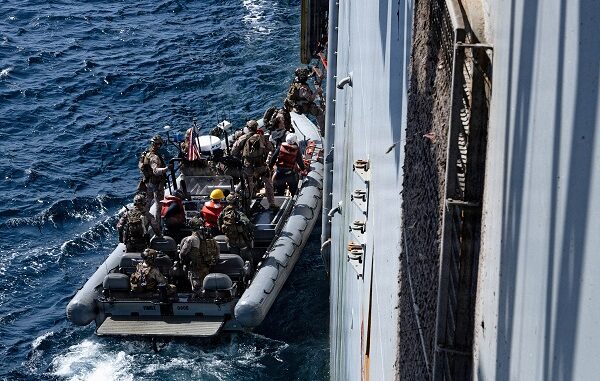
Top Photo: Marines assigned to the 31st Marine Expeditionary Unit board Blue Star III, a commercial ship suspected of attempting to transit to Iran in violation of the U.S. blockade of Iranian ports, April 28, 2026. U.S. forces released the vessel after conducting a search and confirming the ship’s voyage would not include an Iranian port call. (photo courtesy of Marine Corps)
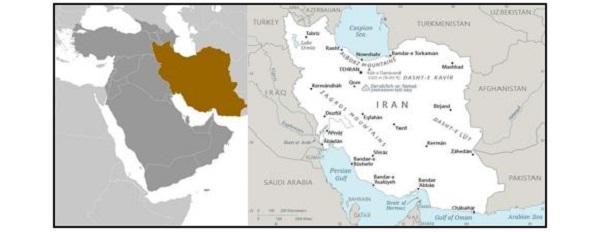
Click here for a larger physiography map of Iran that opens in a new tab.
Key Developments
- Ceasefire Holding but Negotiations Stalled
- Maritime Blockade Continues to Disrupt Global Energy Markets
- Iranian-aligned Militias Sustaining Regional Pressure Campaign
- CENTCOM Cdr Briefing to Trump
- Price tag for war? 25 billion says DoD; but probably more
- MP CT National Guard Unit Deploys to Middle East
- Crude oil went up to $124.67 a barrel
- CENTCOM Requests Dark Eagle Weapon
- “Maritime Freedom Construct”
- USS Gerald R. Ford to leave Middle East
- Who is In Charge in Iran?
- U.S. Strategic Endstate Remains Undefined
Pentagon Testimony to Senate
Secretary of Defense Pete Hegseth and chairman of the Joint Chiefs of Staff Air Force General Dan Caine testified before the Senate Armed Services Committee on Thursday, April 30, 2026 on the DoD budget request for FY 2027. The video of the testimony can be watched here, the Hegseth statement here, and the Caine statement here. During the hearing a lot of ground was covered on Operation Epic Fury.
Operational Overview
CENTCOM Cdr Briefing to Trump. Admiral Cooper, the U.S. Central Command commander, and chairman of the Joint Chiefs of Staff General Dan Caine provided a briefing on Operation Epic Fury to President Trump on Thursday, April 30, 2026. The briefing covered potential military options, including limited ground interventions, targeted strikes on Iranian energy infrastructure, and other contingencies.
U.S. Naval Blockade. According to a statement from U.S. Central Command on Wednesday, April 29, 2026, the U.S. has now directed 42 vessels to turn back to Iranian ports or turn away from transiting the Strait of Hormuz. This figure reflects activity since the beginning of the U.S. blockade. There are 200 aircraft and 25 ships involved in the naval blockade.
Guard Military Police Unit Deploys to ME. Approximately 150 Soldiers from Headquarters and Headquarters Company, 192nd Military Police Battalion, Connecticut Army National Guard were tapped by the Pentagon to deploy on short notice to the Middle East to support Operation Epic Fury. The 192nd is scheduled to provide a range of support functions to U.S. military forces engaged in Operation Epic Fury, including mission command, staff planning, security, personnel services, and logistical support. “192nd MPs deploy in support of Operation Epic Fury”, DVIDS, April 28, 2026.
Carrier to Depart Middle East. The USS Gerald R. Ford will depart the Middle East in the next few days providing some time home for over 4,500 sailors who have been deployed for over 10 months. That will leave two carrier strike groups in the CENTCOM area of responsibility for Operation Epic Fury. Once in home port the sailors get some leave while the carrier undergoes repairs, refit, and maintenance.
CENTCOM Requests Dark Eagle. U.S. Central Command is requesting to have the U.S. Army’s Dark Eagle Long Range Hypersonic Weapon deployed to the CENTCOM AOR. The long-range missile has not completed operational testing and has not deployed to a combat zone. The request comes after Iran moved its launchers out of the 300-mile range of the Precision Strike Missile (PrSM).
Iran-aligned Iraqi militias have continued to attack U.S. and coalition partner installations in Iraq as well as facilities in Kuwait and other Arab Gulf states. Several Iran-aligned militias have formed a coalition calling itself the “Islamic Resistance in Iraq”. Collectively they have launched at least 400 strikes against targets in Iraq, Saudi Arabia, Kuwait, the UAE, Qatar, Bahrain, and Jordan. U.S. and Israeli airstrikes have targeted these militias in Iraq. The United States is withholding funds from the Iraqi government in an attempt to influence it from a pro-Iran stance to one more favorable to the United States. One of the U.S. aims is to influence the selection of the next Iraqi prime minister. “Iraq is Caught Up in the U.S.-Iran War”, Intelbrief – The Soufan Center, April 30, 2026.
War Powers Act and the Ceasefire. Secretary of Defense Pete Hegseth stated that the administration considers the 60-day War Powers Resolution timeline paused during the ceasefire period—a position likely to face legal and congressional scrutiny. That stance provides the administration more time to operate unilaterally without congressional approval. The 60-day mark is Friday, May 2, 2026. If the administration’s argument is accepted then the clock stopped on April 7th. “Hegseth says war powers 60-day deadline on pause during ceasefire”,Washington Examiner, April 30, 2026.
Negotiations, Diplomacy, and Economic Implications
“Maritime Freedom Construct”. The United States is proposing to allies to join a new coalition that would secure shipping through the Strait of Hormuz. It would ask partners to join as either diplomatic or military contributors. The effort would share intelligence and enforce sanctions as well as coordinate diplomatic activities. The effort was spelled out in an internal State Department cable sent to U.S. embassies on Tuesday that called on U.S. diplomats to press foreign governments into signing up. “As Hormuz Traffic Stalls, U.S. Pitches New Coalition to Get Ships Moving Again”, The Wall Street Journal, April 29, 2026. (subscription)
Crude Oil Price Rises. The price of oil went up to $124.67 a barrel, the highest it has been in quite a long time. If the “double blockade” continues the price will remain inflated for the near future. The economic impact to Iran, Europe, and Asia is significant.
$25 Billion. That is the price of Operation Epic Fury thus far as stated by Secretary of Defense Pete Hegseth during an appearance before the House on Wednesday, April 29, 2026. Some House representatives questioned this figure; stating they believe it is a low estimate.
Reference: BCA’s Iran Conflict Daily Dashboard. Real-time charts on the Hormuz crisis, energy, and macro risk. https://www.bcaresearch.com/collection/bcas-iran-conflict-daily-dashboard
Commentary, Analysis, and Opinion
Not the Victory That Trump Claims. Dr. Tahir Mahmood Azad, a research scholar at the University of Reading, UK, provides his perspective on the achievements thus far of the United States in its war on Iran. He argues that the war has caused structural damage to the post-Cold War order the United States itself built. He says that there are some areas of concern: military, financial, regional, diplomatic, global, and reputational. “The Cost of the Iran War for the United States: A Strategic Blunder in Five Dimensions”, Small Wars Journal, April 27, 2026.
Tactical Success, but Strategic Outcome is Questionable. Operation Epic Fury achieved its military objectives – degrade Iran’s nuclear program, target senior leadership, and reduce its conventional military capacity. The naval blockade has produced leverage in the ongoing negotiations. However, there has been a failure to connect military action to a political end-state. The institutional processes that exist to ensure that connection were not used. This has resulted in a questionable strategic outcome thus far. Joe Funderburke provides his analysis in “War Without a Theory of Victory: How the United States Lost the Strategic Thread in Iran”, Small Wars Journal, April 27, 2026.
Air Power and Regime Change. M.L.R. Smith of the Australian War College provides his perspective on how there is “a lingering suspicion of promises that war can be conducted cleanly at distance” and a regime can be destroyed from above without the burden of occupation. He reaches back into history to buttress his argument – using the examples of Serbia (1999), Libya (2011), and other conflicts. “Regime Change from the Sky: Strategy, Air Power and the Illusion of Control”, Military Strategy Magazine, April 29, 2026.
He concludes with:
“Air power can coerce and degrade; under certain conditions, it may contribute to the removal of a regime. By itself, however, it does not construct a new order, nor does it reliably produce outcomes aligned with the attacker’s preferences. Instead, it operates within a field of uncertainty in which the point of decision often becomes visible only in retrospect.”
Who is in Charge in Iran? Iran no longer has a single, undisputed clerical arbiter at the top of government. Instead, power is defused among several actors; but commanders of the Islamic Revolutionary Guard Corps (IRGC) are at the top of the pyramid. This has complicated negotiations with the United States. Regime change, despite the U.S. administration’s narrative, has not happened. The leadership changed with the adoption of more hardline positions. “Iran’s Guards Seize Wartime Power, Blunting Supreme Leader’s Role”, gCaptain, April 28, 2026.
Assessment:
Operation Epic Fury has transitioned from high-intensity kinetic operations to a coercive pressure phase centered on maritime control and economic disruption. While tactical objectives appear largely achieved, the absence of a clearly defined political end-state continues to constrain strategic success. Iran’s decentralized power structure—now increasingly dominated by IRGC elements—complicates negotiation pathways and may prolong the conflict. Iran will hold out for retaining control over shipping through the Strait of Hormuz and maintain its nuclear and missile capabilities. Absent a diplomatic breakthrough, the current posture risks evolving into a protracted standoff with persistent regional instability.
References
Operation Epic Fury Daily Timeline (National Security Info)
https://www.national-security.info/events/epic-fury/timeline-epic-fury.html
Past Articles by SOF News on Operation Epic Fury
https://sof.news/tag/epic-fury/
Past Articles by SOF News on Iran
https://sof.news/tag/iran
Operation Epic Fury – U.S. Central Command Updates
https://www.centcom.mil/OPERATIONS-AND-EXERCISES/EPIC-FURY/
OEFU Casualty Tracker
https://dcas.dmdc.osd.mil/dcas/app/conflictCasualties/oefu
ISW Daily Iran Update. The Institute for the Study of War provides a daily summary of the events taking place in the Iran War. https://understandingwar.org/analysis/middle-east/
Interactive Map: U.S. and Israeli Strikes on Iran, by the Institute for the Study of War and Critical Threats.
https://storymaps.arcgis.com/stories/089bc1a2fe684405a67d67f13bd31324
Interactive Map: Maritime Attacks. The Washington Institute map includes detailed descriptions of attacks and incidents, data on each vessel, and geopolitical analysis in the Middle East region from 2017.
https://www.washingtoninstitute.org/menamaritime/
Iran Country Profile by National-Security.Info. Maps, reports, and references.
https://www.national-security.info/country/iran.html
