
Executive Summary
The planned ceasefire meeting in Islamabad, Pakistan for Wednesday never happened; Iran declined to show. The U.S. naval blockade on vessels going to and from Iranian ports is still in effect. By Thursday, three ‘sanctioned’ oil tankers had been seized by U.S. naval forces. The two-week ceasefire ended on Wednesday, April 22, 2026; however, President Trump stated on Tuesday that he was extending the ceasefire but continuing the blockade. Trump could be setting the stage for a unilateral de-escalation in the near future.
The U.S. naval blockade is intact and stopping ships visiting Iranian ports. Other vessels are being allowed through by the U.S. Navy. Iran’s navy may have been sunk but it has numerous small boats – cigarette boats and others – a “mosquito fleet” that poses a threat to U.S. Navy vessels as well as commercial shipping in or near the Strait of Hormuz. In addition, short-range missiles and drones are a factor as well. The Trump administration has indicated that we are now in the ‘economic phase‘ of Operation Epic Fury, putting a strangle-hold on Iran’s economy.

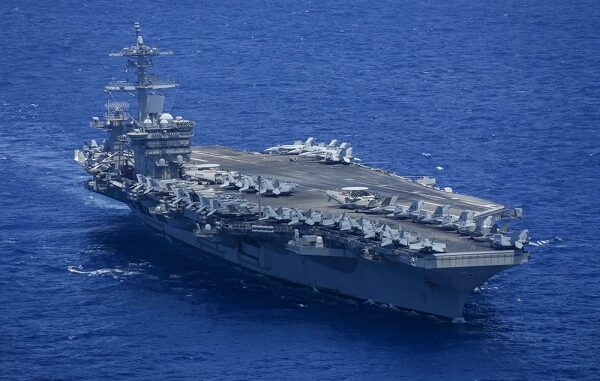
Top Photo: Nimitz-class aircraft carrier USS Abraham Lincoln (CVN 72) is currently in the U.S. Central Command Area of Operations. (photo 24 June 2022 by Mass Communication Specialist Seaman Aleksandr Freutel, location Pacific Ocean)
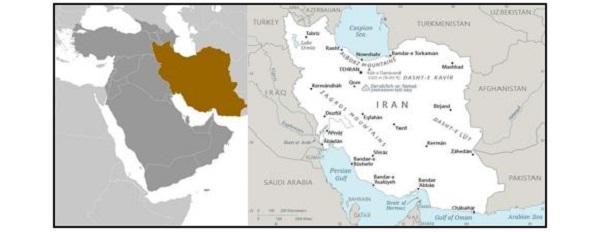
Click here for a larger physiography map of Iran that opens in a new tab.
Key Developments
- No ceasefire meeting took place on Wednesday
- U.S. naval blockade still in effect
- Three oil tankers seized by U.S. Navy
- Iran attack on and seizure of two oil tankers
- Ukrainian counter-drone tech
- Iranian proxy activity continues at reduced but persistent levels
- Insurance and shipping markets still pricing elevated risk
- Economic phase of conflict
- Israeli-Lebanon ceasefire extended
Operational Overview
U.S. naval forces remain postured for rapid strike operations, indicating a deterrence posture rather than a transition to de-escalation. As of April 23, 2026, the USS George H.W. Bush (CVN-77) (picture NSI), a Nimitz-class aircraft carrier, is now operating in the Indian Ocean. There are now three aircraft carriers in the CENTCOM AOR.
Small Boat Threat. The paramilitary Revolutionary Guard has hundreds of small boats that can threaten unarmed oil tankers and container ships in the Persian Gulf and Strait of Hormuz. The Iranian Kuch-type Fast Patrol Boat / Attack Speedboat employed by the Islamic Revolutionary Guard Corps Navy is 30 long and 10 feet wide, carries a variety of weapons, and can lay sea mines. “Iran’s Swarm Tactics Show Why Hormuz is Far From Safe“, gCaptain, April 23, 2026.
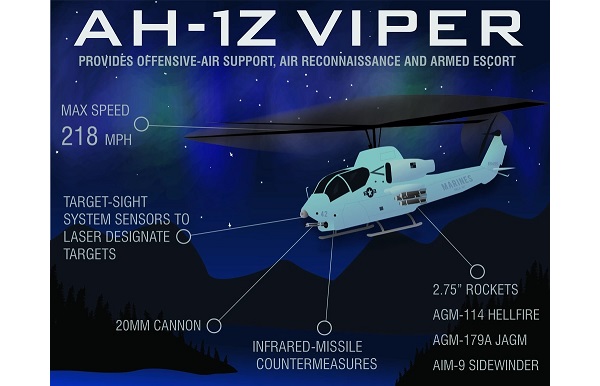
Image. (U.S. Marine Corps graphic by Cpl. Lauren L. Salmon, 28 Nov 2022)
The U.S. naval and air assets should be able to handle the small boat threat. The U.S. has extensive capabilities to track and identify these small boats – they can quickly detect, track, and eliminate them. For example, one of the U.S. assets is the U.S. Marine Corps AH-1Z Viper that uses the Target Sight System (TSS) which can identify IRGC threats from miles away – day or night. The chopper is equipped with the new JAGM (Joint Air-to-Ground Missile) and would be effective against small boat swarm tactics. The AH-1Zs are deployed aboard a U.S. Navy amphibious assault ship (LHA) and amphibious transport dock (LPD). These vessels are likely deployed in the Arabian Sea or Gulf of Oman. (info submitted by subscriber)
Air Operations, Drones, and Missiles
Air Flow. There is a constant stream of refueling and cargo aircraft from the United States to Europe and the Middle East (and return flights) during this refit and rearming phase of Operation Epic Fury. Aerial surveillance missions are continuing as well.
Ukrainian Counter-Drone Tech. The U.S. military is lagging behind in counter-drone defense and has suffered casualties and damage to high-value aircraft and military equipment. Ukrainian counter-drone technology has been deployed to at least one U.S. airbase in the Middle East to fill this gap in defenses. A Ukrainian command-and-control platform called Sky Map has been deployed at Prince Sultan Air Base in Saudi Arabia along with Ukrainian trainers. Sky Map has a dashboard that features maps and video feeds and synthesizes data from radars and sensors to detect incoming threats. “US turns to Ukrainian counter-drone tech after Iran attacks”, Reuters, April 22, 2026.
Attacks on UAE. The United Arab Emirates Embassy in the United States published a post on X on April 20, 2026, that showed the UAE received more Iranian missile and drone attacks than any other nation from February 28 to April 14. The numbers follow: UAE 2,819, Israel 1,357, Saudi Arabia 1,231, Kuwait 1,214, Qatar 730, Bahrain 717, Iraq 340, and Jordan 287.
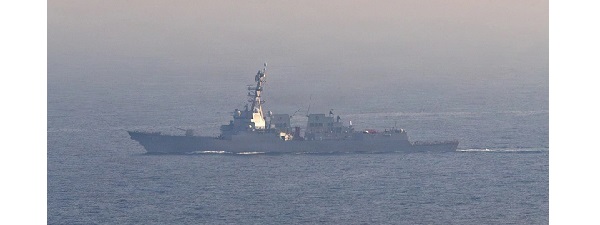
Photo: Arleigh Burke-class guided-missile destroyer USS Rafael Peralta (DDG 115) patrols the Arabian Sea during a maritime blockade against ships entering or exiting Iranian ports and coastal areas, April 21, 2026. Rafael Peralta is deployed to the U.S. 5th Fleet area of operations to support maritime security and stability in the Middle East. (U.S. Navy photo)
Maritime Situation and Strait of Hormuz
Another U.S. Boarding. The U.S. military boarded the M/T Majestic X, making it the third vessel boarded this week by the U.S. The naval blockade has redirected 33 ships since the blockade went into effect.
Iran Attack Oil Tankers. Small naval craft of the IRGC Navy seized two oil tankers in the Strait of Hormuz (NSI) on Wednesday, April 22, 2026. The tankers suffered damage to infrastructure but no crew were injured. The Liberian-registered Epaminondas and the Panama-flagged MSC Francesca were accused of violations and attempting to leave the strait covertly. The IRGC Navy said it transferred the ships into Iranian waters for inspection. “Iran attacks vessels in Hormuz, avoids concrete stance on ceasefire extension”, FDD’s Long War Journal, April 22, 2026.
Clearing Mines? Six months. It may take a long stretch of time to clear the mines placed in the Strait of Hormuz by the Iranians. A mine clearing operation most likely will not begin until hostilities have ended between the United States and Iran. “Clearing Strait of Hormuz of mines could take 6 months, Pentagon tells Congress”, The Washington Post, April 22, 2026. (subscription)
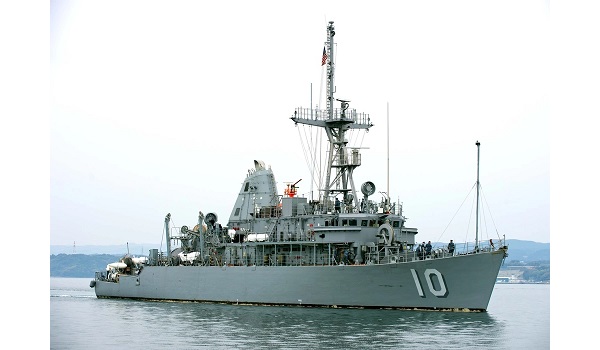
Photo: The Avenger-class mine countermeasures ship USS Warrior (MCM 10) pulls into Commander, Fleet Activities Sasebo. Warrior traveled from Bahrain by heavy-lift transport ship to replace ex-Guardian (MCM 5). (U.S. Navy photo by Mass Communication Specialist 3rd Class Mackenzie P. Adams/Released, March 30, 2013)
Mine-Hunters heading to Middle East. A pair of Avenger-class mine-hunters are heading to the CENTCOM area of operations, having left Japan earlier this month. They departed Sri Lanka a few days ago. Currently, the only confirmed mine sweeper, an Independence-class LCS in the region is the USS Canberra.
Video – U.S. Marines Board M/V Touska. U.S. Marines depart amphibious assault ship USS Tripoli (LHA 7) by helicopter and transit over the Arabian Sea to board and seize M/V Touska. The Marines rappelled onto the Iranian-flagged vessel, April 19, after guided-missile destroyer USS Spruance (DDG 111) disabled Touska’s propulsion when the commercial ship failed to comply with repeated warnings from U.S. forces over a six-hour period. The vessel had departed Kharg Island (NSI) on April 5. (U.S. Central Command Video, 1 min) https://www.dvidshub.net/video/1003123/us-marines-board-m-v-touska
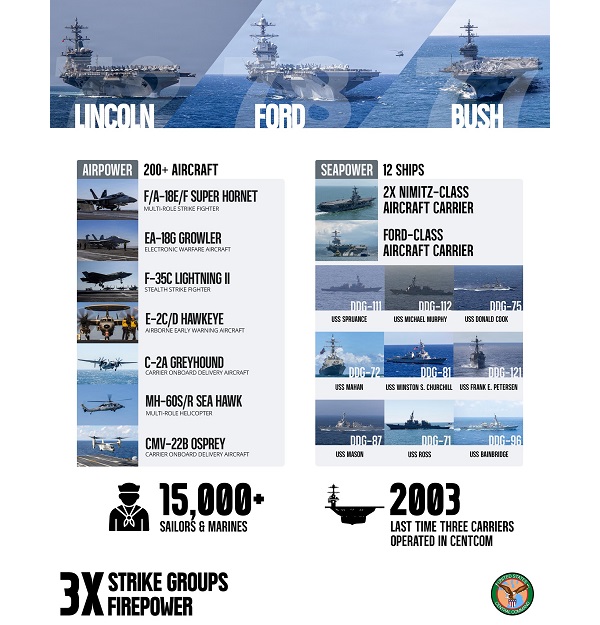
Chart depicts three aircraft carriers in the U.S. Central Command area of operations detailing number of ships, aircraft, and sailors. Click here for a larger image.
Force Posture and Ground Operations
Statis of Key Munitions. A Center for Strategic & International Studies report estimated that the U.S. has used 850 of its 3,100 Tomahawk missiles, 1,000 of its 4,400 JASSMs, 290 of its 360 THAAD interceptors, and up to 1,430 of its prewar inventory of 2,330 Patriot missiles. “Last Rounds? Status of Key Munitions at the Iran War Ceasefire”, CSIS, April 21, 2026.
Video – U.S. Central Command Forces Remain Ready. CENTCOM released a short video about how forces are refitting and rearming during the ceasefire. DVIDS, April 21, 2026, 1 minute.
https://www.dvidshub.net/video/1003430/us-central-command-forces-remain-ready
Negotiations and Diplomatic Activity
U.S Ceasefire Extended. President Trump stated that he was extending the ceasefire scheduled to expire on Wednesday, April 22, 2026, due to the fractured Iranian government. He said that the pause would remain in place until the Iranians submit a proposal. One question that is pondered by many national security observers is can the Trump administration get a better deal from the Iranians than what President Obama got through the Joint Comprehensive Plan of Action (JCPOA). The negotiations that led to JCPOA took over two years. During President Trump’s first term he withdrew from the deal in 2018.
Some media reports stated on Friday morning that an Iranian delegation may arrive in Islamabad, Pakistan on Friday. Iran’s foreign minister, Abbas Araghchi, may show. A U.S. logistics and security team is already in place in Islamabad.
The Israel-Lebanon ceasefire has been extended by another three weeks beginning on April 23, 2026. The talks were conducted at the White House.
Economic Implications
This new phase of the conflict- sea control and blockade – is causing economic pain on Iran. However, it is also causing economic shock on Asia because of where more than 80 percent of Hormuz oil and LNG flows go, much of it to key U.S. allies and partners in the Indo-Pacific region.
Despite the ceasefire announcement, maritime insurers and shipping firms appear to be maintaining a risk posture consistent with active conflict conditions.
Reference: BCA’s Iran Conflict Daily Dashboard. Real-time charts on the Hormuz crisis, energy, and macro risk. https://www.bcaresearch.com/collection/bcas-iran-conflict-daily-dashboard
Commentary, Analysis, and Opinion
“A War of its Own Making”. Retired BG Donald Bolduc, SF officer, provides his perspective on the Trump administrations decision to attack Iran on February 28, 2026. He says that although the administration’s military engagements produce tactical gains it exposed real strategic gaps. The administration tends to get into conflicts easily enough; the tough part is getting out of them. Bolduc’s article explores key political, strategic, and operational lessons from the administration’s military engagement, the risks associated with its actions, and the implications for the future of U.S. foreign policy. “The Bolduc Brief: The Administration’s Inability to Conclude a War of Its Own Making”, SOFREP, April 20, 2026.
The Iranian leadership is in a state of flux. There is uncertainty on who is really in charge. The new supreme leader, Mojtaba Kahmenei, remains in hiding. Media reports state that he suffered grave injuries in the strikes that killed his father. The combination of injuries and his isolation as left military commanders making many of the important decisions. A core of commanders from the Islamic Revolutionary Guards Corps and others aligned with them seem to be key makers on matters of diplomacy and war.
References
Operation Epic Fury Daily Timeline (National Security Info)
https://www.national-security.info/events/epic-fury/timeline-epic-fury.html
Past Articles by SOF News on Operation Epic Fury
https://sof.news/tag/epic-fury/
Past Articles by SOF News on Iran
https://sof.news/tag/iran
Operation Epic Fury – U.S. Central Command Updates
https://www.centcom.mil/OPERATIONS-AND-EXERCISES/EPIC-FURY/
OEFU Casualty Tracker
https://dcas.dmdc.osd.mil/dcas/app/conflictCasualties/oefu
ISW Daily Iran Update. The Institute for the Study of War provides a daily summary of the events taking place in the Iran War. https://understandingwar.org/analysis/middle-east/
Interactive Map: U.S. and Israeli Strikes on Iran, by the Institute for the Study of War and Critical Threats.
https://storymaps.arcgis.com/stories/089bc1a2fe684405a67d67f13bd31324
Interactive Map: Maritime Attacks. The Washington Institute map includes detailed descriptions of attacks and incidents, data on each vessel, and geopolitical analysis in the Middle East region from 2017.
https://www.washingtoninstitute.org/menamaritime/
Iran Country Profile by National-Security.Info. Maps, reports, and references.
https://www.national-security.info/country/iran.html
