
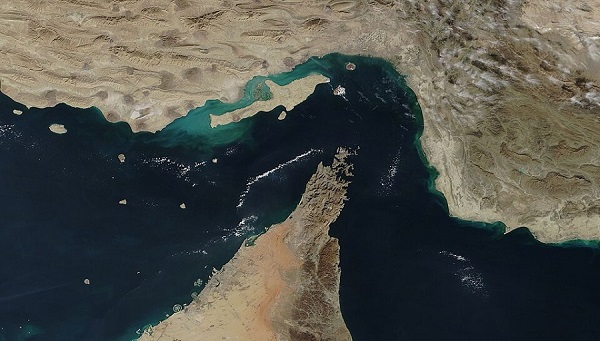
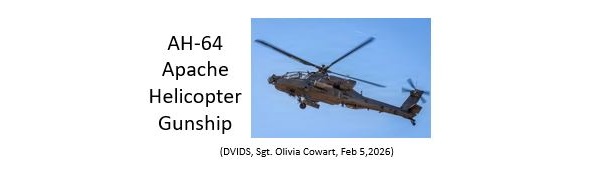
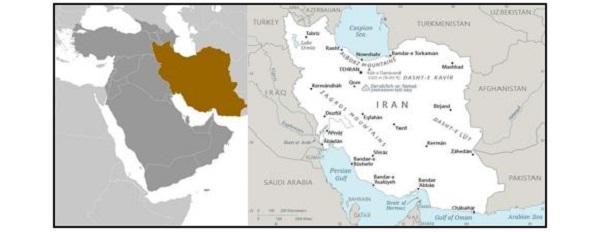
On June 8, 2026, two crew members from a U.S. Army AH-64 Apache helicopter (photo) were rescued by a U.S. Navy unmanned surface vessel (USV) after their helicopter went down off the coast of Oman (map NSI). They were patrolling regional waters as part of Operation Epic Fury. The Soldiers were rescued within two hours and are in stable condition. The rescue efforts were led by U.S. Naval Forces Central Command and the 82nd Airborne Division. The rescue was supported by the U.S. Air Force and Navy units.
The AH-64 was taken down by an Iranian Shahed 136 drone. President Trump posted on Truth Social that the U.S. must respond to this attack on the Apache helicopter:
“I have just been informed by our Great Military that last night the Iranians shot down one of our highly sophisticated Apache Helicopters while patrolling over the Strait of Hormuz. There were two pilots involved, both are safe and uninjured. Nevertheless, the United States must, of necessity, respond to this attack.”
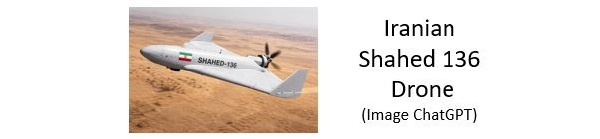
According to news reports, Task Force 59, the U.S. Fifth Fleet’s unmanned systems task force, supported the rescue effort with a naval drone. This naval drone rescue is considered a historic first. The 24-foot unmanned boat located the two aviators and brought them to another location on the water where they were hoisted up to a helicopter for further transport. The chopper crash happened about 3:30 a.m. local time Tuesday while the helicopter was on patrol.
U.S. Response. U.S. Central Command announced (x.com, 9 Jun 2026) that it began launching “self-defense strikes” against Iran at 5 p.m. ET in response to yesterday’s downing of the U.S. Army Apache helicopter. The strikes were against Iranian installations on islands (Qesham Island) in the Persian Gulf as well as along the Iranian coastline. CENTCOM stated that 20 Iranian targets were struck. There are news reports that two U.S. MQ-9 Reapers have been shot down by the Iranians.
The Iranians are launching missiles and drones in ‘retaliatory strikes’; targeting facilities in Kuwait, Bahrain, and Jordan. The Muwaffaq Salti Airbase in Jordan was targeted, the site of F-35 hangars and a command and control center. Several interceptions of Iranian ballistic missiles have taken place at or near the U.S. Navy’s 5th Fleet Headquarters in Bahrain.
Apache gunships are primarily used for precision strikes, close air support, and air reconnaissance. They are extremely effective against Iranian sea drones and small naval gunships that have been used against vessels transiting the Strait of Hormuz.
Task Force 59 (TF 59) is the U.S. Navy’s dedicated unmanned and artificial intelligence task force operating under U.S. Naval Forces Central Command and U.S. Fifth Fleet. Established in September 2021 and headquartered in Bahrain, TF 59 serves as the Navy’s primary operational laboratory for integrating unmanned systems, artificial intelligence, and data analytics into fleet operations.
TF 59 operates in the Arabian Gulf, Gulf of Oman, North Arabian Sea, Red Sea, and the Bab el-Mandeb Strait. These are busy shipping lanes and some of the world’s most contested waters. Iran poses a threat to commercial vessels and U.S. Navy warships in the waters off its shores while Yemen poses a threat to shipping in the Red Sea and the Bab el-Mandeb Strait. Task Force 59 achieved full operational capability in 2023. Task Group 59.1 was launched to focus on autonomous platforms and enhancing them into a mesh-network architecture.
This is the first publicly reported loss of an Apache helicopter during the Iran conflict. It is only the second publically reported rescue of downed aircrew during the current Iran conflict. The first such recovery occurred after a F-15E Strike Eagle was lost over Iran, prompting a large-scale personnel recovery operation that successfully extracted the two crew members. One interesting fact is that the pilot of the F-15E Strike Eagle that was shot down had previously been shot down earlier during Operation Epic Fury when a Kuwaiti pilot mistakenly shot down three F-15E Strike Eagles.
This incident appears to be the first publicly reported rescue of downed aircrew by an unmanned surface vessel (USV) or maritime drone in a real-world operational environment. The naval drone was a 24-foot Navy Corsair made by Saronic Technologies. The Corsair was first fielded in the CENTCOM area of operations in March 2026, shortly after the beginning of Operation Epic Fury. The Corsair has a range of 2,500 nm, speed of 35 kts, and payload of 3,500 lbs.
While unmanned maritime systems have primarily been employed for intelligence collection, maritime domain awareness, mine countermeasures, and strike missions, the rescue of the Apache crew demonstrates a new operational role for naval drones. The incident suggests that autonomous surface vessels may become an important component of future personnel recovery and combat search-and-rescue architectures in contested maritime environments.
**********
References:
“U.S. Army Crew Safely Rescued After Helicopter Lost at Sea”, U.S. Central Command, Twitter/X, June 9, 2026. https://x.com/CENTCOM/status/2064290478091067601
“Navy Deploys GARC Sea Drone for Autonomous ISR Operations”, SOF News, April 14, 2026. https://sof.news/drones/blackseas-garc-naval-drone/
