
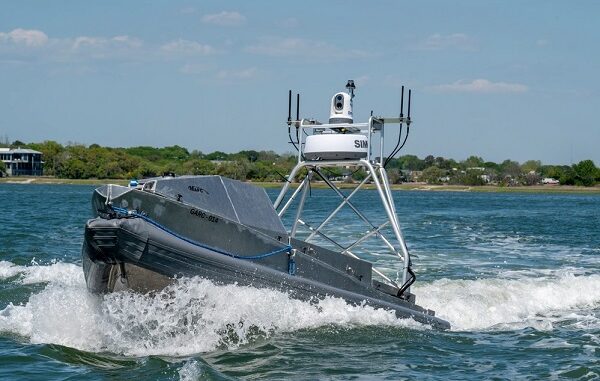
Featured at SOF Week 2025 in Tampa, Florida during May 5-8, 2025, was a small Unmanned Surface Vehicle (sUSV) that was on exhibit by BlackSea Technologies. The Global Autonomous Reconnaissance Craft (GARC) is a small unmanned surface vessel designed for high-speed autonomous operations in contested maritime environments.
The platform aligns with U.S. Navy efforts to expand distributed maritime operations (DMO) through low-cost autonomous systems capable of persistent ISR and swarm-enabled effects.
The GARC naval drone has reportedly been deployed by the U.S. Navy in the Middle East region in support of Operation Epic Fury. (reported by Reuters, 26 Mar 2026) According to the Reuters article, the GARC has logged over 450 hours in Operation Epic Fury as of late March. The GARC provides naval and special operations forces with flexible mission capabilities – to include advanced sensing, intelligence, surveillance, reconnaissance, mine countermeasures, and more.
Tim Hawkins, a Pentagon spokesman for Central Command (CENTCOM) said (as of late March):
“U.S. forces continue to employ unmanned systems in the Middle East region, including surface drone assets like the GARC. This platform, in particular, has successfully logged over 450 underway hours and more than 2,200 nautical miles during maritime patrols in support of Operation Epic Fury.”
The Navy has Bahrain-based Task Force 59 under the U.S. Fifth Fleet. This unit is focused on integrating autonomous platforms and artificial intelligence into maritime operations. Systems such as the GARC complement larger USVs like Sea Hunter and experimental Task Force 59 platforms operating in the Fifth Fleet area of responsibility. The U.S. Fifth Fleet area of operations is the Arabian Sea, Red Sea, and Gulf of Oman. Task Force 59 achieved full operational capability in 2023. Task Group 59.1 was launched to focus on deploying unmanned systems and enhancing unmanned systems in a mesh network.
Specifications. The GARC is 16 feet long and has a 200-horsepower engine that can reach up to 40 knots with a payload of up to 1,000 pounds. The platform supports modular payloads including ISR sensors, communications relay packages, mine countermeasure systems, and potentially kinetic or electronic effects payloads. It is built to operate up to sea state 5 and is easy to ship globally in a standard 20-foot shipping container. Some news reports say that the small sea drones cost roughly $250,000 per vessel.
On April 25, 2025, the Navy established Unmanned Surface Vessel Squadron (USVRON) 7 at Naval Base San Diego. This new unit oversees a fleet of small, unmanned surface vessels (sUSV) including the GARC. The sUSVs of USVRON 7 will provide additional warfighting capability and capacity to augment the Navy’s traditional combatant force. (DVIDS, Apr 25, 2025) The goal for the USVs is to provide the fleet with operations in conjunction with carrier strike groups, expeditionary strike groups, surface action groups, or in independent operations. In 2024 the Navy established USVRON 3 at Naval Base San Diego to oversee multiple small unmanned surface vessels (sUSVs), including platforms similar to the GARC.
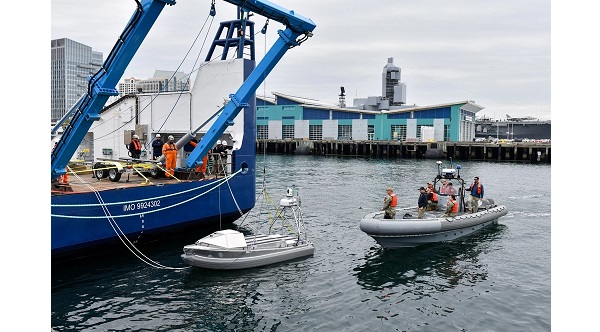
Photo: Crew members of Ocean Infinity’s Armada 7807 robotic vessel launch a Global Autonomous Reconnaissance Craft (GARC) from Unmanned Surface Vessel Squadron 3 (USVRON 3) off the back of the ship while pierside in San Diego Bay. (U.S. Navy photo by Mass Communication Specialist 1st Class Claire M. DuBois, February 26, 2024)
USVRON 7 will incorporate the newest Navy rating, the robotics warfare (RW) specialist into their teams. They will enable Robotic Autonomous System (RAS) operations and maintenance at the tactical edge and be the subject matter experts for mission autonomy, navigation autonomy, data systems, artificial intelligence, and machine learning on the RAS platforms.
In June 2025, operators from Special Boat Team 22 and U.S. government contracted systems engineers deployed and operated a GARC during exercise Baltic Operations 2025 in the Baltic Sea. BALTOPS 25 is the premier maritime-focused multinational exercise in the Baltic Region and provides a unique training opportunity for forces that are preserving freedom of navigation and security in the Baltic Sea. (Watch a video of personnel controlling the GARC from a manned RHIB during BALTOPS 25, DVIDS, June 6, 2025, 2 minutes)
The U.S. Navy hosts annual exercises that utilize and test the concepts of unmanned surface craft taking part in “swarm attacks”. These exercises include Southern Lightning and Silent Swarm. In January 2025 the Navy announced that it is looking to ramp up production of the GARC to a rate of 32 systems per month in 2025.
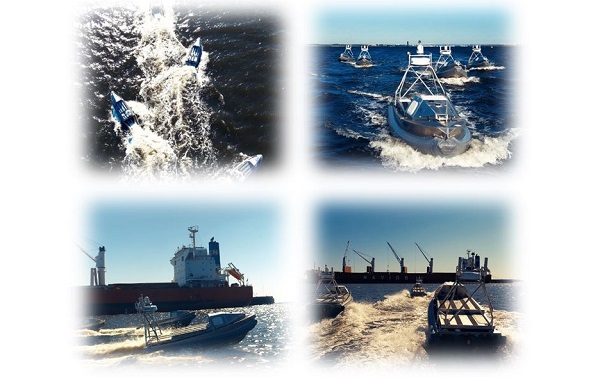
Photos: Provided by Black Sea Technologies. Click here for larger image.
The war in Ukraine has demonstrated how small kamikaze uncrewed surface vessels can damage or sink large Russian warships. These USVs will be extremely important in the Pacific with its vast expanse with extensive coastlines. The GARC and other similar drones are proving their usefulness in the Persian Gulf and other waters found in the region.
**********
BlackSea Technologies is a firm that provides new asymmetric strategies to U.S. Naval and other military forces. The firm is headquartered in Baltimore, Maryland where it manufactures the GARC sUSV.
Top Image: A U.S. Navy Global Autonomous Reconnaissance Craft (GARC) assigned to Naval Information Warfare Center Atlantic, maneuvers the Charleston Harbor, South Carolina April 17, 2025 during Exercise Southern Lightning. (U.S. Air Force photo by Staff Sgt. Emily Farnsworth)
**********
References:
Black Sea GARC Specifications
https://www.blacksea.tech/garc
GARC Video, YouTube, September 5, 2025
https://www.youtube.com/watch?v=KUKu0vGH_3k
