
Updates on drones including latest technology and use in conflicts around the world. An executive summary, key events, and curated articles.
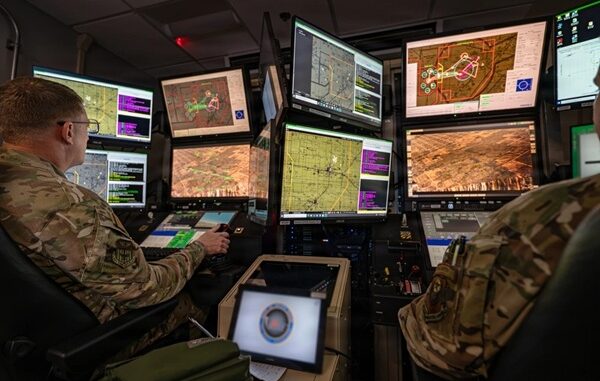
Image: Col. Mark Hamilton,1st Special Operations Wing commander, operates an MQ-9 Reaper simulator at Hurlburt Field, Florida, Sept. 17, 2026. Maintaining active flying status keeps commanders connected to the aircraft, Airmen and operational demands of the units they lead. (U.S. Air Force photo by Senior Airman Raul Mercado)
Executive Summary
October 2026 saw continued advances in the operational employment of unmanned systems, alongside growing efforts to adapt military organizations, acquisition processes, and counter-drone defenses. The U.S. military is expanding its focus on autonomous warfare, including a new Army Special Operations robotics warrant officer specialty and plans for an Autonomous Warfare Command. Ukraine continues to demonstrate rapid drone innovation, employing unmanned systems for precision strikes, battlefield deception, and medical evacuation. Meanwhile, drone warfare is intensifying in Sudan, and the proliferation of unmanned systems is increasing threats to military installations, critical infrastructure, and commercial shipping. These developments underscore the growing importance of autonomous systems, resilient supply chains, and effective counter-UAS capabilities.
Curated Articles
The topics listed below are presented with descriptions and with links to the online article.
- Battery Supply Chain
- GEN-AI, Drones, and Infrastructure Protection
- ARSOF Establishes Robotics WO Specialty
- U.S. Autonomous Warfare Command
- U.S. Counter-Drone Tech in Africa
- MQ-8C Fire Scout Gets a New Life
- MQ-9B SeaGuardian Drones
- Operation High Eagle on Southern Border
- Navy’s X-BAT VTOL Fighter Drone
- Drone Medical Evacuation in Ukraine
- Drone Attacks on Russian Oil Refineries
- Deception on the Battlefield
- Colombian Guerrillas and Their Drones
- Drone Warfare in Sudan
Commentary about Drones
Battery Supply Chain. For decades militaries operated with fuel and ammunition as limits of combat power and endurance. Now the logistics of battery power for drones are beginning to have the same level of operational seriousness. The authors of this article recommend three approaches to fix the problem:
- Building a diversified strategic battery reserve
- Establishing domestic and allied supply chains for defense batteries
- Encouraging U.S. innovation for sustained drone logistics advantage
Read about the topic in “Establishing Battery Supply Chain Resupply Resilience for Drones”, War on the Rocks, October 21, 2026.
GEN-AI, Drones, and Protection of VIPs and Infrastructure. Generative Artificial Intelligence (GEN-AI) when used by terrorists and criminal organizations will be an increasingly more prevalent threat to democratic societies. GEN-AI provides both content and coding to terrorists and others that can be used for targeting critical infrastructure and valuable targets. Dr. Robert Bunker provides more detail in “The Emerging Need to Protect Critical Infrastructure and VIPs from Weaponized AI Drone Threats”, INTELBRIEF, The Soufan Center, October 19, 2026.
America’s Defense Bureaucracy. Ukrainian drone manufacturers can respond to design changes for battlefield drones in days. The U.S. defense establishment and industry take years and sometimes decades. The Russia-Ukraine war can serve as a lesson for the U.S. about economical and efficient warfare. Drones continue to be relevant on the battlefield. As of 2025, 70%-80% of kinetic operations in the Russia-Ukraine war involved drones. The American defense acquisition system is a multi-phase, years-often decades-long process often limited to large defense firms. This fundamentally limits the high-speed innovation of drone warfare. “Ukraine is Building Drones in Days. America’s Defense Bureaucracy Takes Years”, by Jullian Butler, Daily Caller, October 11, 2026.
U.S. Military Drone Developments
ARSOF Establishes a Dedicated Robotics WO Specialty. The Army Special Operations Center of Excellence has the robotics warrant officer military occupational specialty. The first course graduated in October 2026 with ten warrant officers earning the distinction after a 19-week course. The officers will lead specialized robotics detachments and advise brigade- and task-force commanders on autonomous systems, mesh networking, edge AI, electronic warfare and rapid prototyping. “USAJFKSWCS Graduates First 390A Robotics Technicians”, SOF News, October 8, 2026.
U.S. Autonomous Warfare Command. A new four-star Autonomous Warfare Command or AutoWarCom, is being formed to oversee the U.S. military’s expansion of autonomous and robotic capabilities. Defense Innovation Unit Director Owen West will run the new command. The U.S. military is expanding its use of drones and robotics, informed by developments over the past several years in Ukraine and the Middle East. The recently announced Autonomous Warfare Command is an opportunity to organize the military forces for the employment of unmanned systems at the tactical, operational, and strategic levels. This should include changes in the traditional staff functions, refinement of tactics, techniques and procedures, and real-time coordination with industry. Reflecting on the Unmanned Systems Forces (USF) of Ukraine, Dan Madden and Dominic Ventimiglia explore this topic in detail in their article entitled “Unmanned Forces as a Service”, First Breakfast, October 8, 2026.
U.S. Counter-Drone Tech in Africa. U.S. Army Southern European Task Force, Africa announced a partnership with the Army’s Global Tactical Edge Acquisition Directorate to test emerging drone systems in Africa and deliver them to soldiers within 180 days. The command’s first accelerated capability event is scheduled for spring 2027 in Tan-Tan, Morocco. It will focus on counter-unmanned aircraft systems and force protection, targeting capability gaps in protecting early-entry command posts and operating locations against small UAS. “Army Task Force Partners With Acquisition Directorate to Accelerate Counter-Drone Tech in Africa”, Department of Defense, October 16, 2026.
MQ-8C Fire Scout Gets a New Life. The Navy had planned to complete its retirement of the MQ-8C Fire Scout platform by the end of fiscal year 2026. However, the unmanned aerial system will be getting a new life with the Army. “Naval Unmanned Helicopters Get Second Life”, Department of Defense, October 23, 2026.
Coast Guard Orders MQ-9B SeaGuardian Drones. General Atomics will provide the Coast Guard with four MQ-9B SeaGuardian drones. The MQ-9B is an unarmed aircraft and can fly more than 30 hours. The aircraft will give the Coast Guard greater ability to monitor offshore waters, protect borders and critical infrastructure, support search and rescue, combat drug trafficking and counter illegal and unregulated fishing. They will also improve the service’s ability to collect and share intelligence, conduct surveillance and support reconnaissance missions far at sea. “Coast Guard acquires four long-range unmanned aircraft to strengthen maritime security”, U.S. Coast Guard, October 9, 2026.
Operation High Eagle. At the Mexico – California border, anti-drone operations are being carried out to create a safer border. The area is used by criminals for the trafficking of drugs and people. This U.S.-Mexican initiative began in the last couple of months. “Operation High Eagle: Combating Cartel Drones at the Mexico-U.S. border“, Small Wars Journal, October 13, 2026.
Navy’s X-BAT VTOL Fighter Drone. X-BAT flight testing is getting closer on the horizon, and an extremely ambitious timeline to reach an operational capability has been revealed. The X-BAT will have a maximum range of 2,000 nautical miles and service ceiling of around 50,000 feet. “Navy Doubles Down on X-BAT VTOL ‘Fighter’ Drone Development”, The War Zone, October 8, 2026.

Drones and the Russia-Ukraine War
Drone Medical Evacuation. A heavy drone was used by Ukrainian troops to airlift a wounded soldier from a frontline position. This was probably the world’s first battlefield evacuation by an aerial drone. The operation, conducted in October 2026, involved a six-rotor Heavy Shot Ayudag-6 drone built by a Ukrainian manufacturer. Repeated attempts to conduct a ground medical evacuation had failed. The mission covered about 75 minutes and roughly 39 miles. The wounded soldier survived although he lost both legs. “Ukraine airlifts wounded soldier by drone in claimed battlefield first”, by Stephen Pope, Aerotime.aero, October 19, 2026.
Drones Attacking Russian Oil Refineries. Ukraine has targeted critical components (refineries) of Russia’s energy system that are hard to repair. The strikes have crippled Russia’s diesel production and are at the center of a new clash between President Trump and Ukraine. There is a shortage of diesel around the world and within the United States due to the destruction of diesel refineries in the Persian Gulf region. Rather than acknowledge that the Iran War is causing these shortages, Trump is blaming the diesel shortage on Ukrainian attacks on Russian energy infrastructure. U.S. and European sanctions on critical components of diesel refineries have made it difficult to repair the refineries. President Trump is now stating that the sanctions on these critical components will be dropped. “How Ukraine uses precision drone strikes to hobble Russian oil refineries”, The Washington Post, October 11, 2026.
Deception on the Battlefield. Using decoy drones with no explosive payload is one form of deception on the battlefield that can divert attention from operations on the ground or in the air at a different location. In addition, they can attract expensive drone interceptors, saving more sophisticated drones with actual warheads on the way to important targets. An “attritional decoy” could cost about $400, using a radio-frequency emitter built from commercial off-the-shelf components. Read more in “Deception in Mass Autonomous Warfare”, War on the Rocks, October 23, 2026.
References: Deep Strike.
International Drone Developments
Drone Warfare in Sudan. Both sides in the conflict, the Rapid Support Forces (RSF) and the government Sudanese Armed Forces (SAF) have received outside assistance in implementing drone warfare into their operations. The United Arab Emirates is assisting the RSF while other nations (including Ukraine) may have assisted the SAF. The RSF is fielding a Chinese anti-aircraft system while the SAF is deploying Turkish drones. Yasir Zaidan, Ph.D., provides a detailed account of drone warfare in Sudan. “How Sudan Became a Laboratory for Drone Warfare, Thanks to Abu Dhabi”, War on the Rocks, October 15, 2026.

Colombian Guerrillas Using Armed Drones. Colombian guerrilla groups are increasingly using commercially available drones to conduct attacks against security forces and rival armed organizations. “Weapons Analysis: ELN and FARC Guerrillas Operating Armed Drones”, Militant Wire, September 2, 2026.
Drones in the Middle East. Iran is continuing its attacks on commercial shipping transiting the Strait of Hormuz using missiles, drones, and gunboats. The Iranian-backed Houthis in Yemen are attacking infrastructure targets in Saudi Arabia with missiles and drones.
**********
Previous Monthly Drone Updates:
- September 2026
- August 2026
- July 2026
- June 2026
- May 2026
- April 2026
- March 2026
- February 2026
- January 2026
