
The continued evolution of drone warfare remains one of the defining military developments of the modern battlefield. The conflict in Ukraine continues to accelerate innovation in first-person-view drones, autonomous navigation, counter-UAS systems, and maritime unmanned platforms. At the same time, SOF Week 2026 highlighted the growing role of autonomous systems within special operations, ISR, logistics, and force protection missions. AI-assisted targeting, GPS-denied operations, fiber-optic drones, and autonomous swarming are increasingly central theme in 2026 drone warfare discussions.
This monthly drone update provides news on unmanned aerial vehicles (UAVs), including the latest drone technologies, counter-UAS developments, and operational employment in conflicts around the world. Our featured drone topic this month are the different drone products exhibited at SOF Week 2026 this past May in Tampa, Florida. Following that, are the usual curated articles presented each month in the drone monthly news roll up.
- Drones at SOF Week 2026
- THOR Autonomous VTOL Drone
- U.S. Army UAS Programs
- Navies in the Drone Generation
- AGVs and Sustainment
- RAF’s C-UAS Capability
- Drones and Medical Resupply
- Ukraine’s Drone War against Russia
Featured Topic – Drones at SOF Week 2026
With over 800 exhibitors at SOF Week 2026 it would not be unusual to find a number of firms exhibiting their drones and drone-related products. Below are just a few of the products on exhibit during SOF Week.
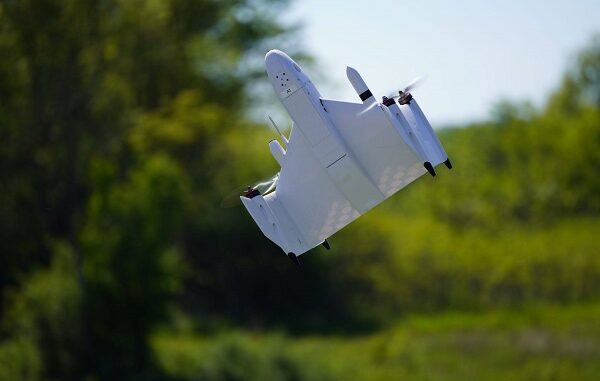
Halley High-Speed VTOL. Tycho.AI showed their new product – the Halley High-Speed VTOL Uncrewed Aerial System (UAS) that was built for denied and contested battlefields. This high-speed, low-altitude Group 1 drone can exceed 200 mph with a range of more than 40 km. The Halley is offered in both an operator-controlled first-person view (FPV) configuration and as a fully autonomous platform for operation in GPS-denied and comms-degraded environments. The Halley drone can be used in counter-UAS intercept, one-way attack, swarming, ISR, search and rescue, and scouting. https://tycho.ai/halley
Kraken K3 Scout. A maritime defense technology company from the United Kingdom, Kraken Technology Group, displayed its high-speed modular uncrewed surface vessel (USV) on the Tampa waterfront during SOF Week. The Kraken K3 Scout will be deployed to the Mideast to help secure the Strait of Hormuz. The USV is capable of speeds up to 55kts and can carry a 600kg modular, interchangeable payload up to 650NM. The company has been awarded a $49 million contract from US Special Operations Command. https://krakentechnology.com/platforms/k3-scout
Vision 60 Ghost Robot. One of the more interesting drone exhibits was the Vision 60 Q-UGV or Quadrupedal Unmanned Ground Vehicle presented by Ghost Robotics. The four legs of this ground robot allow it to traverse very rough terrain, recover from a fall, and even operate inverted. It can perform a variety of missions, keeping ground troops safer. https://www.ghostrobotics.io/
Red Cat Drone Systems. This firm delivers mission-ready solutions across all domains in defense and security. It has a wide array of solutions to include short range recon, extended short range recon, first person view, uncrewed surface vessels, and command and control systems. https://redcat.red/
Scout Counter-UAS System. Sentrycs is a firm that specializes in counter-drone (C-UAS) technology. It was in Tampa presenting its new man-carried system, Sentrycs Scout. This Cyber over RF (CoRF) technology enables passive detection, tracking, and identification of unauthorized drones, along with controlled mitigation capabilities. The Scout, a battery-powered C-UAS system, is designed for tactical forces. https://sentrycs.com/sentrycs-scout-for-tactical-and-mobile-missions/
U.S. Military Drone Developments
THOR Autonomous VTOL Drone. This new program aims to give the Army companies some organic ISR, targeting, and resupply capabilities without relying on higher command assets. Army Contracting Command awarded the contract to Mistral Inc. for the THOR Group 2 UAS, a backpack-portable multi-rotor drone designed for frontline units. Soldiers can carry and deploy the system without vehicles or specialized teams. The Group 2 UAS operates below 3,500 feet and payloads can be swapped out based on its modular system. “US Army selects THOR autonomous VTOL drone soldiers can carry for frontline warfare”, Interesting Engineering, May 1, 2026.
U.S. Army UAS Programs. The Congressional Research Service has updated “U.S. Army Small Uncrewed Aircraft Systems Programs” publication. CRS IF12668, May 6, 2026, PDF, 3 pages.
https://www.congress.gov/crs-product/IF12668
Drones and Medical Resupply. The 44th Medical Brigade of the XVIII Airborne Corps is expanding its battlefield medical support capabilities by integrating unmanned aircraft systems into medical resupply operations. Some of its members attended Clemson University’s Drone Academy. This eight-week online program provided training in drone operations. “44th Medical Brigade Integrates Drones Into Medical Resupply Operations”, U.S. Department of Defense, May 29, 2026.
AGVs and Sustainment. During an 82nd Airborne Division training rotation at the Joint Readiness Training Center (JRTC) soldiers experimented with autonomous ground vehicles (SOF News) and sustainment operations. What began as a novelty emerged into a useful tool during a field exercise. The lesson learned is that the Army needs to look at AGVs as less a future concept and more as a real sustainment capability that can be employed right now across the Army formations. “Autonomous Ground Vehicles and the Sustainment Problem: One Brigades Experiment and What the Army Should Do Next”, by Marc Dibernardo and Dave Rowland, Modern War Institute at West Point, May 27, 2026.
Ukraine-Russia Drone Warfare
Ukraine’s Drone War against Russia. The Russian advance on the ground has stalled over the past several months. Much of this is due to the drone war Ukraine is mounting against Russian forces. Thousands of Ukrainian drones are targeting Russian forces every day, commanded from underground bunkers. Some drones operate along the front lines while others travel thousands of miles into Russia to hit strategic targets – like Russia’s energy facilities. Open-source reporting and Ukrainian assessments indicate that drones are responsible for a significant percentage of Russian battlefield casualties. Some reports say Russia is losing thousands of soldiers a month (25,000) to drones. Ukraine’s three-tier strategy of short-, medium-, and long-range drone programs are taking its toll on Russian forces. The Ukrainian drones are targeting supply lines, rear command centers, and air defense batteries. Remote-controlled combatants have now replaced Ukrainian soldiers in the kill zone. In April, Russia lost more ground than it gained. “After a brutal winter, Ukraine’s drones are breaking Russian defense”, by Steve Hendrix and Serhii Gralloch, The Washington Post, May 29, 2026.
International Drone Developments
Navies in the Drone Generation. The often-heralded obsolescence of traditional naval power looms like a specter over navies in the era of drone warfare. Events in the Black Sea and Persian Gulf continue to demonstrate the growing importance of unmanned maritime systems in naval operations. As with technological innovations of the past, however, there is a strong case to be made that innovation tends to transform—rather than displace—a navy’s role in a broader maritime ecosystem. Andrews, Sean A. G. (2026) “Will Navies Prevail in “Generation Drone”?—An Australian View,” Naval War College Review: Vol. 79: No. 2, Article 7.
RAF’s C-UAS Capability. The RAF Regiment Counter-UAS capability is part of a wider UK and coalition air defense system. At its core are systems such as ORCUS, Ninja, and Rapid Sentry. “RAF Regiment Counter-UAS: Defending the Airspace and Turning Threat into Intelligence”, Soldier Systems, May 9, 2026.
Summary
The developments highlighted during May 2026 demonstrate that unmanned systems are no longer a supporting capability but are increasingly becoming a central feature of modern warfare. From FPV drones operating along the front lines in Ukraine to advanced autonomous systems displayed at SOF Week 2026, military organizations around the world are adapting to a battlefield environment where speed, autonomy, and low-cost precision increasingly shape operational success.
Drone warfare is entering a new phase characterized by scale, autonomy, and persistent operations. Future developments are likely to include greater use of AI-enabled targeting, expanded maritime drone employment, increased use of fiber-optic and anti-jamming guidance systems, and wider deployment of autonomous counter-drone networks. The conflict in Ukraine remains the primary driver of innovation, but the operational lessons are rapidly spreading across Europe, the Middle East, and the Indo-Pacific.
**********
Image. Halley High-Speed VTOL by Tycho.AI.
