
News updates on unmanned aerial systems (UASs) including latest drone technology and use in conflicts around the world.
The rapid proliferation of low-cost unmanned systems is fundamentally reshaping modern warfare, compressing operational depth and eroding traditional assumptions about rear-area security, medical evacuation, and force protection. Recent reporting and analysis highlight a widening gap between technological adoption and institutional adaptation, particularly in training, command structure, and cost-effective countermeasures.
Key Takeaways:
- Drone warfare is compressing operational depth and expanding contested rear areas
- Cost-imposition dynamics favor low-cost drones and interceptors
- Medical evacuation assumptions are increasingly invalid in peer conflict
- Training and organizational reform lag behind technological adoption
- Ground robotics will be decisive in sustainment and maneuver
Curated articles on the topics below are provided:
- Medical Care in the Drone Age
- U.S. Army Needs an Unmanned Systems Command
- Counter-UAS Training
- Lucas Drone
- DoD Requests Boost in Drone Spending
- Passive Drone Defenses
- Bunker Busting Drone
- Merops Drone in Middle East
- Drone Sinks Russian Grain Ship
- Russia’s Drone Line
- The Battlefield’s “Dead Zone”
- Unmanned Ground Vehicles
- RAF Troops Shoot Down 100 Iranian Drones / Missiles
- Report on UASs by IISS
- Video: A-29 Super Tucano as Counter-Drone
U.S. Military and Drones
Medical Care in the Drone Age. In this new age of warfare the skies will no longer be safe for medical evacuation by helicopter. The critical “golden hour” will not be attainable in many cases. This implies extended forward casualty retention, placing increased demand on distributed and forward-positioned medical capabilities. In addition, Iraq and Afghanistan had ‘light’ patient loads with an agile and efficient medical network. Future warfare will be different. Read more in “Drone warfare has dramatically changed the battlefield. Is the US medical corps ready?”, Military Times, April 9, 2026.
U.S. Army Needs an Unmanned Systems Command. James Peterson, a MI officer assigned to the 82nd Airborne Division, argues that is imperative that the U.S. Army establish a command that will accelerate UAS acquisition, establish subject-matter expert cells and innovation labs at every battalion, and create a unified architecture using the Army Intelligence Data Platform to synchronize mission command, intelligence, and targeting across all echelons. “Transforming in Contact: The Army Needs an Unmanned Systems Command Now”, Small Wars Journal, April 14, 2026.
Counter-UAS Training Program Needed. Bill Edwards, currently Director of Counter-Unmanned Aerial Systems (C-UAS) Operations and Training at ENSCO, provides his thoughts on the need to prioritize training to navigate the complexities of the drone age. Having the newest tools but lacking the knowledge required to use them effectively is a path to failure. He stresses that C-UAS training is just as important as new technology. “Stop Chasing the Shiny Object: Focus First on Comprehensive Counter-UAS Training Program”, Small Wars Journal, April 24, 2026.
LUCAS Drone. The U.S. studied Iran’s Shahed-136 drone and reversed-engineered it into the Low-Cost Uncrewed Combat Attack System (LUCAS). A number of the LUCAS drones were propositioned in the Middle East prior to the start of Operation Epic Fury – most likely the November 2025 timeframe. The DoD acquired the first Shahed drone from Ukraine in early 2024. Read more in an article by The War Zone, April 9, 2026.
DoD Seeks Increase in Drone Spending. On April 21, 2026, Pentagon officials presented plans at a press briefing on the DoD’s FY27 budget request with media for the need to increase spending on drones and air defense. The request includes more than $74 billion on drones and related technology and $30 billion on critical munitions, including interceptors. These requests will be part of a $1.5 trillion 2027 budget. A critical shortage exists in the number of THAAD and Patriot interceptors now on hand; depleted supplies resulting from the need to bring down $35,000 Iranian Shahed 136 drones attacking U.S. forces and allies in the Persian Gulf region during Operation Epic Fury. Read more in “US military pushes for boost in 2027 spending on drones and air defense used in Iran war”, Associated Press, April 21, 2026.
Passive Drone Defenses. William Mayne, a Special Forces officer currently assigned to U.S. Army Special Operations Command, presents his thoughts on the utility of antidrone nets as a counter-UAS measure. They are a low-cost, proven drone defense method that should be incorporated into counter drone planning. “Missiles, Guns, Lasers . . . and Nets: the Case for Passive Drone Defenses”, Modern War Institute, April 29, 2026.
Bunker Busting Drone. A new warhead designed for delivery by an unmanned aerial system is being developed. The new weapons system is a lightweight, powerful, and lethal warhead that can be deployed from a small, agile drone. “Braker Breakthrough: Drone-Delivered Bunker-Busting Warhead Passes Test”, Department of Defense, April 22, 2026.
Merops Interceptor Drones. The U.S. has deployed an interceptor drone that is successfully defeating Iranian Shahed-136 drones attacking U.S. positions in the Middle East. The $15,000 Merops drone, is on the right side of the cost benefit equation when taking out the Shahed drone. Read more in “Cheap Interceptor Drones Proven in Ukraine Protected U.S. Troops Against Iranian Shaheds”, The War Zone, April 16, 2026.
Drones and the Russia-Ukraine War
Drone Sinks Russian Grain Ship. A Russian cargo ship carrying grain was struck by a Ukrainian drone in the Sea of Azov on April 5, 2026. The Volgo-Balk class bulk carrier went down off the coast of the Kherson region. Most of the crew managed to abandon ship and make their way to shore. (gCaptain, 6 Apr 2026)
Russia’s Drone Line. The Russian military is continuing to experiment with improving its employment of unmanned aerial systems (UAS) that support its maneuver forces. Both the Russians and Ukrainians face coordination challenges when it comes to ownership of a battlespace. “Russia’s Drone Line Experiment”, Foreign Policy Research Institute, by Dmytro Putiata and Rob Lee, April 6, 2026.
The Battlefield’s “Dead Zone”. The war in Ukraine has had a significant impact on how wars are fought now and in the future. Drones have a lot to do with these changes. The territory in the rear (5 to 50 kilometers deep) of a front line is now significantly more contested due to drones, sensors, and precision fires. Forces in this “dead zone” are continuously detected, targeted and degraded. This contributes to an “empty battlefield as units disperse to survive pervasive surveillance and long-range precision strike. However, traditional dispersion needs to be augmented with multilayered counter reconnaissance, counter-UAS, and integrated protection systems. Read more in “The Dead Zone and the Empty Battlefield”, Modern War Institute, April 13, 2026.
Drones Around the World
Unmanned Ground Vehicles. Militaries are investing heavily in unmanned ground systems designed not for observation and strike but for moving supplies, carrying sensors, relay communications, transport munitions, and conduct medical evacuation. Armies still win by moving, sustaining, and holding ground at decisive moments. Unmanned ground vehicles are here to help in that mission. “Aerial Drones Change How Wars are Fought – Unmanned Ground Vehicles Will Decide Who Wins Them”, by James Chaney, Modern War Institute, April 15, 2026.
RAF Troops Shoot Down 100 Iranian Drones / Missiles. RAF troops defending a coalition Middle East base in Iraq have been using counter-drone systems during six weeks of combat. The base has been targeted by around 28 Iranian-linked drones and missile a day during the U.S.-Iran war. U.S. troops are also located at the base. Apparently, Xbox and PlayStation skills are helpful in operating the counter-drone systems. Sky News, April 30, 2026.
Report on UASs by IISS. Strategic Dossier: UASs, ISR, Deterrence and War. This publication explores how uncrewed aerial vehicles are reshaping military operations in peace and conflict. International Institute for Strategic Studies (IISS), PDF, 114 pages, April 2, 2026.
https://www.iiss.org/podcasts/sounds-strategic/2026/03/uavs-isr-deterrence-and-war/
Video – A-29 Super Tucano as Counter-Drone. Shahed drones are changing modern warfare. Cheap, slow, and deployed in large numbers, they are forcing even the most advanced militaries to rethink air defense. The Embraer A-29 Super Tucano could play a key role in countering drone swarms. Instead of relying on expensive missiles, this aircraft offers a smarter, more sustainable approach using endurance, precision, and low-cost weapons. “U.S. Air Force’s New Answer to Shahed Drones”, American Military, YouTube, April 12, 2026, 8 minutes.
**********
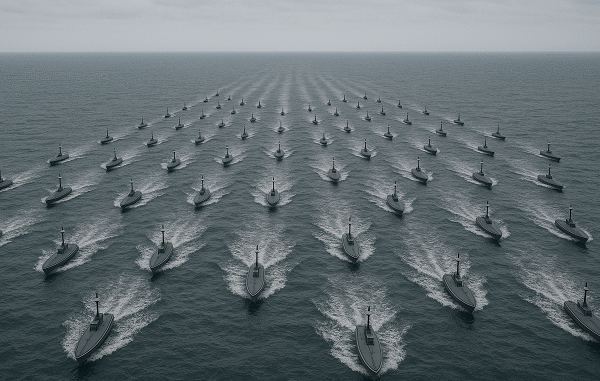
Image. Swarming Sea Drones, SOF News, ChatGPT5 Image.
