
A retired Green Beret on building a business, giving back, and planning your exit
Two years ago, Jerry Jenkins was in the room at the Spookstock auction during SOF Week, watching the bids climb on a custom piece he created. The custom V-42 dagger had a Damascus blade, a hand guard made from World Trade Center steel, and sand from Iran in the handle. When the bidding stopped, it had raised $75,000 for the organization.
Not bad for a hobby he picked up in his garage so he’d have something to do after he retired from the Army.
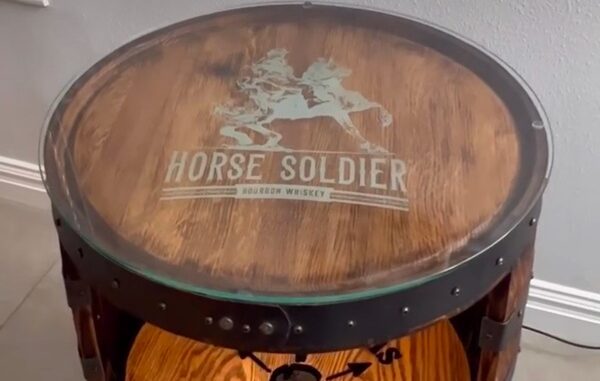
Jerry is a retired Special Forces warrant officer who spent 25 years serving in Special Forces. He founded Regiment Barrel Works, also known as RBW, a Tampa-based shop that turns bourbon barrels into custom pieces. The business turns a profit on custom orders, and it has also become his way of giving back to the community he came from.
This is the first profile in SOF News’ series on Special Operations veterans who have built businesses after service.
A Hobby Built for the Exit
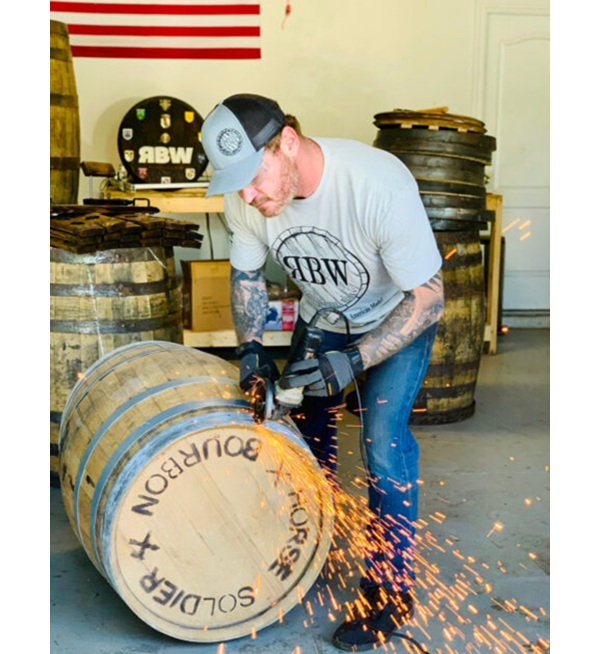
Jerry didn’t pick up woodworking randomly. He started in 2018, two years before his planned retirement, because he knew what was coming.
“I needed a hobby because I wasn’t going to be going to the range anymore or jumping out of airplanes,” he said. “The military was basically my entire life, which for a lot of people it is.”
The spark was a friend’s bourbon barrel liquor cabinet. Jerry asked how he built it, followed the same path, and finished his own. Word got around, and people started asking for pieces. Today, nearly everything he builds is custom. “They ask me if I can do something specific,” he said, “and then I sketch a plan and build it.”
When the hobby became a business
The turn came in late 2019 and early 2020, as Jerry was transitioning out and COVID kept people at home. Friends and strangers started texting and messaging him on Instagram asking how to buy his work, often as going-away gifts.
Flags became the bestseller, an affordable alternative to the fully custom liquor cabinets. So did his bottle opener: a bourbon barrel stave mounted with a dagger and skull.
Today, Jerry works full time outside the shop, and Regiment Barrel Works stays deliberately in between. “It’s not my bread-and-butter moneymaker,” he said. “I do make money with it, but it’s fun to build these things that keep me connected to the community.”
Made to Order, With a Story Attached
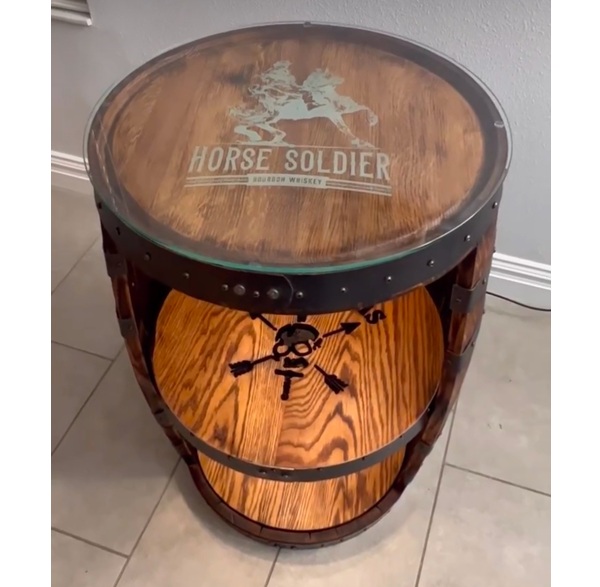
The Regiment Barrel Works catalog covers custom liquor cabinets, flags, charcuterie boards, and knife and gun stands, all built from repurposed bourbon barrels. Jerry also engraves pieces and makes custom hats with PVC patches.
Everything is made to order. For auction pieces, Jerry aims for unique pieces that carry history. That means sourcing materials through a network of fellow veterans:
- World Trade Center steel often comes from Logan Godsif and Ben Mansoor, SOF veteran knife makers who build custom knives and daggers and donate their own work to various auctions.
- Historic wood, including timber from a Normandy barn built in the 1700s, comes from Three Forks Wood Reclamation, founded by SOF veterans who donate wood for charity builds.
- Black Dagger Military Hunt Club, a Tampa nonprofit, also supplies wood to builders like Jerry, who turn it into pieces for the club’s own auctions.
“I’m always looking for something unique to add to these builds,” Jerry said. “That way it stands out, has a story, and hopefully it resonates with people at the auctions.”
A shop that teaches

Jerry’s son, Eli, works alongside him in the shop. Eli is high-functioning on the autism spectrum, and Jerry sees the workshop as a place to teach what school doesn’t: tools, their purposes, and above all, planning.
The goal is for planning to become second nature for Eli, whether he’s making a grocery list or working out how to fix something at home. Rather than lecturing, Jerry plans projects alongside him and lets him learn by doing. “Later in his life, he’ll be able to plan things because of this,” he said. “We start with an end state in mind, and then we work our way backward as we did in the military.”
Giving Back — and Learning to Make It Last
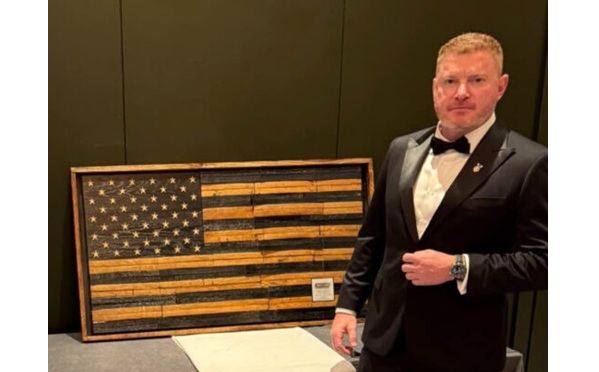
The charitable side started with one request. A nonprofit asked Jerry to build something for its auction. He donated a flag, and it sold for $5,000.
“I just wanted a sense of community again,” he said.
Since then, he has built for Task Force Dagger Foundation, the Special Operations Warrior Foundation, the Spookstock Foundation, the Green Beret Foundation, Stay in Step, Black Dagger Military Hunt Club, Women in Defense Greater Tampa Bay Chapter, and Vigilant Torch. At Stay in Step’s gala in September, his custom rifle mount, featuring a World War II German Mauser and an American M1 Garand, sold for $10,000. He spent nearly two years tracking down the Mauser alone. That kind of persistence is part of what makes his pieces stand out. He’s always searching for something with a story behind it.
The cost of generosity
For years, Jerry bought materials with his own money, donated his labor, and gave away the finished pieces.
“I don’t make any money from the nonprofits,” he said. “In fact, I lose a lot of money donating, but it’s fine because it makes me feel good.”
But that isn’t sustainable, and with more nonprofits reaching out every year, Jerry has changed his policy. Nonprofits now pay roughly the cost of materials, plus shipping, and he donates his time.
It’s a lesson worth passing on to any veteran who builds a business around giving: generosity that drains your time and money can’t last. A sustainable model lets you keep showing up.
Three Questions for Every Founder
What skill or mindset from your military service translated most directly into building this business?
Planning and execution. “In Special Forces, planning is our bread and butter for missions, and then executing that plan,” Jerry said. “Once you make the plan, you’ve got to execute. That’s what we pride ourselves on, and that’s what I brought from the military to this business.” It’s the same lesson he teaches Eli: start with the end state, backward plan, then build.
What has been harder than you expected about civilian entrepreneurship?
The unglamorous groundwork. Writing a business plan, knowing every cost, forming a company, getting an EIN, understanding taxes and what a write-off actually means. “They don’t teach you this in the military,” he said. “Matter of fact, they don’t even teach you this in business school, and I went to business school.” He’s quick to add that it isn’t the military’s job to teach entrepreneurship, so it’s something you need to keep in mind if you’re interested in starting a business.
What would you say to a fellow veteran on the fence about starting a business?
Start with the problem you’re solving. Then study every company already solving it and determine how you’ll stand out – a differentiator, if you will. Get a mentor in the industry you want to enter, and learn to write a business plan. It forces you to figure out your finances and your costs.
Jerry is applying that now in a planned partnership with an apparel company owner in North Carolina. Jerry and his business partner, Aaron Frahm, a former world-class cyclist and established apparel business owner, are launching HeroWorx USA Custom Apparel, a veteran-focused franchise built on a powerful mission: to provide disabled veterans with an affordable pathway to business ownership, financial independence, and a renewed sense of purpose beyond military service. Recognizing that many disabled veterans struggle to find the same sense of mission, identity, and fulfillment they experienced while serving, Jerry and Aaron are creating a franchise system designed to remove the financial barriers that often make entrepreneurship unattainable. HeroWorx USA will offer disabled veterans the flexibility to start small, earn supplemental income by producing custom apparel for military units, family readiness groups, businesses, and community organizations, or grow their franchise into a full-time business that supports them and their families.
With affordable entry options, professional training, centralized production capabilities, equipment, mentorship, and ongoing operational support, HeroWorx USA gives disabled veterans the tools and resources they need to succeed without the substantial financial investment traditionally associated with franchise ownership. At its heart, HeroWorx USA is about much more than custom apparel. It is about giving those who have served our nation an opportunity to find their next mission, regain a sense of purpose, build something of their own, and create a lasting legacy for their families. Guided by its motto, “Your Vision, Our Mission,” HeroWorx USA reflects Jerry’s belief that while military service may end, a disabled veteran’s desire to serve, lead, and contribute never does. This venture, along with Regiment Barrel Works and Jerry’s other entrepreneurial endeavors, reflects his continued commitment to creating opportunities that make a meaningful difference in others’ lives.
Know Your Operational Environment
Jerry found his mentors through The STAR — the SOF Transition Assistance Resource — a network of business owners and executives founded in Tampa that has since expanded to Nashville. Transitioning SOF members attend a monthly dinner hosted by a member business, sit with a different owner each time, and are often invited to shadow them. (Jerry builds the group’s business card holders out of barrel staves.)
His instinct for networking started with a warrant officer mentor who told him to build relationships outside the military. “Networking is one letter away from not working,” Jerry said. Military networks can be insular, he added, and the bigger your network, the more opportunities you can find, for yourself and for others.
For veterans who dread walking into an unfamiliar room, he treats it like a mission:
- Be comfortable being uncomfortable. Comfort breeds complacency.
- Understand the environment. Before trade shows, he researches which companies will attend and strategizes who he should meet.
- Open with observation. A comment on someone’s watch or some other common ground, or “How did you get into this business?” Then let them talk.
- Rehearse. Role-play the conversation with a friend first. You have to practice to feel comfortable and get better.
- Expect rejection. “Eventually you’re going to get a yes.”
- Reflect daily. At night, jot down what went right, what went wrong, and how to fix it. Then reread it the next day.
Start your exit plan three years out
If there’s one thing Jerry wants readers to take away, it’s this: plan your exit early, whether you serve one enlistment or 25 years.
He recommends a written plan started at least three years before separation, with short-, mid-, and long-term goals and clear milestones, the same planning calendars Special Forces teams use. He notes that the military’s Transition Assistance Program works on a roughly 12-month horizon, which he felt wasn’t enough.
Three years buys room to explore, find mentors, build a network outside the military, and change course if the first idea doesn’t hold up. “Go ugly early,” he said. “Write your plan down, with your goals. A lot of people don’t write down their goals.”
Without a plan, he warns, people lose their sense of purpose. “When people don’t have a purpose, they just lose themselves.”
Take care of yourself first
Jerry’ message to fellow veterans who own businesses or want to: take care of your mental health with the same commitment and discipline you bring to your business, your family, and your responsibilities.
“As veterans, we are often conditioned to be strong, resilient, and self-reliant,” he said. “Those qualities serve us well in the military and in business, but we also need to recognize that true strength includes knowing when to ask for help.”
He wants to keep breaking down the stigma around getting support in the veteran community. Resources are available through the VA, veteran service organizations and mental health professionals. “Reaching out for support is not a sign of weakness,” he said. “It is an investment in yourself, your family, and your future.”
For Jerry, it comes down to priorities. “Your mental health matters more than your business, your title, or your professional accomplishments,” he said. “The greatest measure of our success isn’t simply what we build in business, but the lives we build for ourselves and the people we love.”
An open door
Jerry has already mentored several transitioning soldiers, and he extends that offer to SOF News readers. “If people want to call me or talk to me,” he said, “I’ll do it.”
*********
Author: Lindsey Schmidt is a contributing writer for SOF News. She served as an Interrogator and Arabic Linguist supporting U.S. Army Special Forces, deploying to SOTF-N in Iraq and SOCCE-HOA in Djibouti. She later supported CJSOTF-A in Afghanistan as a defense contractor. Based in Northern Virginia, she now works in real estate and remains closely connected to the special operations community.
