
News updates on unmanned aerial vehicles (UAVs) including latest drone technology and use in conflicts around the world. An executive summary, key events and developments, and curated articles are provided in this article.
Executive Summary
Unmanned systems are reshaping air, land, and maritime combat operations across multiple theaters. Both Russia and Ukraine continue introducing new developments and refinements of their respective drone programs. Iranian one-way attack drones remain an active maritime threat, disrupting shipping in the Strait of Hormuz, threatening Gulf states hosting U.S. installations, and attempting to attack U.S. military targets in the region. Fiber-optic FPV drones continue to proliferate on the Ukrainian battlefield, reducing the effectiveness of electronic warfare by eliminating reliance on radio-frequency control links. Our featured topic is about a new naval unit, Unmanned Surface Vessel Division 32, that recently took part in BALTOPS 2026.
Key Events and Developments
- AI-enabled autonomous drones continue to evolve.
- Unmanned ground vehicles expand across the Ukraine battlefield.
- Ukrainian forces conduct record-range deep-strike operations.
- Maritime USVs continue the move from experimentation to real-world combat missions.
- Counter-drone technology is evolving rapidly with interceptor drones and layered air defenses.
Curated Articles
The topics listed below are presented in article descriptions and links in the remainder of this article:
- Grizzly Weapons System
- Apache crew rescued by naval drone
- CCA production contracts
- Drones – a problem to be solved
- World Cup and Counter-UAS
- Drones as Breachers
- Maritime drones and Salaknib 2026
- Learning from Ukraine
- Ukraine and small UGVs
- Ecuador, drones, and drug traffickers
- Korea’s counter-drone strategy
- Clearing the SoH of mines with autonomous systems
Featured Topic – USVs and BALTOPS 2026
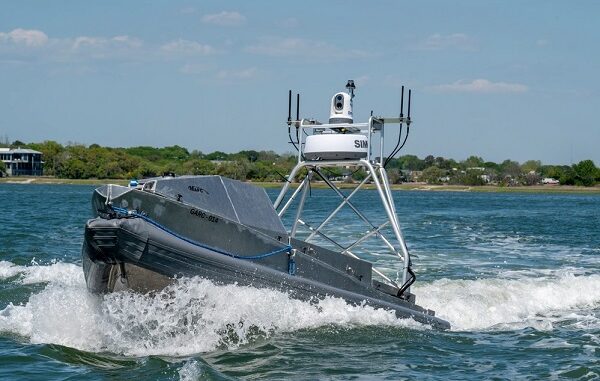
Sailors assigned to the Unmanned Surface Vessel Division 32 were at the forefront of the Navy’s fleet during exercise Baltic Operation 2026, delivering realistic training against unmanned surface vessels to NATO allies. Established early this year, Unmanned Surface Vessel Division 32 (USVDIV-32) is one of the newest additions to the Navy’s unmanned operational units. Tasked with maintaining and operating unmanned vessels, the division’s sailors regularly conduct exercises and training with multiple platforms, with the most common being Global Autonomous Reconnaissance Craft, or GARC (SOF News, April 14, 2026). (Photo of the GARC is at the top of this article)

Exercise BALTOPS 2026 is the premier maritime-focused NATO exercise in the Baltic Sea (map, NSI), running from late May through mid-to-late June. Led by the U.S. 6th Fleet, the 2026 iteration gathered military forces from 15 Allied nations to sharpen amphibious readiness, harbor defense, and uncrewed system operations. The unmanned surface vessels performed swarm exercises and unmanned live-fire exercises to test emerging technologies in naval defense.
One of the defining features of USVDIV-32 is the assignment of a new Navy rate – the Robotics Warfare Specialist. These specialists are trained to operate and maintain vessels such as the GARC. During the exercise, USVDIV-32 played a crucial role by deploying GARCs as an opposing force to allied forces. This provided the allied forces the opportunity to test their abilities to defend against sea drones and provided valuable experience to the sailors of USVDIV-32.
Read more about this topic in “USVDIV-32 Advances Unmanned Operations With NATO During BALTOPS 2026”, U.S. Department of Defense, June 25, 2026. Watch a quick video on BALTOPS 2026 (DVIDS, June 30, 2026, 1 min)
U.S. Military Drone Developments
Grizzly Weapons System. A new weapons system can fire both Hellfire and AGM-179 Joint Air-to-Ground Missiles. It was recently tested against a mid-sized aerial drone. “The Army’s latest anti-drone tool fires missiles from a cargo container”, Task & Purpose, June 7, 2026.
CCA Production Contracts. General Atomics and Anduril Industries have landed contracts for the production of the Collaborative Combat Aircraft (CCA). General Atomics will produce the FQ-42A and Anduril will produce the FQ-44A. The CCA is often referred to as the “loyal wingmen” – a jet-powered, semi-autonomous unmanned aircraft built to fly alongside crewed fighters such as the F-35. The CCA program has a long-term goal of fielding as many as 1,000 CCA. Six companies are in competition to build the software for the CCA. “US Air Force awards first CCA production contracts to General Atomics, Anduril”, Military Times, June 18, 2026.
Drones – a Problem to be Solved. Eric Wesley, a former U.S. Army officer and currently a senior advisor to a counterdrone company, provides his thoughts on how drones are having their moment in time but eventually something will restore the ability to maneuver under the drone threat. “Drones Are Not the Future of War – They Are the Problem to be Solved”, Modern War Institute, June 23, 2026.
World Cup and Counter-UAS. Read an article on how Kansas City is protecting the World Cup activities with counterdrone technology. “How law enforcement is stopping drones at the World Cup”, Axios.com, June 22, 2026.
Drones as Breachers. Oregon Army National Guard combat engineers recently tested using a heavy-lift drone to deliver an explosive-filled tube through simulated enemy defenses. Soldiers sent a live Bangalore torpedo into the Idaho sky amid 25mph gusts of wind. On a range at Orchard Combat Training Center, they maneuvered the drone and detonated the explosives, taking cover before the munition cleared a path through a wire obstacle. “The US Army goes into the breach – without soldiers”, Army Times, June 30, 2026.
Maritime Drones and Salaknib 2026. Soldiers assigned to the 25th Infantry Division partnered with Philippine Army forces and industry representatives during Salaknib 2026 to demonstrate how autonomous maritime systems can enhance security and protect critical transportation operations in contested environments. “Army demonstrates security capabilities with autonomous maritime systems at Salaknib 26”, Army.mil, June 17, 2026.

Drones and the Russia-Ukraine War
Ukraine has expanded long-range strategic drone strikes against Russian oil refineries, logistics hubs, rail infrastructure, and military facilities well over 1,000 km from the front lines. It has used coordinated drone attacks to disrupt fuel depots, transportation nodes, and military supply routes supporting front-line operations and Crimea. Ukraine has accelerated procurement of unmanned ground vehicles (UGVs) for logistics, casualty evacuation, mine-laying, and combat support. Russia has increased the scale of Shahed/Geran drone attacks, conducting some of its largest one-way attack drone raids of the war while continuing to upgrade the drones with improved electronic warfare resistance and target-recognition capabilities.
Learning from Ukraine. The nature of warfare has changed in the past several years. Observing the Ukraine-Russia war demonstrates how rapidly drones have transformed modern warfare. These drones – air, land, and sea – have a strategic, operational, and tactical impact on the war. Much of the battlefield attrition is now inflicted by drones. The U.S. has been closely observing this conflict that began with the full-scale invasion of Ukraine by Russia in February 2022. The U.S. is now attempting to scale up its drone warfare capabilities in order to prepare for future conflicts. Cosmo Curtatone and John Nagl provide an analysis in “How the United States is Learning from Drone Warfare in Ukraine”, Small Wars Journal, June 17, 2026.
Ukraine and Small UGVs. The unmanned ground vehicles used by Ukraine and Russia on the battlefield perform a variety of functions to include cargo transportation, reconnaissance, barricade breaching, medical evacuation, and engaging enemy combatants. Carsten Oyer explains how the U.S. Army is experimenting with small UGVs in “Army looks to small UGVs as Ukraine war reshapes battlefield robotics”, Small Wars Journal, June 19, 2026.

Drones and the Iran War
Apache Crew Rescued by Naval Drone. On June 8, 2026, two crew members from a U.S. Army AH-64 Apache helicopter (photo) were rescued by a U.S. Navy unmanned surface vessel (USV) after their helicopter went down off the coast of Oman (map NSI). They were patrolling regional waters as part of Operation Epic Fury. The Soldiers were rescued within two hours and are in stable condition. The rescue efforts were led by U.S. Naval Forces Central Command and the 82nd Airborne Division. The rescue was supported by the U.S. Air Force and Navy units. According to subsequent reporting, the AH-64 was taken down by an Iranian Shahed 136 drone. “Apache Crew Rescued by Naval Drone off Coast of Oman”, SOF News, June 9, 2026.
Clearing the SoH. A mine doesn’t have to strike a ship to disrupt global commerce. In the Strait of Hormuz (SOF News map) the threat of mines alone has sparked uncertainty across the entire maritime industry, increasing insurance costs and delaying shipments along major routes. For shipowners, operators, and insurers, the challenge is not just the presence of mines but the time it takes to determine whether these critical waterways are safe. Clearing the strait takes hard work, time, and the right equipment and personnel. Learn more in “Clearing the Strait: How Autonomous Systems are Redefining Mine Countermeasure Operations”, gCaptain, June 8, 2026.
International Drone Developments
Ecuador, Drones, and Drug Traffickers. The United States is providing Ecuador with over $6 million in funds for drones to interdict drug trafficking in Ecuador. Battlefield-tested commercial platforms are providing security forces with new weapons against the drug lords. Drones can compress the find-fix-finish cycle but there is a need for transparent rules of engagement. “Ecuador Bets on Drones to Beat the Cartels – At What Cost?”, Small Wars Journal, June 22, 2026.
Korea’s Counter-Drone Strategy. A Ukrainian defense media outlet questioned the realism of Korea’s first live-fire counter-drone drill, prompting debate over the military’s evolving drone defense strategy. The Republic of Korea Air Force defended the exercise as a first-step test of existing weapons systems rather than an attempt to replicate combat conditions in Ukraine. Defense Express, a Ukrainian military news outlet, recently analyzed footage from the ROK Air Force’s drill, in which eight M167 Vulcan air defense guns were used to engage 50 low-flying drones. “Ukrainian outlet’s critique exposes gaps in Korea’s counter-drone strategy”, The Korea Times, June 30, 2026. Read also “South Korea sets first national standard for counter-drone systems”, UPI, June 28, 2026.
**********
Image. A U.S. Navy Global Autonomous Reconnaissance Craft (GARC) assigned to Naval Information Warfare Center Atlantic, maneuvers in Charleston Harbor, South Carolina April 17, 2025 during Exercise Southern Lightning. (U.S. Air Force photo by Staff Sgt. Emily Farnsworth)
Previous Monthly Drone Updates:
