
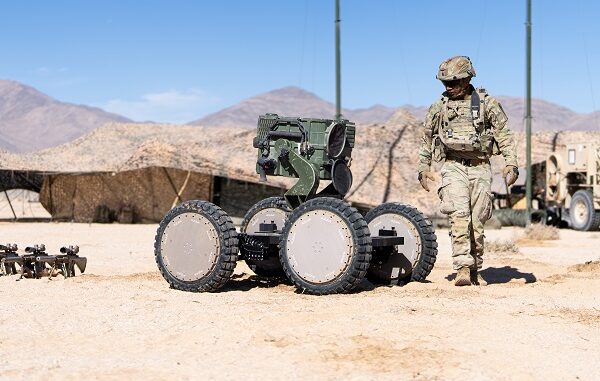
Photo: An AZAK unmanned ground vehicle (UGV) equipped with an LRAS and configured with the S26 wheel provides a low center of gravity and a highly modular design, with a wireless, tethered, autonomous control. (photo provided by AZAK: NTC, Nov 2025)
The war in Ukraine gas driven a significant shift in modern warfare, particularly through the widespread use of unmanned aerial vehicles (UAVs), more commonly known as drones. A very large percentage of the personnel casualties on both sides of the conflict are inflicted by aerial drones. Not far behind in the development and employment stage is the use of unmanned ground vehicles (UGVs); and now autonomous ground vehicles (AGVs).
Key Takeaways:
- Most UGVs are teleoperated or semi-autonomous, not fully autonomous
- Primary roles include EOD, ISR, logistics, and limited combat support
- Communications vulnerability remains a major constraint
- Ukraine is accelerating battlefield experimentation with ground drones
- Future growth lies in manned–unmanned teaming (MUM-T)
These self-driving vehicles are robots that operate on the ground without a human on board. The systems use sensors – camera, LiDAR, radar, and other inputs – to perceive and navigate their surroundings. Most UGVs still require significant human control; even those incorporating artificial intelligence (AI) are typically semi-autonomous rather than fully independent. There are many commercial applications for UGVs and AGVs but the applications for warfare are rapidly evolving. UGVs can use preloaded maps, global positioning systems (GPS), or real-time sensor data to navigate and perform functions.
Ground drones are used by both the Ukrainians and the Russians for reconnaissance, explosive ordnance disposal (EOD), delivering explosive payloads, resupply, medical evacuation, fires, and other missions. These remotely operated ground vehicles reduce risk to personnel by performing tasks traditionally carried out by infantry.
The key characteristics of UAVs and UGVs include the ability to operate in a multi-terrain environments to include mud, rubble, urban debris, ice, and snow across a variety of climatic and weather conditions. They usually have a low center of gravity and are extremely stable – designed to handle slopes, ditches, and small obstacles. Most have a reduced noise signature utilizing electric propulsion. UGVs exist across a wide range of sizes and configuratons – both large and small – all performing functions that soldiers usually do on the battlefield.
UGVs are highly dependent on communication links and are vulnerable to jamming, signal loss, and urban interference. Navigation is further constrained in GPS-denied environments, although some systems incorporate onboard navigation tools such as inertial guidance and SLAM-based mapping. Most UGVs remain teleoperated or semi-autonomous rather than fully autonomous.
During a recent industry show in Fort Walton Beach, Florida, the Special Air Warfare Symposium (SAWS 2026), AZAK, Inc. provided a demonstration of its highly modular design UGV that puts most of the functions within the wheel. This design places key components—including the motor, battery, controls, brakes, and steering—within the wheel itself, enabling a highly modular architecture. This novel approach provides the ability to employ mechanical innovation resulting in many different configurable mobility solutions. Based on the S26 wheel, this UGV is highly modular with almost all functions of drive, guidance, and more located on the wheel. Watch a video of the AZAK S26 Wheel in action.

In the image above, from left to right, the basic AZAK S26 wheel is where the motor, navigation, and control systems are located. The 463L pallet can hold 96 wheels and 24 vehicle frames, the UGV can be configured with many different designs including the four and two wheel models. (images provided by AZAK)
There are various levels of autonomy to include human-in-the-loop, supervised autonomy, and collaborative autonomy. These various modes permit route following, waypoint navigation, swarming, and manned/unmanned teaming.
The operational value of UGVs is less about replacing soldiers and more about displacing risk. Their greatest utility lies in high-threat environments—IED clearance, confined urban reconnaissance, and logistics under fire—where the cost of exposure to personnel is highest. However, their dependence on communications links and limited endurance constrains their effectiveness in peer or near-peer environments where electronic warfare is prevalent.
UGVs are emerging as a niche but expanding capability within ground maneuver forces. The U.S. Army is taking note of the advances in unmanned ground vehicles. It has established programs to research, test, and field UGVs for a variety of purposes. Some UGVs and AGVs have already been fielded; and more are on the way as the U.S. increases its development and procurement programs. A number of U.S. commercial companies are marketing their products to the Department of Defense.
**********
References:
Unmanned Ground Vehicles, national-security.info.
