
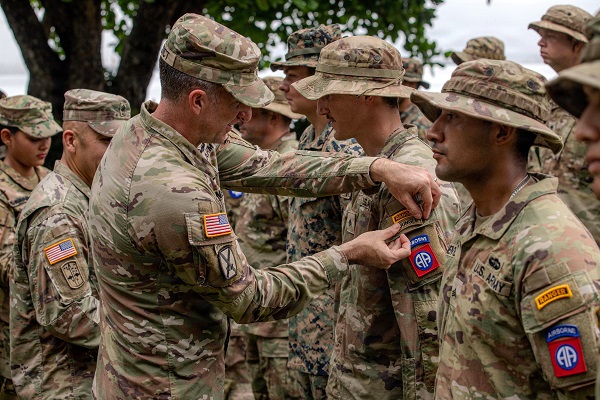
Image: U.S. Army Col. Keith W. Benedict, commander of Joint Security Cooperation Group – Panama, awards students with the jungle tab on the graduation day of the Jungle Operations Training Course – Panama at Aeronaval Base Cristóbal Colón, Panama, Feb. 20, 2026. The jungle tab signifies expertise in jungle survival, mobility, and tactical operations in an austere environment. (U.S. Army photo by Spc. Richard Morgan)
Soldiers who completed a recognized Army jungle training course are now eligible for the Jungle tab Army-wide. In a July 22 memorandum, the Army approved permanent, service-wide wear of the Jungle tab as an official skill tab. The tab is worn on the upper left sleeve of the uniform, alongside other permanent individual skill tabs such as the Special Forces, Ranger, Sapper, and President’s Hundred tabs. Before the memorandum was issued, the wear of the Jungle Expert tab was generally limited to personnel assigned to U.S. Army Pacific units or serving within its area of responsibility. The new tab simply says “Jungle”.

The tab is authorized for graduates of the Hawaii or Panama-based Jungle schools. Retroactive eligibility also extends to service members who participated in unit-level training at the Jungle Operations Training Center at Fort Sherman, Panama from 1990 until its closure in 1999. The new policy will be included in the next revision of Army Regulation 670-1 and Army Regulation 600-8-22. Special skill tabs are awarded to denote proficiency in performance of duties under hazardous conditions and circumstances of extraordinary hardship and special qualifications and successful completion of prescribed courses of training
The Jungle Operations Training Center (JOTC) operated at Fort Sherman, Panama for many years until it was closed in 1999 along with the closure of Fort Sherman. The Jungle Expert badge was worn by graduates of the JOTC at Fort Sherman. The badge was authorized for wear by soldiers assigned to U.S. Army South who graduated from JOTC but the badge was never recognized Army-wide. The Jungle Expert badge was retired in 1999. It featured the words “Jungle Expert” above an embroidered sailing ship.

Image: The Jungle Expert badge awarded to graduates of the Jungle Operations Training Course (JOTC) at Fort Sherman, Panama. (Wikipedia). The galleon represents the Caribbean during the Spanish colonial era. According to an earlier Army description, the cross on its sail was associated with Christopher Columbus, while the blue background represented the Caribbean Sea.
The Jungle Operations Training Center in Panama operated from the early 1950s to 1999. It was located on the Caribbean side of the Panama Canal. The course was nicknamed “the Green Hell.” It trained thousands of soldiers, including personnel preparing for service during the Vietnam War. The terrain in Panama was similar to that found in South Vietnam. The school had an annual enrollment of 9,000 personnel. In 1976, the Army decided to train whole battalions at the course, rather than individual soldiers. The JOTC also taught a 10-day Air Crew Survival Course and a four-week Engineer Jungle Warfare Course. The school was shut down as a result of the 1977 treaty signed by President Carter with Panama turning over the Panama Canal in December 1999, the trend toward an Army using high-tech equipment, and a belief that jungle wars for the U.S. were in the past. The Army decided that it would be too expensive to relocate the school.
A new jungle training school was set up in Hawaii, run by the 25th Infantry Division’s Lightning Academy. It is called the Jungle Operation Training Course and is 12 days long. The course covers land navigation, combat tracking, small unit tactics, knot tying, rope systems, and primitive survival skills in a jungle environment. The course is run at the Lightning Academy’s East Range Training Area. Prior to attending the course, prospective students must pass a combat water survival test. There are other ‘must pass’ events that students need to meet; land navigation, rope and knot tying skills, and physical fitness assessments. Graduates of the Hawaii course who were assigned to U.S. Army Pacific area of responsibility or U.S. Army Pacific units could wear a tab that said “Jungle Expert”.

Image: The Jungle Expert tab was created by U.S. Army Pacific and could be worn by graduates of the 25th Infantry Division’s Jungle Operations Training Center in Hawaii who were assigned to the U.S. Army Pacific’s area of responsibility or units. (Wikipedia)
In 2025, the U.S. and Panamanian forces renewed jungle training at the former Fort Sherman; now known as the Aeronaval Base Cristobal Colon. The current Jungle Operations Training Course in Panama is a 18-day program with three phases. The Army Security Cooperation Group – South now oversees the Combined Jungle Operations Training Center in Panama.
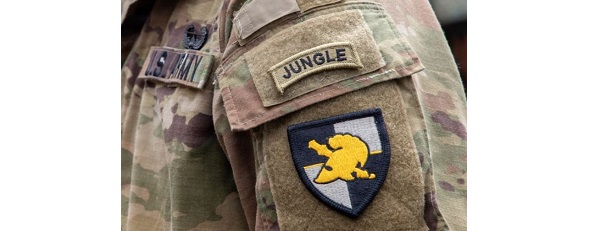
Image: A soldier receives the Jungle tab in a ceremony in July 2026 in Panama. U.S. Army Photo by Pfc. Carolyn Dodge.
Retroactive Eligibility. Current graduates and qualifying former students are eligible for the tab. Retroactive eligibility includes graduates of the recognized Hawaii and Panama courses and personnel who completed qualifying unit-level training at Fort Sherman between 1990 and 1999. Past graduates should submit a Personnel Action Request (PAR) with proof of completion of a jungle school to their chain of command to be awarded the tab retroactively.
The Jungle Tab joins the Special Forces, Ranger, Sapper, and President’s Hundred tabs as a permanent individual Army tab. Other tabs, including Airborne, Mountain, and Arctic tabs, generally depend upon unit assignment or command-specific authorization.
**********
References:
“Earning the Army’s jungle tab”, army.mil, December 8, 2024
Video – How Army Jungle Soldiers Are Training for a Possible War with China, Business Insider, YouTube, June 1, 2023, one hour. https://www.youtube.com/watch?v=OwBYPgBK_OA
“Jungle Training Center Comes to End of Long Slog”, by Juanita Darling, Los Angeles Times, March 26, 1999.
“Farewell to a Tarzan training ground”, by David Abel, The Christian Science Monitor, June 3, 1999.
