
An Interview with Author Christopher “Moon” Mullins and Historian Arthur “Ben” Powers,
Podcaster for The Commander’s Voice.
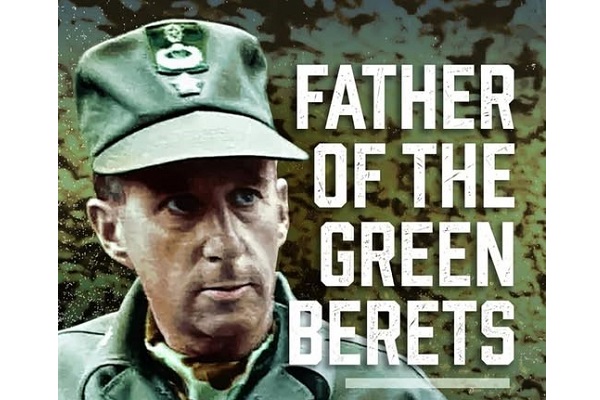
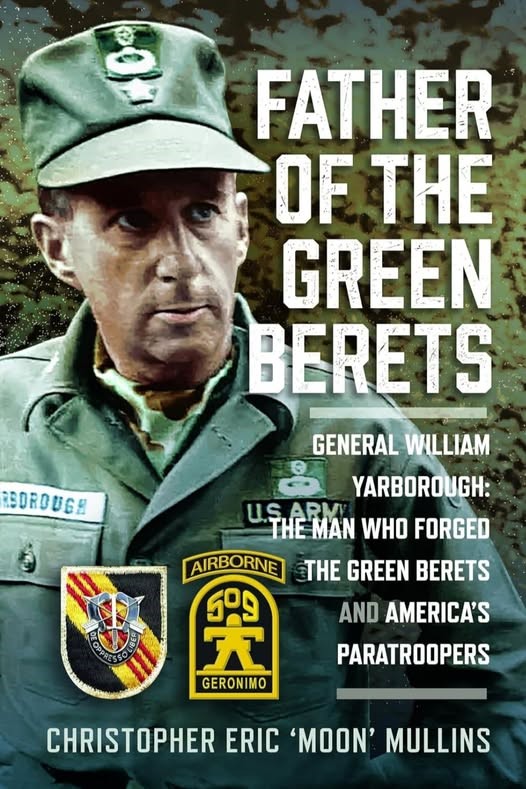
The history of the United States Army is often told through the lens of grand strategy and sweeping maps, yet the soul of the soldier is frequently found in the icons they wear. For retired First Sergeant Christopher “Moon” Mullins, the pursuit of military history is not merely a scholarly endeavor but a continuation of a life spent in the 82nd Airborne Division and the 5th Special Forces Group Comms Support B Teams. His latest work, Father of the Green Berets: General William Yarborough: The Man Who Forged the Green Berets and America’s Paratroopers, serves as a definitive reckoning of the life and legacy of Lieutenant General William Pelham Yarborough—a man who arguably did more to sculpt the physical and psychological identity of the American elite soldier than any other officer of the twentieth century.
In this dialogue, Moon is joined by fellow author Ben Powers to discuss the transition from the “Greatest Generation’s” airborne infancy to the birth of the “Quiet Professionals.” Their conversation explores how Yarborough’s dualism as a warrior-intellectual allowed him to navigate the bureaucracy of the War Department and the battlefields of WWII to design the enduring symbols of the American paratrooper and secure official recognition of the green beret as the distinctive headgear of Army Special Forces.
Finally, after three years of hard work, Father of the Green Berets is ready for pre-order.
Ben — You’ve spent a career in airborne and SOF formations—what specifically about LTG William P. Yarborough made you decide he was worth the effort of a full book, as opposed to other figures in that lineage?
Moon — It came down to the fact that while names like Gavin or Ridgway are etched into the tactical history of WWII, Yarborough is etched into the very fabric of who we are. He wasn’t just a successful parachute infantry battlefield commander; he was an architect of identity for paratrooper and Army Special Forces. Most figures in our lineage left behind battle plans or books, but Yarborough left behind the wings on our chests, the berets on our heads, and that unmistakable swagger of a paratrooper. I realized that we had plenty of books on how paratroopers fought, but almost none on why they look, act, and think the way they do and how that persona was developed and transformed over the years. He was the root source for the culture that you and I lived in for over twenty years.
“Most figures in our lineage left behind battle plans or books, but Yarborough left behind the wings on our chests, the berets on our heads and that unmistakable swagger of a paratrooper.”
Ben — What is the central question your book is trying to answer about Yarborough—and what do you think most existing narratives get wrong or leave incomplete?
Moon — The central question was: How does a “warrior-intellectual” survive and thrive in a “Big Army” system that is historically suspicious of both intellectuals and specialists? Most narratives treat him as a second-tier battlefield commander, but his history proves him to be one of the best paratrooper battlefield commanders of WWII! He was also identified early as a simple pioneer who just “invented” things related to airborne soldiers, gear, and their rituals. I think they miss the political friction he encountered throughout his career leading toward the command of the 509th, in the 82nd Airborne Division’s 2nd Battalion of the 504th, in Mark Clark’s 5th Army Headquarters as the airborne planner, working with Darby’s Ranger Force during the tough Italian Campaign, while serving in Vienna as Provost Marshal after the war, and taking over the Special Forces Command after being passed over for a major command during the Vietnam War! They get the myth of the Green Beret right, but they miss the struggle of the man who had to navigate the bureaucracy of the XVIII Airborne Corps personalities and the War Department to protect those symbols – through a design patent for the parachutist badge and official authorization for the green beret. My book tries to answer how he balanced being a gritty combat leader with being a visionary who was often decades ahead of his peers.
Ben — Yarborough sits at the intersection of institutional memory and myth. Where did you find the biggest gap between the historical record and the way he’s remembered inside the airborne/SOF community?
Moon — The biggest gap is in his WWII combat record versus the “unassailable” myth. Inside the community, he is a god-tier figure. But the historical record shows a human being who faced significant professional crises, most notably his relief from command (2/504) at Tuminello Pass by Matthew Ridgway. We tend to remember the JFK visit and the 1960s glory, but we skip the parts where he was a struggling battalion commander in Italy trying to prove that the airborne concept wasn’t a failure. The gap lies in his vulnerability; the myth says he was always right, but the record shows he had to fight like hell to be heard.
Ben — What did Yarborough actually change in terms of organization, doctrine, or culture—and how durable were those changes?
Moon — Culturally, he gave us the “Green Beret” as a mark of distinction, which is perhaps the most durable cultural change in the history of the Army. Organizationally, he transformed the Special Warfare Center into a legitimate academic and tactical powerhouse, enhancing the Language School which remains the bedrock of SOF training. He shifted doctrine away from just “jumping behind lines” to “unconventional warfare”—the idea of the soldier as a catalyst for local forces. Those changes haven’t just endured; they are the primary way Special Forces fight today.
Ben — Was Yarborough more effective as an innovator inside the system or as a challenger to it? Where did he succeed—and where did the institution push back?
Moon — He was a masterful “inside-the-system” challenger. He didn’t just scream from the sidelines; he used the system’s own tools—like patents and presidential influence—to force change. He succeeded in securing the identity of the paratrooper and the Green Beret. However, the institution pushed back hard during his time as Assistant Chief of Staff for Intelligence (ACSI). That was a period of civil unrest and Cold War paranoia where his unconventional thinking was viewed through a much more suspicious lens, proving that the system has a limit on how much “vision” it can handle at once. This section of the book is probably my favorite. I deliberately left a lot of the narrative open for interpretation. I provided the facts and data but let the reader make their own decision on the reasoning.
Ben — How would you characterize Yarborough’s command style in practice—particularly in terms of trust, discipline, and tolerance for initiative?
Moon — He was a “Commander’s Intent” leader before that was a buzzword. He had a very high tolerance for initiative but a very low tolerance for intellectual laziness. He trusted his subordinates to execute complex, decentralized missions—like the “Sacrifice Play” at Avellino—but he expected them to be as well-read and culturally aware as he was. He was disciplined, but it was the discipline of the professional elite, not the “spit-and-polish” rigidity that he felt often stifled creativity. As a paratrooper, this was the kind of commander we wanted: tough but fair.
Ben — You and I both come from communications backgrounds. How did Yarborough use communication—formal or informal—to shape outcomes, and what does that tell us about influence at senior levels?
Moon — He was a genius at informal communication. The 1961 JFK visit is the perfect example. He bypassed the XVIII Airborne Corps and 3rd Army formal chain of command’s hostility toward the Green Beret by communicating directly with the Commander-in-Chief and his trusted associates. He understood that at senior levels, influence is often about storytelling and symbolism. He didn’t just send memos; he created “visual facts” on the ground—like a formation of men wearing green berets at the Gabriel Demonstration areas, Mott Lake, or Camp Mackall—that the formal system couldn’t ignore.
Ben — If you had to place Yarborough alongside another military innovator (Ridgway, Gavin, Abrams, etc.), where does he align—and where does he diverge?
Moon — He aligns with Jim Gavin in terms of his vision for the future of the airborne, but he diverges significantly in his intellectual breadth. While Ridgway was the ultimate conventional “stabilizer” and Gavin was the “tactician of the future,” Yarborough was the “anthropologist of the warrior.” He focused on the psychological and cultural aspects of the soldier in a way that Abrams or Ridgway didn’t. He was less about the tank or the machine gun and more about the man attached to them.
Ben — What aspects of Yarborough’s approach still matter for today’s Army or SOF community—and which ones are products of a different era that don’t translate well?
Moon — His emphasis on cultural intelligence and language still matters immensely. In an era of “Great Power Competition,” his view of the SF soldier as a diplomat-warrior is more relevant than ever. What doesn’t translate as well is his highly centralized control over the “look and feel” of the unit. Today’s Army is much more decentralized in its branding, and the level of personal control he exerted over uniform design and heraldry is a product of an era where a single visionary could still physically draw the future on a drafting table.
Ben — After completing this book, has your view of Yarborough changed—and if so, what did you revise in your own understanding?
Moon — My view became much more grounded. I went into the project looking for “The Commander of the 509th and the Father of the Green Berets” and found a man who was often lonely in his brilliance. Much like the accounts you’ve chronicled in Never a Dull Moment, I realized that historical success is rarely a straight line. I revised my understanding of his time in Italy; I realized that his success was a series of hard-fought recoveries from professional setbacks. I came away with more respect for his persistence than his inventions.
*********
About the Participants:
Ben Powers is a retired Army officer and paratrooper with a deep background in military communications and signal operations. He is a published military historian and the author of Never a Dull Moment: The 80th Airborne Anti-Aircraft Artillery Battalion in World War II, which provides a definitive account of the division’s “Triple A” battalion, their unique role, and challenges its soldiers faced during the war.
Christopher Eric “Moon” Mullins is a retired Army First Sergeant and a published military historian. With over 20 years of active-duty service in the 82nd Airborne Division and 5th Special Forces Comms Support, he has authored ten books focusing on his family, elite unit lineages and military history. His latest work, Father of the Green Berets, is now available for pre-order via Frontline Books and Amazon.
Pre-order Father of the Green Berets here on Amazon!
https://a.co/d/08Ugpfwd