
Why SOF modernization must include persistent support for correct execution after fielding
By Woody Hurd
On my first deployment to the Middle East with 5th Special Forces Group, I was tasked with setting up a notoriously complex tactical SATCOM node on a rooftop. I was the team’s 18D (Medical Sergeant), and most of the team, including our 18E (Communications Sergeant), was on the other side of a mountain. Getting that terminal to acquire a satellite, with nothing but my Echo talking me through it over the phone, was next to impossible. The equipment worked. The knowledge existed. It just lived in one man’s head on the wrong side of a mountain.
A later combat deployment made the same point at a much higher price. After a brief familiarization from the outgoing team, I became the primary operator for a loitering munition system. I eventually became effective with it and had successful missions, but the early weeks were inconsistent. We worked through connectivity problems, employment issues, and incomplete procedures while the operational requirement was already real. During that learning curve, we burned through well over a million dollars in wasted munitions. When a field service representative arrived a month or two later, he told me I was supposed to complete formal training before using the system. By then, I had already employed it successfully in combat many times. My answer was blunt: “The enemy does not give a sh*t about our training requirements.”
Neither story is a criticism of the equipment or the people who fielded and supported it. Both systems provided real capability. They illustrate a shared challenge created by speed, complexity, personnel turnover, and the distance between expert knowledge and the person who must execute. When the mission begins, the operator needs more than access to the equipment. They also need access to the current knowledge required to employ it correctly.
Fielding is not the finish line
SOF must continue fielding advanced systems quickly. The force cannot wait for every capability to mature through a long, sequential process before it reaches the formation. From the operator’s perspective, however, fielding is only the beginning. The real test comes months later, after the training team has departed, the original users have rotated, the software has changed, and someone who did not attend the fielding event has to make the system work under pressure.
Modernization is usually measured by what the force acquires, but operational efficiency also depends on how much of the equipment already in the formation can be used correctly by the people who may need it. That distinction matters in SOF, where small teams often operate with limited support and individual operators are expected to understand equipment far beyond their primary specialty. Adding a new capability grows combat power. So does widening the circle of people who can competently employ, troubleshoot, and sustain what is already on hand.
The person who attends training is not always the person who later employs the equipment. Gear moves between teams and rotations, unfamiliar systems are inherited, and software updates alter menus, connections, and troubleshooting sequences. Local shortcuts can gradually become accepted practice until several versions of the truth exist. Some adaptation is necessary, but adaptation should solve novel operational problems, not compensate for knowledge that could have been preserved and made accessible. A communications package configured incorrectly, a sensor assembled out of sequence, or a weapon employed from outdated guidance can cost time, money, opportunity, or even lives. These are readiness failures, not administrative mistakes.
This gap develops naturally because no single organization holds every piece of the knowledge required for successful execution. Technical experts understand the system. Instructors understand how to teach it. Operational units understand the conditions under which it must perform. Maintainers, field service representatives, and original equipment manufacturers each see different parts of the problem. The challenge is preserving and connecting that knowledge as the system, the mission, and the people change.
Training is essential, but episodic
Formal training remains irreplaceable. New-equipment training, schoolhouses, refresher training, and field service representatives build context, judgment, and confidence that no manual can provide on its own. The limitation is not the quality of training. It is time and proximity. A service member may receive instruction once and then use the system intermittently for years. A maintainer may encounter a fault that never appeared during the course. A Team Sergeant may inherit equipment from another rotation and have to determine what is approved and what was simply local habit. The training may have been excellent, but it is not standing beside the operator when the task returns.
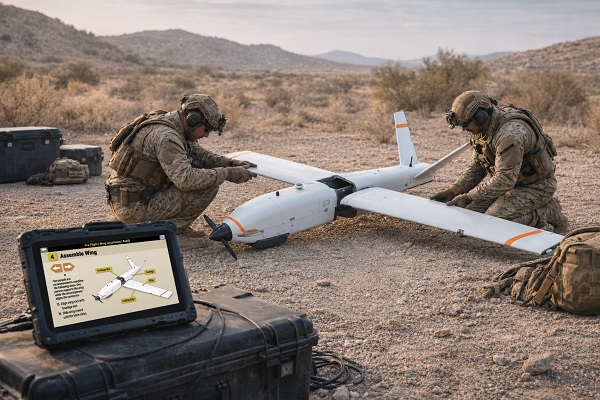
When I think back to the loitering munition, the knowledge needed to employ the system was separated from the moment of execution. The same problem appears in less dramatic situations every day. A new operator is handed unfamiliar equipment. A radio will not pass data at 0200. A vehicle subsystem behaves differently after an update. A rarely used UAS must be assembled by someone who last touched it months ago. Accessible guidance can help a new user build competence, refresh an experienced user, or walk someone through the task when the expert is unavailable. Across a team, that means fewer capabilities depend on a single trained operator and more of the formation remains effective when people rotate, split into smaller elements, or operate beyond immediate support.
That support does not replace hands-on instruction, judgment, or certification when those are required. It extends them. The strongest model begins during initial fielding and new equipment training, when instructors and field service representatives teach operators with the same digital resources they will later use in the field. The user learns the system and learns where to find the current procedure. After the training team leaves, that resource remains available for onboarding new personnel, refreshing infrequent tasks, guiding execution, and supporting troubleshooting. Because it can be updated as the system and procedures change, the continuity can extend from fielding through long-term sustainment.
Preserving what the force already knows
The answer is not another uncontrolled checklist. The force needs a common procedural baseline built from approved source material, maintained with the involvement of the organizations that understand and support the capability, and available to the person performing the task. The knowledge already exists across technical manuals, SOPs, programs of instruction, field notes, and experienced personnel. Bringing those sources together in an executable form turns knowledge held by a few specialists into usable capacity across a larger portion of the formation.
Under that model, approved guidance is translated into visual, step-by-step workflows that can be used under friction. Version control ensures that an approved change replaces the prior procedure instead of creating another competing file, while still allowing distinct configurations when necessary. Access extends across authorized devices and into disconnected environments. Done well, this reinforces the support structures already in place. Schoolhouse instruction remains accessible after graduation, technical changes can be communicated through a governed process, and operational units spend less time rediscovering procedures the enterprise already knows. The result is greater reach for the training and expertise already being provided.

From scattered sources to a common baseline. Technical manuals, subject-matter expertise, slide decks, and checklists can be converted into governed visual workflows that operators can execute under pressure. (Image: StartGuides.)
A two-way execution layer
Providing current guidance to the force is only half of the opportunity. A persistent execution layer should also create a clear path for operators, maintainers, instructors, subject-matter experts, and unit staff to provide structured feedback. They should be able to flag an outdated step, capture a lesson learned, identify a recurring failure point, or point to a system for which no useful execution aid exists. When I was in 5th Group, I did not know what SOF AT&L was, much less that observations from a team room or deployment could help shape how equipment was trained, supported, or improved. Operator input was not unwelcome. The path was simply invisible to many of us.
A better model would make feedback part of normal execution rather than dependent on knowing the right person or attending the right meeting. At the individual level, it could improve an existing workflow by identifying missing steps, incorrect information, or lessons that deserve formal review. Across the portfolio, aggregated input could reveal where users repeatedly struggle, which systems lack adequate support, and where limited development resources would have the greatest operational value. The same layer that helps the force execute current procedures could also help the enterprise understand where those procedures, systems, and support models need to improve.
A practical USSOCOM example
Work underway across USSOCOM offers one practical example. USSOCOM organizations have purchased dozens of StartGuides Performance Support Apps covering vehicles, unmanned aircraft, tactical communications, weapons, networking, identity, intelligence, and other critical mission areas. The applications convert approved, Government-provided source material into secure, visual guidance for operators, maintainers, and instructors at the point of need, including offline.
None of this creates a separate source of technical truth or replaces hands-on training. The applications make approved knowledge easier to execute, update, and distribute. Technical stakeholders help ensure the content remains accurate, operational users identify where guidance is unclear, and instructors can reinforce the same procedural baseline during training. Those applications are moving toward broader availability across supported SOF devices through MATrIX, a governance and distribution layer that keeps each application version controlled as procedures and systems change.
The larger lesson is not tied to one platform or company. Every fielded capability already has a network of people and organizations working to make it successful. The modernization challenge is to preserve what they know, govern how it changes, and place it within reach of the operator who has to execute. When that does not happen, the force repeatedly pays to relearn lessons it has already learned.
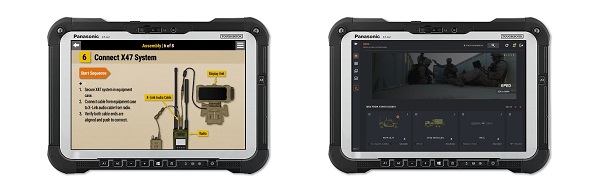
From a single procedure to the broader portfolio. An individual Performance Support App (left) and the MATrIX governance and distribution layer (right). (Left image: AI-generated due to distribution restrictions; right image: StartGuides.)
The next modernization discipline
SOF will continue fielding advanced systems because the mission demands it. But modernization has two levers: introducing new capabilities and increasing the usable capacity of what the force already owns. A system that only one person on a team can confidently employ may be technically fielded, but it remains operationally fragile. Persistent execution support expands the number of people who can bring that capability to bear, especially when small teams are isolated, support is distant, and each operator is expected to understand far more than a single specialty.
A persistent execution layer can connect initial fielding, training, daily execution, sustainment, and structured feedback so that knowledge moves with the capability and improves over time. This is not a criticism of rapid modernization. It is what allows rapid modernization to endure.
The expert will sometimes still be on the other side of the mountain. The question is whether the knowledge has to be.
Fielding puts capability into the force. Persistent execution support keeps it there.
**********
Author Bio: Woody Hurd served as a Special Forces Medical Sergeant (18D) with 5th Special Forces Group, deploying multiple times to the Middle East in support of Operation Inherent Resolve. He now leads USSOCOM efforts for StartGuides.
Top image: The expert is not always on your side of the mountain. Operators assemble a UAS using step-by-step guidance from a Performance Support App at the point of need. (Image: AI-generated; mock system and content shown due to distribution restrictions.)