
By Shaun Chittick.
Background
This essay provides an account of H.L. Hunley’s daring attack on the Union’s USS Housatonic on 17 February 1864. H.L. Hunley was a civilian submersible on loan to the Confederate Navy. The Union had a larger and more powerful navy than the Confederacy, so the Union used this advantage as part of their “Anaconda Plan” to blockade southern ports to prevent resupply.
Mission Tasking
H.L. Hunley, commanded by Lieutenant George Dixon and crewed by seven mission specialists would transit undetected from its launch point at Marshall Battery on the eastern tip of Sullivan’s Island just over three nautical miles to conduct a demolition attack against the USS Housatonic. Following the attack, the Hunley would signal support elements ashore who would then guide her back to her launch point with a pre-arranged recovery signal.
Operational Prep of the Environment
The Union South Atlantic Blockading Squadron ringed the entrance to Charleston Harbor. Its primary purpose was to prevent blockade runners that were bringing supplies into besieged Confederate forces in Charleston. Fort Sumter lay in ruins from Union barrages. The Union successfully captured Morris Island just outside Charleston harbor in September 1863, but the Confederates still retained control of Fort Sumter. The Union established a two-ring blockade of the entrance to the harbor using both stationary ironclad vessels; and mobile wooden ships for boarding, search, and seizure of suspected blockade runners.
The USS Housatonic was a screw sloop of war, which meant it was designed to operate both along the coast and in open ocean. The Housatonic had three sailing masts and two steam engines, which gave the vessel both endurance for longer voyages, and speed for close-in fights. She had 16 guns, including a mix of smooth bore and cannon. Her Parrott rifles had greater range for longer distance engagements, the Dahlgren smooth bore gun was for broadside attacks against other vessels, and the rest of her complement was for shore bombardment. She arrived on station on 19 September 1862 as part of the outer ring of the blockade and anchored approximately 5 ½ miles east southeast of Fort Sumter.
H.L. Hunley arrived via train from Mobile, AL in August 1863. Racing against time to counter the debilitating effects of the Union blockade, the Hunley team began testing soon after the submersible’s arrival.
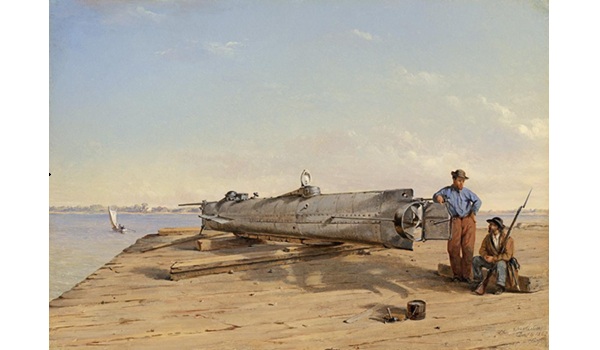
Image: Drawing by artist Conrad Wise Chapman – Submarine Torpedo Boat H.L. Hunley, Dec. 6, 1863. (Click here for a larger view of the drawing)
Mission Planning and Training
Lieutenant Dixon and his crew trained and rehearsed for six weeks aboard the H. L. Hunley for four nights per week, between mid-December 1863 and the end of January 1864, before winds and sea state picked up in the open water immediately southeast of Charleston. The Hunley crew could overhear Union sailors aboard various vessels as the submersible passed them as Dixon gauged transit times and looked for opportunities to attack. Both sunset and the high tide cycle occurred at Breach Inlet around 1930. The tidal change was 5.2 feet between high and low tide, and Hunley drafted four feet below the water line while she was transiting on the surface. USS Housatonic was anchored 3-4 miles away in 27 feet of water. Housatonic drafted 8.7 feet, so that means there was less than 20 feet of clearance beneath her hull.
Order of Battle
- H.L. Hunley with eight embarked crew:
Lieutenant George Dixon
Arnold Becker
Corporal J.F. Carlsen
Frank Collins
C. Lumpkin
Miller
James A. Wicks
Joseph Ridgaway
- Launch and Recovery Support Crew ashore at Battery Marshall
H.L. Hunley Technical Specifications
- Length: 40.3 feet
- Beam: 3.5 feet
- Height: 4.5 feet
- Draft (height below the waterline): 4.0 feet
- Displacement (weight): 7.5 short tons
- Depth Limit: tested to 25 feet
- 3/8 in thick iron plate made up her hull
- Speed: up to 3 knots per hour surfaced, and 3-4 knots submerged
- Range: 10 nautical miles per hour (surfaced), 1 nautical mile per hour (submerged). Based on sea state, currents, and human endurance.
- Endurance: 20 minutes submerged
- Eight crewmen (Captain, First Lieutenant, and six mission specialists)
- Propulsion: Human-propelled hand crank generating 3.5 hp
- Auxiliary equipment: Two 18” tall conning towers with glass panels for viewing. There was also a magnetic compass, a mercury-filled depth gauge, a single candle for interior illumination, forward and aft ballast tanks connected via piping and pumps that added and removed ballast, as well as moving sea water forward and aft to adjust the vessel’s trim, rudder, diving planes, and a joystick for steering. There were also several cast iron keel blocks attached to the bottom of the hull that could be released by levers inside the vehicle in case of an emergency. There was also a small snorkel for refreshing internal air while on the surface that reportedly did not work.
- 1 x external 85 lb. black powder “torpedo”, or detachable charge encased in a copper vessel attached to a 16-foot-long spar, or pole.
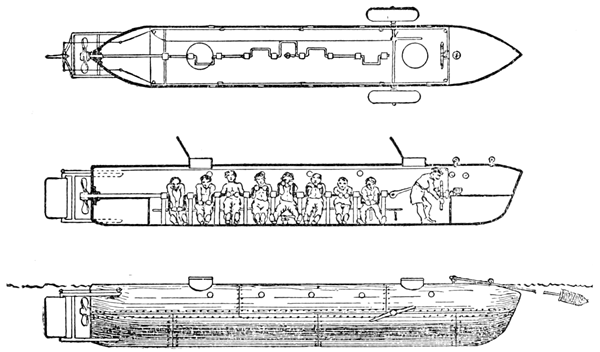
Image: Drawing of the H.L. Hunley submersible by unknown author. (created 1900?) Published in Popular Science Monthly (1900). View a larger image of the drawing. See another diagram of the H.L. Hunley here.
USS Housatonic with 155-man crew
- Length: 205 ft.
- Beam (width): 38 ft.
- Draft: 8.7 ft.
- Displacement: 1240 long tons
- Propulsion: Three masts with sails and two steam engines generating a combined 1150 hp.
- Speed: 9 kts. under steam power and varying speed under sail
- Armament: 16 guns (including mixed smooth bore and cannon)
1 x 100-pounder Parrott rifle
3 x 30-pounder Parrott rifles
1 x 11 in. Dahlgren smooth bore
2 x 32-pounders
2 x 24-pounder howitzers
1 x 12-pounder howitzer
1 x 12-pounder rifle
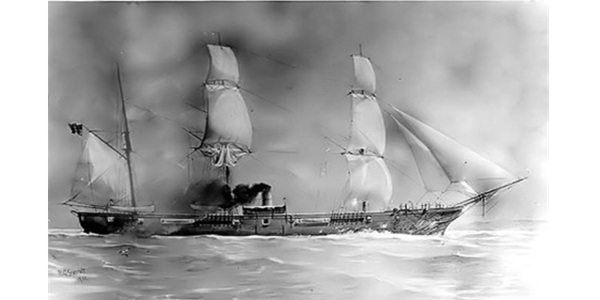
Image: USS Housatonic (Naval HIstory and Heritage Command)
The Transit
On 17 February 1864, George Dixon guided the Hunley out through Breach Inlet on the eastern edge of Sullivan’s Island on a stealthy approach, traveling just barely above the surface and navigating by magnetic compass. Heading south-southeast at an average speed of 1.6 knots, it took just under two hours to arrive in the vicinity of the USS Housatonic.
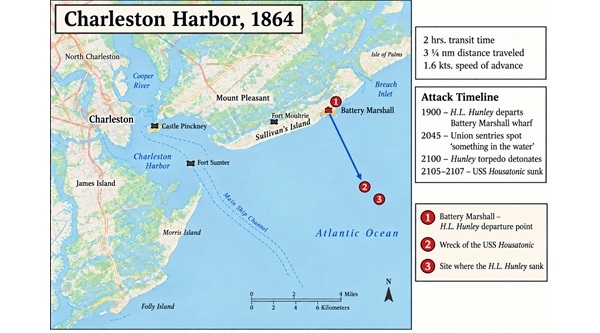
Map: Base map by OpenStreetMap contributors, edited with ChatGPT. View a more detailed map of Charleston Harbor.
The Attack
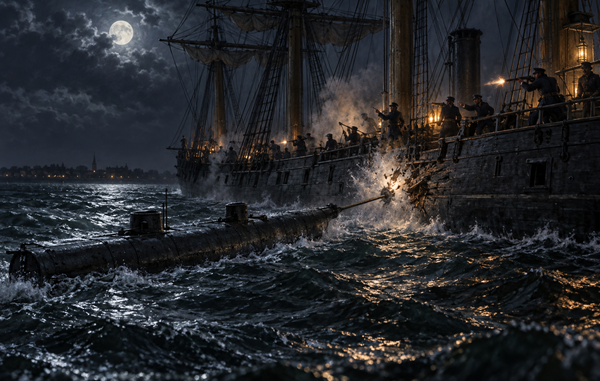
The Hunley closed to within 400 yards of the starboard side of the USS Housatonic before she was spotted by a Union sentry at around 2045. The officer on the deck thought it might be a porpoise, coming up to blow. The crew knew it was no porpoise when the object approached the ship in a straight line. Several sailors on the deck of the USS Housatonic reported seeing something on the water a hundred feet away, but by now it was too late. The officer of the deck, Acting Master J. K. Crosby, sounded the alarm and the sentries fired their guns over the railing. They scored multiple hits as the submersible drove into their hull, although the bullets bounced harmlessly off the metal hull of the raider. Hunley’s spar hit the starboard side of the Housatonic between the main and mizzen masts, or about two-thirds of the distance from her bow. The charge was designed to initiate as the Hunley backed away from its target. The detached charge remained in the target’s hull and remained connected to the retreating submersible only by a pull cord which released a firing pin once Hunley was a safe distance from the explosion. Soon afterward, the spar torpedo (detailed schematic of torpedo) detonated beneath the surface and blew a hole in the ship. The Housatonic sank in five to seven minutes, according to Union reports, resulting in the death of five of its complement of 155. Ensign E. C. Hazeltine, Captain’s Clerk C. O. Muzzey, and three of the crew, Quartermaster John Williams, Second- Class Fireman John Walsh, and Landsman Theodore Parker were lost with the Housatonic when she sank.
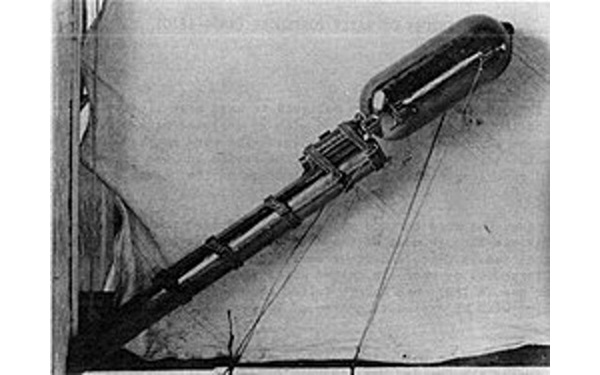
Image: Explosive charge lasted to boom of spar torpedo of H.L. Hunley. (public domain, US navy)
Movement to Extraction
Here is where the historical record fails. There is no reporting from the crew of the Housatonic, or from Union or Confederate Navy leadership regarding Hunley’s fate. Researchers have been unable to ascertain whether the spar torpedo detonated on contact, or as Hunley backed away from the charge once it was emplaced. The submersible likely would have been pulled inside the hull of the Housatonic by suction following the blast had Hunley been close enough during the explosion. With 150 of the 155-man crew in the exposed rigging as the Housatonic’s hull slipped beneath the waves, there would likely have been a few witnesses if the iron raider managed to slink away on the surface following the attack.
Outcome
The H.L. Hunley was lost, but the causes were debated at length for nearly 150 years until it was located in 1995. Hunley lay on the bottom roughly 300 meters further out to sea than the Housatonic, between 30 and 34 feet from the surface. Archaeologists determined in 2013 that H.L. Hunley was less than 20 feet from the torpedo when it detonated against the Housatonic’s starboard hull. Evidence strongly suggests that the shockwave from the explosion damaged the submersible.
USS Housatonic was sunk in 27 feet of water, so her rigging stood above the water’s surface even after her keel came to rest on the sea floor.
Union casualties were as follows:
Ensign E. C. Hazeltine
Captain’s Clerk C. O. Muzzey
Quartermaster John Williams
Second- Class Fireman John Walsh
Landsman Theodore Parker
Confederate Casualties were slightly higher:
Lieutenant George Dixon
Arnold Becker
Corporal J.F. Carlsen
Frank Collins
C. Lumpkin
Miller
James A. Wicks
Joseph Ridgaway
Significance and Lessons Learned
The American Civil War saw the introduction of a number of technological advances to include ironclad vessels, sea mines, torpedoes, and combat submersibles. Preceded only by David Bushnell’s “Turtle” during the American Revolutionary War, this raid was one of the first uses of a combat submersible in a combat role.
*********
References
“The Sinking of the USS Housatonic was a Turning Point in Naval Warfare”, War History Online, March 25, 2022.
https://www.warhistoryonline.com/instant-articles/uss-housatonic-sinking.html
“H.L. Hunley Wreck (1864)”, Naval History and Heritage Command, (date unknown).
https://www.history.navy.mil/research/underwater-archaeology/sites-and-projects/ship-wrecksites/hl-hunley.html
“The H.L. Hunley in Historical Context”, Naval History and Heritage Command, (date unknown).
https://www.history.navy.mil/research/underwater-archaeology/sites-and-projects/ship-wrecksites/hl-hunley/the-h-l-hunley-in-historical-context.html
“Science Meets History: Incident Analysis of H.L. Hunley”, Naval History and Heritage Command, (date unknown). https://www.history.navy.mil/research/underwater-archaeology/sites-and-projects/ship-wrecksites/hl-hunley/hunley-incident-analysis.html
“The New Explosive Theory About What Doomed the Crew of the ‘Hunley'”, Smithsonian Magazine, March 2020.
https://www.smithsonianmag.com/history/new-explosive-theory-what-doomed-crew-hunley-180974159
“Housatonic I”, Naval History and Heritage Command, (date unknown)
https://www.history.navy.mil/research/histories/ship-histories/danfs/h/housatonic-i.html
“Exploring Maps and Charts of Breach Inlet, Isle of Palms, SC”, US Harbors.com
https://www.usharbors.com/harbor/south-carolina/breach-inlet-isle-of-palms-sc/map
About the Author: Commander (USN, retired) Shaun A. Chittick graduated from Basic Underwater Demolition/SEAL training in November 1985, and rose through the ranks to senior chief (E-8) during assignments to SEAL Team FOUR and the Naval Special Warfare Development Group (NSWDG). He was commissioned as a SEAL Officer in 2000 and completed assignments at SDV Team ONE, SDV Team TWO, NSWDG, Naval Special Warfare Group Four (NSWG-4), and retired out of SDV Team TWO in January 2021 after over thirty-six years of service. He currently works as a government employee for Naval Undersea Warfare Center Keyport.
Top image: H.L. Hunley attack on Union warship during the Civil War (image created by ChatGPT).