
Failure, Persistence, and Leadership: Rey Baviera’s 12-Year Journey to Becoming a Navy SEAL
By Special Operations Association of America (SOAA).
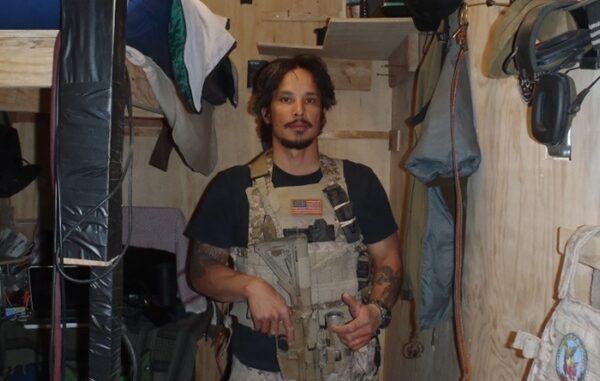
Any operator who has survived one, or multiple recycles in their special operations training pipeline can tell you that failure is a far better teacher than success. Retired U.S. Navy SEAL Dr. Reynaldo Baviera, a campaign planner with the U.S Space Force and board member at the Special Operations Association of America (SOAA), has had more of those opportunities for learning than most. Baviera’s 15-year SEAL career was preceded by three attempts to get through Basic Underwater Demolition/SEAL training (BUD/S) during his first 12 years of military service.
Baviera dove deep into each of his BUD/S experiences, and what they taught him about being prepared to lead in combat.
Round One – Are you ready to lead?
Four years after entering the U.S. Navy in 1992, Baviera was inspired to attend BUD/S by another sailor assigned to his ship who had attempted the SEAL training pipeline.
At the time, Baviera had one year left on his contract, and was unsure about whether he felt his true identity was as a service member, or the “punk kid off the street” who wanted out of the Navy. In the midst of that internal crisis, Baviera decided to go through the painstaking process of submitting a BUD/S application. By the time his BUD/S package went through Baviera’s chain of command and his Signalman detailer, it had been uniformly disapproved on account of a non-judicial punishment (NJP) he had received within two years of submitting his application.
Not to be deterred, Baviera closely examined the BUD/S application instructions and noticed that he could request a waiver for his NJP. With the waiver submitted, his second package was approved.
When he arrived at BUD/S as part of Class 209 in 1996, Baviera quickly learned that he was not prepared to do the type and extent of soft-sand running he needed in order to be successful in the course. He suffered an injury one week prior to the infamous Hell Week.
After Baviera rehabilitated from his injury, he was able to rejoin BUD/S on Day One, Week One with Class 211.
His second time around, Baviera “was strong going into Hell Week,” but decided in the midst of the grueling, five-and-a-half-day, sleep-deprived test of trainees’ mental and physical endurance that he didn’t “want to do this anymore.” Baviera rang the bell three times to signal that he quit the course.
Round Two – Again, With Experience
Soon after checking out of BUD/S, Baviera departed active duty service and joined the U.S. Navy Reserve. But a year later, he decided that he “never gave BUD/S a real fighting chance,” and submitted a second packet.
The Navy was facing funding constraints in 1999, so submitting his application required that Baviera return to active duty. With his submission accepted, Baviera began BUD/S with Class 225.
During his second attempt at the course, Baviera’s BUD/S class was under the instruction of a notoriously difficult SEAL proctor. By the time the class of 200 entered Hell Week, only 25 candidates remained, with Baviera being among them. Baviera went on to complete the Second Phase of BUD/S, and was well into Third Phase when, three weeks before graduation, he was rolled from the class on account of weapons violations.
When he joined Class 226, Baviera was rolled in at the beginning of Third Phase. Six weeks after he began, Baviera once more received a weapons violation. Because it was his second time with the same infraction, Baviera was dropped from training.
After he was dismissed from his second attempt at BUD/S, Baviera was put on light limited duty for 16 months on account of an injury he experienced during training. By the time he returned to full mobility, he applied for BUD/S a third time. When Baviera arrived at the medical office to be cleared to start the course again, the personnel looking through his medical records told him that he “should not be here.”
“I technically don’t count that third time as me going back because I never really classed up,” Baviera explained. After the disappointment, he said that he “had no intention of going back to BUD/S.”
Round Three
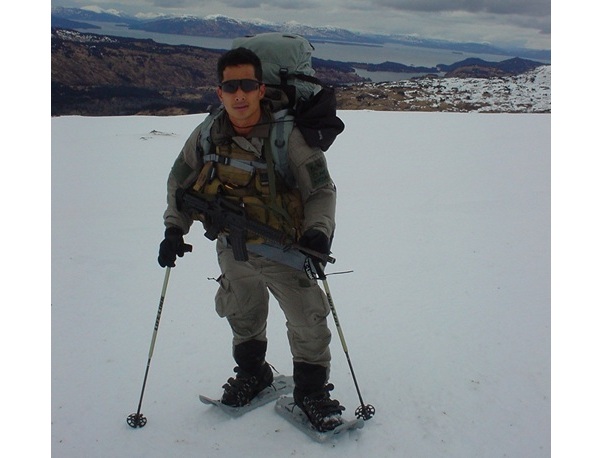
The terror attacks of 9/11 shifted the needs of the Navy. With more security forces required overseas, Baviera was sent to Italy and cross-rated from a Signalman to a Master-at-Arms (MA), a law enforcement detail.
One day, as Baviera was in the armory passing out weapons, a teammate named Chris began singing a cadence song reserved for SEAL trainees who have made it to Second Phase of BUD/S training.
Baviera said that he and Chris “became best friends” once they recognized that they had each made it through Hell Week and tried, but ultimately failed, to make it through BUD/S. Unlike Baviera, Chris was interested in trying the course once more. He proposed that he and Baviera submit another package along with several other security force personnel who had previously attempted the selection program.
Baviera initially declined. It wasn’t until he read an article in Stars and Stripes about several SEAL missions in Iraq and Afghanistan that he began to reconsider, as Baviera wondered whether some of the friends he made in BUD/S were on those missions.
When Baviera finally decided to put in a fourth BUD/S package, it was quickly denied.
Word from Baviera’s leadership was that he had gone “to BUD/S too many times,” that his job as an MA was undermanned, and that he was too old at 30 to go through the selection process again.
Once again, Baviera was not willing to take “no” for an answer. He reached out to the SEAL Scouting Team, and was put in contact via e-mail with the demanding instructor who had overseen his last BUD/S Class.
“Is this the Baviera I put through SEAL training?” the instructor asked.
After Baviera responded in the affirmative, the instructor asked what he needed to provide to make Baviera’s application a success.
Baviera resubmitted his package in November 2003 with an endorsement letter from his former instructor, who was highly regarded in the SEAL community. The SEAL detailer who had disapproved of Baviera’s BUD/S package emailed a response, telling him that if he truly wanted to return to BUD/S, he would send him to the course. “You better be ready to start in January,” the detailer said.
With the impending holidays throwing a wrench in the moving schedule, Baviera said that he “ had to jump through so many hoops to make sure that me, my wife, and our household goods would be back in the States.” He said that he “was able to get it done to the detriment of my health.”
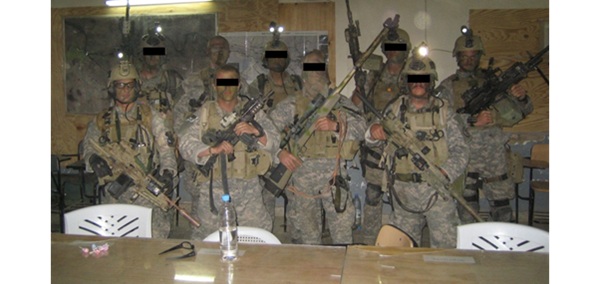
Not even sickness could stop Baviera from passing the course on his final attempt, setting him on a path to a decade and a half of service in the SEAL community, to include participating in the Battle of Ramadi with Task Unit Bruiser.
Lessons Learned
Throughout his 12-year journey to become a SEAL, Baviera learned firsthand about the importance of leadership.
His first attempt at BUD/S taught Baviera that he was mentally unprepared for a leadership role “because I was still trying to find myself.” He explained that “as a leader, you need to know who you are because you’ll need to be able to pull from your experiences. And if you’re wishy-washy, you shouldn’t be in that position.”
By his second journey through BUD/S, Baviera had overcome his struggles with identity, and his prior experiences in the course helped him advise the men around him. Though he feels he could have been an effective leader if he had made it through BUD/S on round two, the years between his second and third attempt had helped Baviera adopt a deeper internalization of the humility that accompanies true leadership.
“The new guy has to recite what is called the SEAL Salute,” he explained. In the salute, the SEAL trainee says that they have “been around the world twice,” and ends by explaining that they are “going back around again.”
A true leader, Baviera says, knows that “there’s always something you can learn again.” Even as an expert, “redoing the same thing over and over,” mastery involves “adding on and learning and getting better over time.”
That truism has served Baviera well, whether while going through BUD/S three times, taking on a civilian role at U.S. Space Force, or improving his skills as a practitioner and instructor of Brazilian Jiu-Jitsu.
**********
This article was provided by the Special Operations Association of America (SOAA). A non-profit organization, SOAA advocates for the special operations community, from the front lines to the halls of Congress. https://soaa.org/
Photos provided by Dr. Reynaldo Baviera.