
By Jim Loucks.
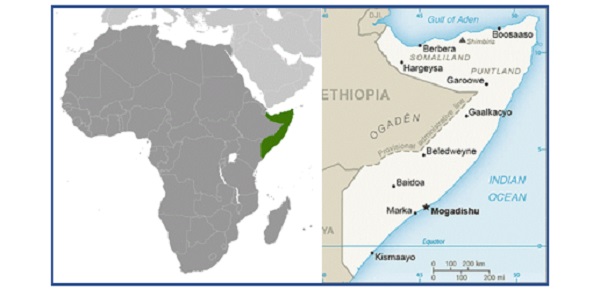
Washington spent most of two decades building a counterterrorism force in northern Somalia. A dispute between Mogadishu and Puntland took it apart in two days.
Before dawn on August 5, 2026, Puntland state forces opened fire on the Puntland Security Force (PSF) camp by the airport on the northern edge of Galkayo. Hiiraan Online reported mortar and heavy machine-gun fire, with the state forces shelling the PSF headquarters. By midday the camp was in Puntland’s hands, and President Said Abdullahi Deni was calling the assault a planned security operation. The next day Puntland took over the PSF headquarters in the northern port city of Bosaso after the force inside withdrew without a fight.
The PSF no longer holds a base in Puntland. For most of two decades it was an American partner force in northern Somalia.
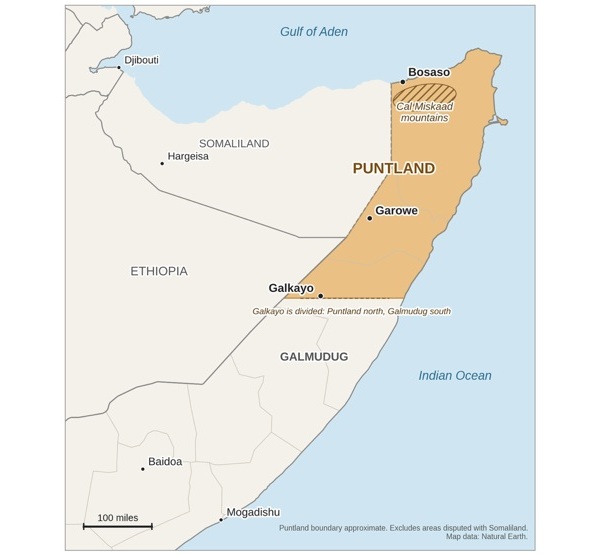
Puntland, northeastern Somalia, with the divided city of Galkayo. Map by the author, September 2026, using Natural Earth data.
Built by the CIA, Run by a Family
The force grew out of the Puntland Intelligence Service, which a 2025 study in Defense & Security Analysis says was established with the U.S. Central Intelligence Agency’s help shortly after the September 11 attacks. The service later split into an intelligence agency and the PSF, an elite counterterrorism force trained by U.S. special forces. In 2021 the Counter Extremism Project described the PSF as supplied and trained by Navy SEALs and CIA officers and considered a U.S. asset.
A 2022 Brennan Center study quotes Stephen Schwartz, a former U.S. ambassador to Somalia, saying the United States built the force. According to the study, CIA officers recruited, trained, and paid its fighters for about a decade before handing the force to the Pentagon, and its roughly 600 fighters then reported directly to the Department of Defense. The Pentagon ran the PSF under Section 127e, an authority that let U.S. special operations forces train, equip, and pay the force and direct it against targets the United States chose. That set it apart from the Danab brigade, which drew State Department peacekeeping funds and Pentagon train-and-equip money as part of the Somali National Army.
On September 28, 2016, U.S. forces conducted what U.S. Africa Command called a self-defense strike in Galkayo at the request of a PSF patrol under attack. A Pentagon investigation later found that the 10 people killed were members of a regional force from Galmudug, the state that shares Galkayo with Puntland, and an ally of the United States. Galmudug’s security minister said at the time that Puntland had misinformed the Americans.
The PSF’s cost has never been published. Brown University’s Costs of War project totaled $2.5 billion in disclosed U.S. counterterrorism assistance to Somalia since 2007 but could not include intelligence or special operations spending, which the government does not disclose. A congressional staffer told the project that even U.S. officials do not know the full total, and that finding out would take an act of Congress.
It was also a family enterprise. Vice News reported in 2022 that the Diyaano family ran the force for three generations. First was Osman Abdullahi Diyaano and then his two sons. Asad Osman Abdullahi Diyaano led the PSF from 2010 to 2018, when his brother Mohamud took command. Asad ran for Puntland’s presidency in 2019 and lost to Deni. In September 2024 the federal cabinet made him commissioner of the Somali Police Force, the post he still holds.
After the Americans Left
The American military left Somalia in January 2021. The withdrawal left the force without Pentagon guidance or salaries for the first time in its history, according to the Brennan Center. Sahan’s Somali Wire reported that U.S. support finally ended in October 2021, when U.S. Special Operations Command Africa handed the PSF’s equipment directly to the Diyaano family, through whom Washington had long paid the force’s weapons, salaries, and ammunition. That November, Deni fired Mohamud Diyaano. The PSF refused the order, and in December the two sides fought in Bosaso. Vice found that U.S.-made weapons supplied to the PSF were used in the fighting. Reported death tolls range from at least seven to 22 or more. Elders mediated, and Deni reinstated Mohamud in March 2022.
Omar Mahmood of the International Crisis Group told Vice that outside actors in Somalia often set out to build institutions and end up backing individuals instead. After the Americans left, the PSF followed its commanders, and its commanders’ politics leaned toward Mogadishu.
Mogadishu Takes Over the Payroll
In October 2024, the federal government announced that the PSF had been fully integrated into the Somali National Army, with Mogadishu taking over its salaries, equipment, and leadership. Puntland has consistently held that the PSF is not part of its defense structure and has rejected federally registered units operating inside the state without its consent.
The dispute turned military this summer. In mid-June the federal government appointed a commander for the army’s 54th Division, based in Garowe, Puntland. Critical Threats noted it was the first time that Mogadishu had named a divisional commander in Puntland on its own under the current federal framework. Puntland rejected the appointment, barred federal officials from the state, banned federal military recruitment, and restricted movement of federal-aligned forces between Garowe, Galkayo, and Bosaso. In early July the federal prime minister and interior minister said recruiting in Puntland would go ahead regardless. Mogadishu had used force against two other member states in the previous year. In late July 2025, federal troops took a border town in Jubaland’s Gedo region, next to Kenya, after six days of fighting with Jubaland’s forces. In March 2026, the army seized Baidoa, the South West State capital about 150 miles northwest of Mogadishu, and its president resigned.
On July 20, Puntland’s regular state forces, known as Darawish, fought PSF units north of Bosaso. Puntland said its forces seized 13 military vehicles and captured 30 PSF members. By the end of July, state forces had surrounded the PSF camp at Galkayo.
The Fall of Galkayo
Galkayo is a divided city. Puntland administers the north and Galmudug State the south. On August 4 a federal shipment of ammunition and uniforms was flown into the Galmudug side, bound for the Puntland side. Clan militiamen seized it, Galmudug security forces moved to recover it, and at least seven people were wounded. The Somali Digest reported that the cargo included mortar rounds for the PSF camp. Puntland’s presidency praised Galmudug’s forces and residents for stopping the shipment, though local reporting has Galmudug police escorting the trucks. By then, many of the camp’s personnel had already surrendered and supplies were running low.
The assault came the next morning. Deni said the camp was where the federal government had been moving weapons, equipment, and troops to undermine Puntland. Puntland police said they arrested 101 people and took 60 wounded into custody. Among those arrested were Giijaale Abdi Baidoa, identified as the PSF’s Galkayo commander, and officers accused of helping the federal government register recruits from the surrounding region. Residents said that the fighters who got out withdrew to the Galmudug side of the city.
On August 6 Puntland took over the Bosaso headquarters after the withdrawal that was negotiated through clan elders. Puntland gave the remaining federal-aligned forces 48 hours to surrender or join the state forces, and elders from three regions opened talks to head off fighting at the remaining bases. The Garowe commentator Ismail Warsame wrote that federal-aligned forces at one smaller base withdrew, and that those holding camps north of Galkayo abandoned them and moved south. On August 15 another federal-aligned group in the northeast agreed to join Puntland’s forces after mediation by local elders and politicians. On August 17, a brigade of about 700 soldiers at Ligle camp outside Garowe, on federal pay for nearly a year, began registering with Puntland after elders brokered its return.
What the PSF Leaves Behind
The fight against the Islamic State in the Cal Miskaad mountains goes on. Horseed Media reported new operations there on September 3. Puntland’s state forces have carried that campaign with U.S. and Emirati airstrikes in support, and in November 2025 U.S. special operations forces conducted a raid in the range alongside Puntland counterterrorism forces. Some coverage credits the campaign to the “Puntland Security Forces,” a loose label for the state’s forces generally. The PSF, outside the state’s command structure by 2024, was not the force in those mountains.
The United States now works in Puntland with the state forces that took the PSF apart. On August 2, three days before the Galkayo assault, a delegation led by Africa Command met Deni in Bosaso. Afterward Puntland’s State House announced that the United States would expand its base there.
Donors have worked around the federal-state divide for years. Mogadishu does not control large parts of the country, and in my experience assistance planners end up dealing with the member states directly where the federal government cannot deliver. That approach produced the partnership in the Cal Miskaad mountains. It also leaves a unit built outside any state structure, as the PSF was, without a political owner once the donor steps back.
For anyone building partner forces in Somalia, a unit’s training and equipment may matter less than who pays it and whom it answers to once the donor leaves. The PSF answered to its commander, and its commander answered to Mogadishu. Puntland state settled the question in two days in August.
**********
Jim Loucks spent seven years supporting the State Department’s counterterrorism programs from Mogadishu and Nairobi, and nine years in Somalia and Kenya overall. He writes The CT Conundrum on Substack.
Top image: Derived from CIA maps.