
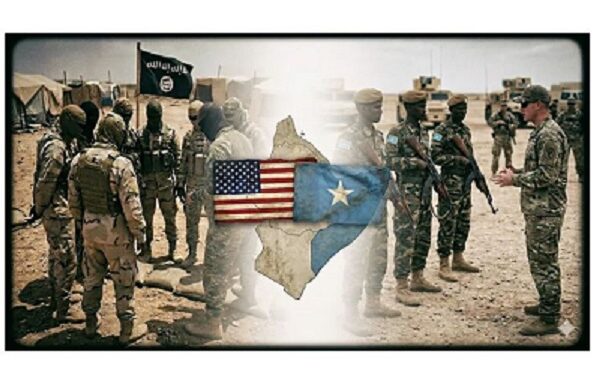
The argument that America can secure its borders without securing East Africa misunderstands how the threat travels.
By Jim Loucks.
(abstract, full article at link below)
President Trump’s September 30, 2025 statement dismissing U.S. engagement in Kenya and Somalia as policing “the far reaches” of foreign countries signals a decisive shift in defense priorities — one that prioritizes border enforcement over forward engagement and frames the two as mutually exclusive. They are not.
Al Shabaab is Al Qaeda’s largest, wealthiest, and deadliest affiliate, generating over $150 million in annual revenue and governing a quarter of Somalia’s district capitals through a functioning shadow state. It is not a contained regional insurgency. The 2013 Westgate Mall siege, the 2014 suicide bombing in Djibouti targeting Western military personnel at a facility adjacent to Camp Lemonnier, the 2015 Garissa University massacre, the 2019 DusitD2 attack that killed a U.S. citizen, the 2020 Manda Bay attack against U.S. and Kenyan forces, and a 2022 cross-border incursion that left up to 1,000 fighters embedded in southern Ethiopia are not discrete incidents. They are a trend line of expanding geographic reach.
Most critically, Al Shabaab has demonstrated direct intent to strike the U.S. homeland. In 2024, a Kenyan national was convicted in federal court for conspiring — at the direction of a senior Al Shabaab commander — to crash a commercial aircraft into a U.S. building, having spent two years training at a flight school in the Philippines for that purpose.
The U.S. forward presence in East Africa employs the By, With, Through (BWT) model — advising and enabling Somali and Kenyan partner forces rather than conducting large-scale unilateral operations. It is low-cost, high-return, and the upstream security measure most likely to prevent East Africa-linked threats from completing the South American transit routes through which they approach U.S. borders. Known or Suspected Terrorist encounters at U.S. borders rose from 15 in fiscal year 2021 to 169 in fiscal year 2023. These are the needles in the haystack. A border-only strategy cannot find them without prior intelligence developed far upstream.
The appeal of the isolationist impulse is understandable. Two decades of costly interventions have left Americans skeptical of foreign military commitments. But Al Shabaab is not Iraq or Afghanistan, and the BWT mission is not a war. Dismantling it doesn’t extinguish the threat. It removes the warning.
Read the full analysis at The CT Conundrum on Substack:
https://thectconundrum.substack.com/p/the-new-isolationism-why-ignoring
Jim Loucks is a former U.S. counterterrorism advisor and career law enforcement professional with ISAF service experience, based in Nairobi, Kenya. He publishes The CT Conundrum at thectconundrum.substack.com.