
By the Special Operations Association of America.
About two months after a fruitful May meeting between Chinese President Xi Jinping and President Donald Trump offered a veneer of geniality between the People’s Republic of China (PRC) and the U.S., tensions are beginning to emerge. Nearly a week after the U.S. began to implement restrictions on defense purchasing from companies associated with the Chinese military, the PRC launched a nuclear-capable ballistic missile from a nuclear-powered submarine. China’s launch was widely interpreted as a demonstration of Chinese second-strike capabilities, and the PRC’s lack of proper advance warning of the launch earned condemnation from countries around the world.
The launch was also a stark reminder of the military capabilities that underlie the PRC’s unrestricted warfare campaign, which Special Operations Association of America (SOAA) board member and retired U.S. Army Colonel Edward Croot described in April as a “deniable, whole-of-government policy of leveraging economic, diplomatic, legal, and information tools to diminish and erode U.S. influence.”
Croot says that the Chinese launch “is a classic PRC attempt to mask unrestricted warfare tenets of surprise, deception and inducing complacency in the information space.” He calls for the U.S. to continue “unifying the global condemnation” of the PRC’s behavior, which marks “an escalation” over prior military activities.
Military Moves
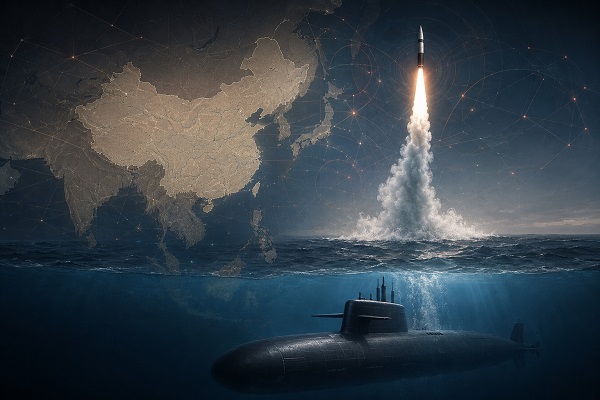
On July 6, China launched a submarine-launched ballistic missile (SLBM) with a simulated nuclear warhead from a nuclear submarine.
The Center for Strategic and International Studies (CSIS) noted that the missile was likely a JL-2 or JL-3 model, which are both capable of accomplishing the 7,300 km flightpath that saw the warhead land in the South Pacific Nuclear Free Zone. The missile’s flight distance is at the max range for the JL-2’s capacity. The JL-3 model, introduced last year, can reach up to 10,000 km.
Chinese media stated that the test was conducted as a “routine part of China’s annual military training program” and had “notified in advance” relevant countries. However, the Hague Code of Conduct against Ballistic Missile Proliferation (HCOC) requires countries to give at least 24 hours’ notice to each of 140 member states, which should include “information about the launch area, direction of launch, and the general class of missile being tested.” China gave “mere hours” of notice of their launch to the U.S. and Japan, and gave Australia about 23 hours of notice. Notably, China has not subscribed to the HCOC.
Japan, Australia, the U.S., New Zealand and France have publicly expressed their disapproval with the PRC’s notifications and “publicly condemned China for not following the proper code of conduct.”
Croot says that “the late notification by the PRC is a textbook unrestricted warfare technique of international law manipulation.” He believes that with time the PRC “will continue to shorten the notification timelines, and explain away in the public information domain, until something tangible is done by the global international rules-based community.”
The Rationale for the Exercise
The PRC’s SLBM launch demonstrated that the Chinese possess the ability to strike back with a nuclear weapon even if the mainland comes under devastating nuclear attack.
Additionally, CSIS analysts believe that the launch “showcase[d China’s] resolve and frustration at U.S. allies and partners.” In July, Fiji and Australia signed a defense alliance in which both countries promised to “act to meet the common danger” if the other were attacked.
Recent military exercises may have also stoked PRC ire, including the Australian army’s Exercise Southern Jackaroo and the U.S.-run Rim of the Pacific (RIMPAC) naval exercises, which involved more than two dozen U.S. allied and partner nations.
Croot notes that “the PRC does nothing by accident. This demonstration is their version of ‘integrated deterrence’ against recent Australian and Fijian alliance activities” and joint military exercises, he explained. According to Croot, the PRC’s demonstrated willingness to use its latest capability sets “a very dangerous precedent with a very dangerous capability that should be viewed as a red-line by the U.S. and our allies.”
The 1260H List Goes into Effect
About a week prior to the Chinese launch, efforts were increased to remove companies linked to the Chinese military from American defense supply chains. As of June 30, 2026, the Defense Department is prohibited from extending, renewing, or entering contracts for goods, services, or technology with entities that the Pentagon deems as Chinese military companies.
The list of restricted companies, known as the Section 1260H list, is updated annually and was expanded in 2026 to include subsidiaries and affiliates of companies known to be linked to the Chinese military. Included is Chinese company Alibaba, which has filed suit against the Pentagon in response to its designation.
At present, contractors can request a waiver to continue operating with entities on the 1260H list. The process for receiving a waiver involves providing a rationale about why a contractor needs additional time to comply with requirements, and presenting a plan for ceasing to work with banned companies. Further restrictions are set to arrive in 2027, when the Defense Department will be forced to stop doing business with companies that are indirectly linked to the firms on the 1260H list.
Companies added to the 1260H list face an increased risk of being added to the Office of Foreign Assets Control’s Non-SDN Chinese Military-Industrial Complex Companies List, which would keep American investors from trading in those companies.
They also are at greater risk of being added to the Military End User List, or the Department of Commerce Bureau of Industry and Security Entity List, which increases the difficulty of gaining export licenses.
Croot calls on “each and every U.S. government partner” to “use their unique authorities and capabilities to their maximum capacity and punish companies like Alibaba thoroughly and widely.”
Next Steps
Following the PRC’s military posturing, Seth G. Jones, President of the Defense and Security Department and Harold Brown Chair at CSIS, addressed Congress on July 21 about the threats posed by China’s irregular warfare campaign, which is conducted both within the U.S. and around the globe. Jones told lawmakers that he does not believe the U.S. has “a comprehensive strategy, either at the federal level, or just talking last week to members of some of our joint terrorism task forces and fusion centers, where there is little activity at the state and local level to understand and operationalize the threat from unrestricted warfare happening, particularly by the Chinese but also the Russians and Iranians inside our borders.”
Croot, who raised alarms about Chinese citizens’ land ownership near strategic U.S. nuclear sites in March, agrees with Jones’ assertion. “My concern is we aren’t even responding to their open activities, let alone recognizing them ahead of time and gaining initiative by acting now,” he elaborated.
To do so requires “taking meaningful action against the PRC,” particularly as it demonstrates escalating nuclear capabilities, Croot argues.
**********
This article was provided by the Special Operations Association of America (SOAA). A non-profit organization, SOAA advocates for the special operations community, from the front lines to the halls of Congress. https://soaa.org/
Image created by ChatGPT.