
Curated news, analysis, and commentary on special operations, intelligence, irregular warfare, national defense, and global conflicts.
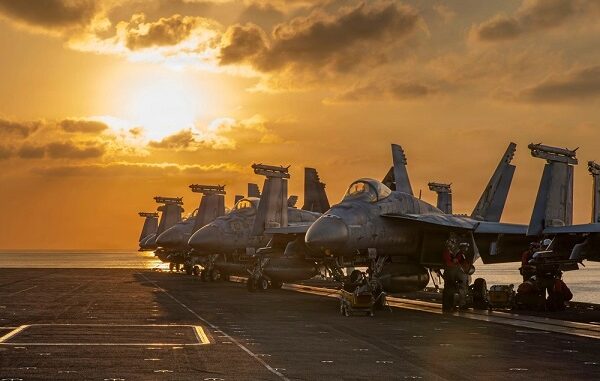
Photo / Image: Aircraft is staged for flight operations on the flight deck of Nimitz-class aircraft carrier USS Abraham Lincoln (CVN 72) in support of Operation Epic Fury, Mar. 3, 2026. (U.S. Navy photo)
Executive Summary
This weekly briefing summarizes developments in special operations forces (SOF), global conflicts, intelligence, and national security from the past week. Iran continues to attack U.S. forces in the region in an effort to stop the United States from undermining Iranian efforts to control the Strait of Hormuz. The U.S. is retaliating with strikes of its own on Iranian military targets. Unmanned systems continue to significantly affect military operations in the Persian Gulf and Ukraine. Strikes deep into Russia are disrupting the oil and gas supplies and the supply lines to Crimea are being successfully interdicted. AI is playing an increasingly important role in U.S. military operations and affairs.
Do you receive our daily newsletter? If not, you can sign up here and enjoy it 2 or 3 times a week with your morning coffee (or afternoon tea depending on where in the world you are).
Key Outlooks
- The Iran-U.S. conflict continues with tit-for-tat exchanges of strikes
- “Bull” Simons Award presented to former Navy SEAL
- “Gray Zone” in the maritime domain
- Reports on psychedelics and veterans
- Calendar of upcoming SOF events
SOF News
SOF and Allostatic Load. The combination of psychological, physical, and cognitive impacts on the body can lead to an accumulation of stresses known as allostatic load. This condition can impede SOF personnel’s ability to recover and deploy as an effective part of a unit. It has also been linked with cardiovascular disease, rapid aging, psychological disorders, physical and musculoskeletal dysfunction, and other medical conditions. Read more in “Service at the Tip of the Spear Takes a Toll”, Special Operations Association of America, June 24, 2026.
Technology Could Change SOF Culture. “This article, written by JSOU President Dr. Paul Brister, argues that emerging technologies are transforming SOF in ways that could fracture their shared identity, splitting them between “hyper-heroic” operators who perform dangerous, human-only missions and “anti-heroic” operators who conduct warfare remotely. It explains that this divide challenges the traditional SOF warrior ethos and warns that this technological bifurcation may create deep institutional, cultural, and strategic tensions, raising questions about whether SOF can sustain both models of warfare under a unified identity.” “The Warrior vs. The Algorithm: How Technological Adoption May Fracture the SOF Culture”, Joint Special Operations University (JSOU), June 25, 2026.
Alamo Scouts and Today’s SOF. The U.S. military (and SOF) has been shifting focus from COIN and CT to great power competition (also called strategic competition). The conventional force are embracing the ‘big battle’ – large forces on the battlefield facing off against each other. How does Special Forces fit into large scale combat operations (LSCO)? The answer could be found in the history of the Alamo Scouts of World War II. This was an Army special operations unit that operated in the Pacific that conducted special reconnaissance, deep sensing, partner force liaison, and direct action missions to support conventional forces and the theater campaign. “The Joint Force in the Jungle: The Alamo Scouts Blueprint for Special Forces in Large Scale Combat Operations”, Special Warfare Journal, June 15, 2026.
“Bull” Simons Award Presented to Navy SEAL. This year’s award (2026) was presented to retired Navy Captain Frank K. Butler who served as a Navy SEAL officer and Navy physician during his 30-year military career. “SOCOM Presented its Highest Award to Navy SEAL for the First Time”, SANDBOXX News, June 25, 2026.
CIWAG Maritime Symposium. David Maxwell, a retired SF officer, provides an overview of the Center for Irregular Warfare and Armed Groups (CIWAG) Maritime Symposium held last week in Newport, Rhode Island – home of the Naval War College. Maxwell argues for more writing on irregular warfare and related topics and provides ten writing challenges. Small Wars Journal, June 29, 2026.
SF and Unmanned Systems. Maj. John Kowalski puts forth the argument that the rapid advance of technology and unmanned systems has changed how USASOC’s Special Forces teams will need to operate in future conflicts. He argues that an unmanned systems NCO should be added to the ODA task organization and that the Remote Unmanned Systems Integration Course (RUSIC) at Fort Bragg should be turned into a center of excellence (COE). The integration of UXS into ODAs will ensure ARSOF is postured to support joint operations and deliver strategic effects in future strategic competition through unconventional statecraft, maritime trade warfare, and distributed maritime operations. “Unmanned Systems and Army Special Forces”, Army University Press, May-June 2026 (Military Review).

Wu Wei and SOF. Fabio Gomes writes on how the powerful concept of wu wei can add precision, timing, and deep situational awareness to decision-making in high-pressure environments. He proposes a strategic framework that highlights the importance of perception over overt intervention. “Fighting Without Fighting: Wu Wei and Strategic Conduct in Special Operations”, Joint Special Operations University Press, June 17, 2026.
IW: More Than Just SOF. MAJ Joshua R. Hall, a student at the Command and General Staff College, writes on how irregular warfare is not just a function of special operations forces. He argues that conventional forces (CF) have conducted IW in the past – with and without SOF. Hall believes that Congress should require close coordination between both SOF and CF to ensure their respective capabilities are integrated and their efforts are synchronized. “Irregular Warfare is More Than Just SOF”, Line of Departure, May 29, 2026.
Fitness Center Dedicated to 10th SFG(A) Soldier. U.S. Army Garrison Wiesbaden officially renamed its fitness center on Clay Kaserne on Saturday, June 27, to the “Master Sergeant Michael B. Riley Fitness Center,” honoring a fallen U.S. Army Green Beret who gave his life in service to the nation. “Honoring one of their own: Garrison Wiesbaden dedicates Fitness Center to MSG Michael B. Riley”, U.S. Army, June 27, 2026.
SOCAFRICA Cdr Visits Nigeria. The U.S. has a defense partnership with Nigeria in confronting extremist groups operating in the region. The commander of Special Operations Command Africa, Major General Cluade Tudor, visited Nigeria this past week with the aim to strengthen the existing security cooperation and strategic partnership between Nigeria and the United States. U.S. SOF has been assisting the Nigerians in the conduct of Operation HADIN KAI. The operation is the Nigerian Armed Forces’ primary joint counterinsurgency campaign against Boko Haram and its splinter faction, Islamic State West Africa Province, in northeastern Nigeria and the broader Lake Chad Basin. (Sahara Reporters, June 26, 2026)
3rd SFG(A) Supports Red Flag in Alaska. Green Berets from the 3rd Special Forces Group (Airborne) are taking part in Red Flag – Alaska, an exercise conducted by the Air Force. The SF soldiers were taking part in Operation Close Shave – the ground component of the Air Force exercise. The SF team had the mission of infiltrating into enemy territory to identify threats, gather intelligence, and create conditions to allow aircraft and paratroopers to operate in the battlespace. “Silent Professionals Set the Conditions for Red Flag Success”, DVIDS, June 24, 2026.
7th SFG(A) CoR Ceremony. Soldiers from the Red Empire gathered in the Liberty Chapel to bid farewell as Command Sgt. Maj. David Angle, the outgoing senior enlisted advisor of 7th Special Forces Group (Airborne), or 7th SFG(A), relinquished responsibility to Command Sgt. Maj. Henry Adames at a ceremony on Eglin Air Force Base, Florida, June 26, 2026. “7th SFG(A) honors legacy with change of responsibility”, U.S. Army, June 26, 2026.

SOF History
On July 2, 1959, detachments of the 77th Special Forces Group began Project HOTFOOT in Laos. Special Forces personnel, wearing civilian clothes and assuming the role of contracted civilian technicians, trained Laotian Armed forces units on U.S. weapons and individual soldier skills. At the time, Laos was a Cold War ‘hot spot’ facing threats from the Communist Pathet Lao and North Vietnamese Army troops operating inside Laos. https://en.wikipedia.org/wiki/Project_Hotfoot_(Laos)
On July 4, 1968, The Green Berets, a film loosely based on a book by Robin Moore, was released starring John Wayne as a Special Forces colonel in Vietnam and David Janssen as a newspaper correspondent who questioned the war’s wisdom. Much of the film was shot in the summer of 1967 (before the Tet Offensive).
On June 30, 1972, the 8th SFG (A) was redesignated as the 3rd Bn 7th Special Forces Group (Airborne), in Panama.
On June 29, 1990, the 3rd Special Forces Group (Airborne) was reactivated to cover Special Forces operations in EUCOM’s African region.
On June 28, 2005, Operation Red Wings took place in Afghanistan. A four-man SEAL reconnaissance team was inserted into a remote Afghanistan mountain range to observe a Taliban outpost with a high-value target. The team was compromised and quickly surrounded by a much larger enemy force. A quick reaction helicopter was dispatched with Navy SEALs to rescue the four-man team but was shot down. Three members of the reconnaissance team were killed and all members of the Quick Reaction Force (QRF) on the “Night Stalkers” MH-47 Chinook helicopter were killed. The mission was one of the deadliest single-day losses in U.S. Special Operations history.

National Security and Commentary
CRS Report – The U.S. Marine Corps Marine Littoral Regiment (MLR). In 2020, the U.S. Marine Corps announced a major force design initiative referred to as “Force Design 2030”. The concept was to place more emphasis on naval expeditionary warfare and the plans included the establishment of three Marine Littoral Regiments or MLRs. Two MLRs have been established but plans for a third MLR have been sidelined. In addition, the Navy is ditching its plans for the acquisition of the Navy Medium Landing Ship (LSM) that would support the MLRs; instead opting for a commercial replacement. The Congressional Research Service (CRS) has published an update to the MLR program in IF12200, June 25, 2026.
U.S. Army’s Space Operations Branch. In June 2026 the U.S. Army announced it has established its newest branch to meet the challenges of modern, multidomain warfare. The new branch brings together Army Space Operations officers and enlisted Tactical Space Operations Specialists into one branch. Read more in “US Army Establishes Space Operations Branch to Enable Multidomain Dominance”, Soldier Systems, June 26, 2026.
Revolutionary Warfare. Moe Gyo, a writer and consultant working with ethnic organizations in Myanmar, explains the visions of Mao Zedong, Vo Nguyen Giap, and Che Guevara. Each of their visions represents a different dimension of insurgent warfare. He believes that examining the relationships between these dimensions allows for a broader understanding of how revolutionary movements evolve. “Revolutionary Warfare in Three Visions”, The Resistance Hub, June 2026.
Psychedelics and Veterans. There is a growing movement calling for expedited medical research into the effectiveness of psychedelic treatments for use in mental health care. Supporters believe that psychedelics can be used to support veterans with post-traumatic stress disorder (PTSD), traumatic brain injury (TBI), depression, and substance dependency. One of these hallucinogens is Dimethyptamine (DMT). Read more in “What is DMT, and How Can it Help Veterans?”, Special Operations Association of America, June 26, 2026. Here is another article on the same topic: “What is Psilocybin, and How Can it Help Veterans?”, Special Operations Association of America, June 15, 2026. See also a recent report entitled U.S. Veterans and Psychedelics, by RAND Corporation, June 23, 2026, PDF, 28 pages.
Army Magazine. The June 2026 issue of the monthly journal by the Association of the United States Army (AUSA) is now online. It has several articles of interest on drones, killer robots, armored vehicles, and book reviews.
https://www.ausa.org/issues/army-magazine-vol-76-no-6-june-2026
Military Review. The May/June 2026 issue is now online with several interesting articles.
https://www.armyupress.army.mil/Journals/Military-Review/English-Edition-Archives/May-June-2026/
Venezuela Aid. U.S. military assets have been assisting in providing aid to Venezuela in the wake of two devastating earthquakes that has left thousands dead and many more homeless.

Iran War and Operation Epic Fury
Over the past few days Iran continued to attack the U.S. and its allies in the region; the intent is to stop the U.S. from undermining the Iranian intent to control the Strait of Hormuz. Iran has attacked U.S. installations in Kuwait and Bahrain. The U.S. has attacked Iranian communications, air defense sites, mine-laying capabilities, and other military targets. As of Sunday night both the U.S. and Iran have reportedly agreed to stop attacks and meet Tuesday in Doha, Qatar to resume talks. The discussions have shifted from Switzerland to Qatar.
SoH: Control by Iran. One of Iran’s primary objectives in the current negotiations is to secure its sovereignty over the Strait of Hormuz. This objective is more important for Tehran than securing fees from merchant vessels as they transit the Strait. “How Iran Hopes to Control the Strait of Hormuz: It’s Not Just About Fees”, Understanding War, May 23, 2026.
Ten Takeaways from Iran War. One of the biggest lessons of the current war with Iran is that adversaries do not need to defeat Western forces outright if they can make the surrounding political-economic system absorb unsustainable pain. The Iran War offers ten broader lessons for irregular warfare and strategic competition. , by Neda Bolourchi, Modern War Institute at West Point, June 22, 2026.
Mines in SoH. According to the UN’s International Maritime Organization (IMO) the Strait of Hormuz has about 80 mines in its historic shipping lanes. The mines are thought to be deployed in the middle corridor – known as the Traffic Separation Scheme. Two alternative shipping channels through Hormuz are available. One is a Tehran-controlled lane that veers closer to Iran; the other is one that hugs Oman’s coast and is coordinated by the U.S. The UK and France are formulating plans to lead a multinational mine-clearing mission in the strait. “IMO Estimates There Are 80 Mines in Hormuz’s Shipping Lanes”, gCaptain, June 26, 2026.
- References for Epic Fury:
- Past SOF News posts on Epic Fury, Epic Fury Timeline, Iran Country Profile, Strait of Hormuz, Kharq Island, maps, ISW interactive map, OEFU Casualties, and CRS reports.

Ukraine Conflict
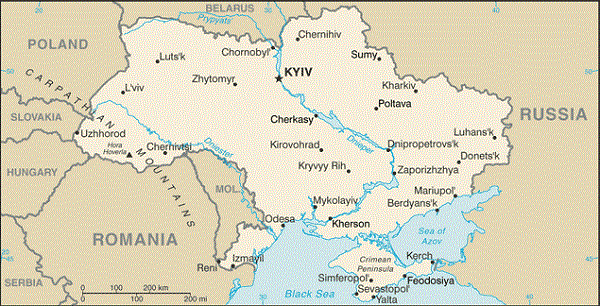
Ukraine War Longer than WWI. In June, the war in Ukraine has surpassed the first World War in duration. World War I was over 1,500 days long. The Russian invasion of Ukraine, what Putin had described as a “three-day special military operation” has now gone on longer than the first World War; costing Russia over 500,000 dead and many thousands more severely wounded.
Ukraine’s Deep Strike Capability. Ukrainian missiles and drones continue to strike oil refineries deep inside Russia. This has left Russia with serious gasoline shortages. It now is unable to meet the internal domestic demand and seems about to begin to import gasoline from Asia.
Russia’s Supply Lines Under Attack. A new generation of Ukrainian mid-range drones is severely disrupting the Russian military’s supply lines to the southern front lines, striking bridges, trains and fuel trucks – and giving Kyiv a chance to derail Moscow’s plans for a summer offensive. “No fuel, no weapons: How Ukraine’s new drone strategy is mauling Russian supply lines”, CNN World, June 21, 2026.
Crimea. Ukrainian forces have destroyed a third railway bridge that connects to Crimea. The Ukrainians have damaged the rail lines connecting Crimea to the mainland causing severe logistical problems.
- References:
- Weapons of Ukraine, Study of War Daily Report, Euromaiden Press Daily Report, Ukraine NGO Coordination Network (UNCN).
- Maps: Russia’s Invasion of Ukraine by the Institute for the Study of War and Critical Threats, Ukraine Maps by National Security Info, War in Ukraine by Scribble Maps.

Intel, IO, Cyber, AI, IW, Technology
Firings at ODNI. The new acting director of the Office of the Director of National Intelligence, a Trump ally with no national security experience, began firing workers at the beginning of last week. The past director, Tulsi Gabbard, had already taken an axe to the organization over the past year. The organization has oversight on 18 different U.S. intelligence organizations.
AI as a Higher HQs in Exercises. Large Language Models (LLMs) can revolutionize simulations by acting as a virtual Higher Headquarters. This would enable units at echelon to increase staff proficiency at the pace and convenience of their own schedule without impacting adjacent or higher organizations. This article outlines the findings from a two-week practicum involving 61 students representing the 25th Infantry Division staff during a simulation exercise. This exercise demonstrated that when properly resourced, AI can serve as a powerful cognitive partner, bridging the gap between limited human resources and the complex demands of a Division-level simulation. “AI as a Higher Headquarters”, by Thad D. Weist, Small Wars Journal, June 26, 2026.
AI and Humans. Thomas Mulligan argues that the human spy will not be done away with the use of artificial intelligence. While he acknowledges that AI will be an indispensable tool for case officers, agents, and others in the intelligence world; he also says this will also increase the importance of old-fashioned human intelligence. “Why Human Intelligence Matters More in an AI World”, The CIPHER Brief, June 17, 2026.

Strategic Competition
“Gray Zone” in the Maritime Domain. While strategists debate carrier strike groups and hypersonic missiles, the actual gray zone competition is being won or lost in fishing harbors, port inspection offices, and coast guard patrol boats. There are six counterintuitive findings that challenge military conventional wisdom about gray zone competition in the maritime domain, with immediate implications for U.S. security cooperation and small-state defense planning. Small-state defense planners should understand that gray zone competition does not require capabilities you cannot afford. They should focus on what they can sustain: governance, legitimacy, and persistence. “Beyond Blue Water: Gray Zone Lessons from Small Island Nations”, by Ahmed Rasheed and Thomas A. Crowson, Small Wars Journal, June 26, 2026.
Failure of the Tibetan Resistance. LTC Phillip J. McCormick, a U.S. Army information operations officer, writes on why the Tibetan resistance of the late 1950s failed. While it had many of the ingredients associated with a successful insurgency, it failed to produce lasting military or political success. “No Sea for the Fish: Religion, Violence, and the Failure of the Tibetan Resistance”, Small Wars Journal, June 24, 2026.
CRS Report – Taiwan: Defense and Military Issues. The Congressional Research Service has updated its report on the Taiwan’s security situation, PRC “Gray Zone” activities targeting Taiwan, U.S. support for Taiwan’s defense, U.S. strategy and policy, and more. CRS IF12581, updated June 18, 2026.
SOF News welcomes the submission of articles for publication. If it is related to special operations, current conflicts, national security, or defense then we are interested.
SOF News Book Shop

View our selection of books about special operations forces at the SOF News Book Shop.
Upcoming Events
July 3, 2026
Land of the Free at the Hotel del Coronado
C4 Foundation
Coronado, CA
July 11, 2026
Songwriters Behind the Headlines
Big Sky Troubadours benefiting the Special Operations Warrior Foundation (SOWF)
Whitefish, Montana
July 21-22, 2026
Critical Minerals & Rare Earth Elements Conference
Reston, Virginia
IWI and SOAA
July 24, 2026
Production: 11 Days
Task Force Pineapple
Southern Pines, NC
July 25, 2026
27th Annual Delphinus Engineering Allen Stone Braveheart Memorial Races
Navy SEAL Foundation
Virginia Beach, VA

SOF News is not a ‘money making’ enterprise; but we do have administrative, operating, and publishing expenses. Individuals and businesses provide the funds to defray these expenses. Their contributions are deeply appreciated. Learn how you can support SOF News.
