
Story by Taha Khan.
An AFT score and the promotion points it earns are two different numbers. Since replacing the ACFT on June 1, 2025, the Army Fitness Test has used five events worth up to 500 points altogether. Soldiers preparing a promotion packet first need to check their results against the AFT scoring tables. Once the total is correct, they can work out how many promotion points that test is worth.
Reading the AFT Scoring Tables
An AFT score is calculated by matching each event’s result to its relevant scoring column and then adding those five even scores. The five events include:
- 3-repetition maximum deadlift
- Hand-release push-up
- Sprint-drag-carry
- Plank
- 2-mile run
The Army uses two standards: General scoring depends on age and sex, while Combat scoring depends on age but uses the same scoring column for men and women.
Under the Army’s AFT requirements, an ordinary five-event test needs at least 60 points in every event, with 300 overall for General or 350 for Combat.
The tables show M/C and F columns within each age group. M/C applies to male General scoring and to Combat scoring for either sex, while F applies to female General scoring.
So, the age group and applicable standard must be established before looking up a result, because another Soldier’s score for the same performance may come from a different column.
A Worked Scoring Example
For a 25-year-old Soldier using the 22–26 M/C column, the following results produce 371 points. These values come from the official AFT scoring scales, effective June 1, 2025.
| Event | Recorded result | Points |
| Three-repetition maximum deadlift | 240 pounds | 79 |
| Hand-release push-up | 39 repetitions | 82 |
| Sprint-drag-carry | 2:30 | 60 |
| Plank | 2:30 | 80 |
| Two-mile run | 18:23 | 70 |
| Total | 371 |
Adding 79 + 82 + 60 + 80 + 70 gives 371. All five events meet the minimum, and the total clears both General and Combat scoring requirements.
But the table doesn’t award points evenly. For example, in the 22–26 M/C column, a 240-pound deadlift earns a Soldier 79 points, while a 250 lbs. deadlift earns them 81 points without any 80-point threshold separating them.
For the sprint-drag-carry, 2:31 of recorded time earns 60 points and a 2:26 finish time earns 61 points, so even if a soldier finishes in 2:30, they still earn 60 even though it’s faster than the minimum. That’s because they have not reached the next scoring threshold.
Choosing the nearest row or estimating a point value halfway between two entries can produce an incorrect score.
Event Minimums and Passing Standards
Besides the total, individual event scores matter as well, meaning an overall high score can still result in failing the test.
For example, getting scores of 85, 80, 80, 80, and 50 in the five events totals 375, but the 50-point event falls short of the minimum 60 required for passing. The other four events’ scores still cannot make up for this one failure even though they bring the total over the required passing threshold.
Also, a Combat total of 350 means an average of 70 points across five events, rather than a requirement to score 70 in each one.
Scores of 80, 75, 70, 65, and 60 reach 350 while meeting every event minimum.
To pass the standard five-event AFT, a Soldier must score at least 60 points in every event and reach the required total: 300 for General or 350 for Combat.
Soldiers having authorized medical profiles go through separate requirements, which need to be verified against the current policy and their specific profile.
The CFT or Combat Field Test plays a separate role as well. As per the Army Directive 2026-07, CFT is established as a pass or fail test for designated combat specialties. The CFT does not add points to the AFT total or replace the AFT.
AFT Scores and Promotion Points
An incorrect total can put a Soldier’s estimate in the wrong promotion-point band. AR 600-8-19, dated March 6, 2026, uses Table 3-4 to convert AFT totals for promotion to sergeant and staff sergeant. The maximum fitness-test award is 120 promotion points.
The following bands show how the conversion works:
| AFT total | Promotion points |
| 370–374 | 42 |
| 375–379 | 45 |
| 380–384 | 48 |
| 400–404 | 60 |
| 500 | 120 |
The 371-point example discussed above earns the Soldier 42 promotion points from the table above. If they had guessed their score to be 375 by rounding it off, they would’ve expected 45 promotion points instead, overestimating the fitness-test contribution by 3 promotion points.
In this situation, if the soldier improves their sprint-drag-carry time from 2:30 to 2:05, they will increase the event score from 60 to 70, earning 381 AFT points if every other score stays unchanged.
That total is worth 48 promotion points, an increase of six from the original example.
Whether those points affect selection depends on the Soldier’s other qualifications and the applicable promotion process.
The score used also matters. Soldiers must use their last record fitness-test score, even when an earlier result was higher. AR 600-8-19, paragraph 3-15c, sets this rule, so choosing the best result from several tests can overstate the points.
For Soldiers with permanent profiles, promotion scoring follows profile-specific rules. The unit should confirm the applicable event credits and performed-event scores under current regulations and directives.
Checking the Official Record
A free AFT calculator provides a way to check each event and the total without moving between five scoring tables. Select the age group and scoring standard, then enter the recorded results.
Use pounds for the deadlift, including the bar, and the push-ups the grader counted.
For timed events, the entries need minutes and seconds, so 2:30 means two minutes and thirty seconds, while 2.30 decimal minutes would mean two minutes and eighteen seconds.
Compare the calculator’s result with the official scorecard. The Army’s promotion guidance requires AFT scores to be recorded in the Digital Training Management System (DTMS) for promotion points. The calculator helps check the scoring, but it does not submit results to DTMS or change the Soldier’s official record.
When reviewing a Promotion Point Worksheet (PPW), check the test date, AFT total, and fitness-test promotion points. If they don’t match the scorecard, unit personnel staff can review the discrepancy, using the event or total that differs as a starting point.
Checking these entries before the packet is reviewed gives Soldiers time to raise a specific discrepancy with their unit rather than rely on estimates.
*********
Author Bio. Taha Khan is a content writer and the creator of ArmyFitnessTestCalculator.com. His interest in military fitness and discipline led him to develop the platform as a passion project to help Soldiers understand Army fitness scoring and related requirements. His website offers free calculators for the AFT, individual events, and fitness-test promotion points. He approaches these topics as a researcher, drawing on officially published Army scoring tables and policy documents. His aim is to make the numbers easier to check and the rules easier to understand.
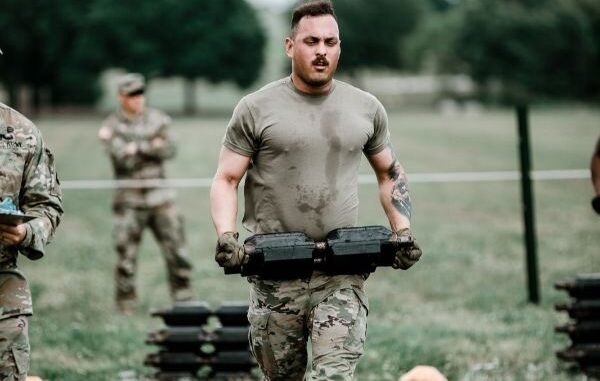
Photo credit: Art Guzman.