
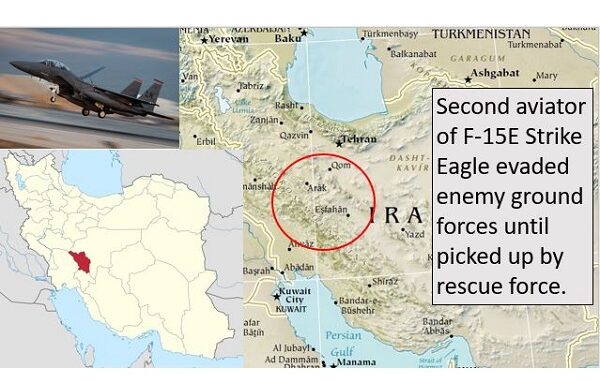
The Weapons Systems Operator (WSO – Dude 44B) from the F-15E Strike Eagle shot down over Iran was rescued late on Saturday night, April 4, 2026 (EST). (This article is being updated periodically as new information becomes available).
Summary
A USAF F-15E Strike Eagle was shot down over southwest Iran on early Friday, April 3, 2026 (local time), reportedly in Chaharmahal and Bakhtiari Province (see map) while conducting a deep strike mission. Both aircrew members ejected from the F-15E seconds after being hit by Iranian fire and parachuted to the ground. They made contact with with U.S. forces via encrypted radio and activated their emergency location beacons (most likely a CSEL).
The F-15E Strike Eagle (C/S Dude 44) belonged to the 494th Fighter Squadron, of the 48th Fighter Wing of the United States Air Forces in Europe (USAFE). The 48th is located at RAF Lakenheath in Suffolk, England and consists of two F-15E squadrons.
It is unknown what type of weapon system brought the F-15E down. Defense analysts speculate that it may have been Iran’s Bavar-373 (Wikipedia) long-range mobile surface-to-air missile system, a Russian-made S-300 missile system (Wikipedia), or a Russian provided 9K333 Verba shoulder-fired, infrared homing MANPADS (Wikipedia).
Rescue of the Pilot. As of mid-day Friday one crew member, the pilot, was recovered just hours after parachuting to the ground. During the rescue of the pilot one of the two HH-60W Jolly Green II combat rescue helicopters of the Personal Recovery Task Force (PRTF) was hit by ground fire. Several crew members were wounded; however, the helicopter was able to fly out of Iran with the F-15E pilot onboard. An A-10 Thunderbolt II supporting the pilot rescue received hostile fire. (NSI) The pilot got the aircraft out over the Persian Gulf, ejected, and was picked up by rescue forces. (SOF News, 3 Apr 2026)
Rescue of the Weapons Systems Officer. The second aviator, the Weapons Systems Officer (WSO), ejected safely from the aircraft. He injured his ankle either during the ejection or upon landing with his parachute. He landed a significant distance away from the pilot, so the tow never linked up on the ground. The WSO had a pistol, an aviator’s survival vest, and a Combat Survivor Evader Locator (CSEL). His immediate task was to evade – moving away from the crash site as far and as quickly as possible – on an injured foot. On Friday, the aviator had moved away from the crash site, evaded enemy searchers, moved in a southeast direction from the crash site, found a hide site on a mountain ridge, and set up a beacon and emergency communications device. After 14 hours the Air Force received confirmation from the Central Intelligence Agency on his location and positive identification.
The location (X, 5 Apr 2026) of the WSO rescue was southwestern Iran in the midst of the Zagros Mountains. The Islamic Revolutionary Guard Corps (IRGC), affiliated Basij militia units, and armed tribesmen conducted a massive search for the downed airman.
The rescue effort included 155 aircraft. Four bombers, 64 fighters, 48 refueling tankers, 13 rescue aircraft, and others. The ground team was supported by Air Force jets providing close air support and armed drone support. Roads leading to the extraction zone were struck (cratered) to prevent Iranian reaction forces from entering the extraction zone area. Iranian news agencies posted photos of massive traffic jams of Iranian security elements attempting to reach the extraction zone area. U.S. B-1 bombers dropped about 100 bombs (each weighing 2,000 lbs) during the mission to rescue Dude 44B; hitting roads, IRGC garrisons, and other targets.
Establishing the FARP. The rescue force occupied and secured an unused air strip on a farm in a rural area southwest of the city of Isfahan on late Saturday night, April 4, 2026 (EST). This location, called a FARP, would be the staging area for the aircraft, troops, and equipment taking part in the rescue operation. The special operations ground force was inserted by two AFSOC C-130s into this location as it was near the hide site of the WSO not far from the Kolah Ghazi National Park. The Forward Arming Refueling Point (FARP) was set up for refueling the three Little Bird helicopters as well as to temporarily support the rescue operation. An ex-USAF Special Tactics Squadron member tells how the impromptu airfield in Iran would have been rapidly established and defended. “How a Dusty Strip Deep in Iran Can Be Turned into a U.S. Special Operations Base in Hours”, by Howard Altman, The War Zone, April 6, 2026.
MH-6 Little Birds. One MH-6 flew to the mountain ridge (X, 5 Apr 2026) and brought the aviator back to the ad hoc landing strip (unconfirmed info). The ground force linked up with the evading crewmember and began setting up for extraction. The WSO was rescued late on Saturday night, April 4, 2026 (EST).
Unfortunately, the nose gear of one of the exfiltration AFSOC C-130s got stuck in the sandy dirt at the airstrip. The second C-130 either had the same problem or had another reason why it could not fly. So replacement aircraft had to be brought in – a standby contingency force was given the order to proceed to the airstrip. The original infil and exfil aircraft were destroyed on the ground at the airstrip and the personnel recovery task force exfiltrated on the three newly arrived AFSOC transports. The three contingency aircraft may have been USAF 427th SOS CN-235 aircraft. (see Instagram video) Some news reports say that the two original infil aircraft were two MC-130Js, while others state that it was one MC-130J and one HC-130J.
There are unconfirmed reports that during the operation the Central Intelligence Agency (CIA) launched a deception campaign prior to the rescue attempt of the WSO. The agency spread the word inside Iran that U.S. forces in Iran had already found him and were attempting a ground exfiltration in southern Iran – possibly ending in a coastal maritime exfil. Apparently, this diverted some Iranian security units away from the crash site location. (The Washington Post, 4 Apr 2026) (subscription)
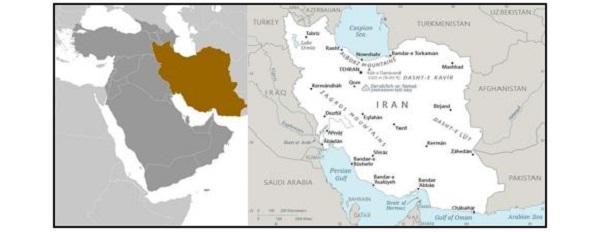
Click here for a larger physiography map of Iran that opens in a new tab.
Timeline
- On April 3, 2026, a F-15E took hostile fire from Iraqi ground forces.
- Both aviators ejected out of their aircraft and parachuted to the ground. However, they were separated on the ground and lost contact with each other.
- They both made radio contact with higher command.
- CENTCOM’s Joint Personnel Recovery Center (JPRC) declares a “PR Event”.
- Rescue of F-15E Pilot – Dude 44A
- The pilot was rescued by American rescue forces on Friday but the Weapons Systems Officer (WSO) could not be picked up by the rescue helicopters.
- One or perhaps two HH-60 rescue helicopters were struck by enemy ground fire but managed to return to base.
- One of the A-10 Thunderbolt IIs supporting the pilot rescue attempt took hostile fire. The A-10 pilot, c/s Sandy, made it to Kuwaiti airspace over the Persian Gulf and bailed out. He was picked up by American rescue forces.
- Rescue of F-15E WSO – Dude 44B
- On late evening of Saturday (4 April 2026) or early morning Sunday (5 April 2026) there are multiple reports from Iranian media of U.S. aircraft in the air over southwestern Iran.
- Two MC-130J AFSOC aircraft landed at what is believed to be an unused remote airstrip, setup security and a Forward Arming Refueling Point (FARP), and began preparations to rescue the evader.
- A MH-6 Little Bird left the FARP to pickup the evader and then returned to the FARP. The AFSOC C-130s were stuck in the ground (call it moon dust?), they were blown up in place.
- Three more AFSOC aircraft came in to conduct the extraction of the rescue party and WSO. May have been USAF 427th SOS CN-235 aircraft.
- Late on Saturday night major news networks (CNN, Fox, etc.) reported that the second airman had been rescued.
- CENTCOM’s Joint Personnel Recovery Center (JPRC) declares the PR event closed.
The successful recovery of both F-15E aircrew demonstrates continued U.S. ability to conduct personnel recovery operations inside highly contested environments. Combat search and rescue missions remain among the most complex air operations due to the requirement to rapidly locate isolated personnel while suppressing enemy air defenses and coordinating multiple joint force assets. The incident also underscores that Iranian integrated air defense systems retain limited capability to threaten coalition aircraft despite sustained strike operations by the United States and Israel.
**********
“Operation Epic Fury – U.S. Central Command Updates
https://www.centcom.mil/OPERATIONS-AND-EXERCISES/EPIC-FURY/
Top Image Credits: Iran province map outline by Yamaha5 – Iran location map.svg, CC BY-SA 3.0, https://commons.wikimedia.org/w/index.php?curid=25560707. Physical map by CIA. Photo of U.S. Air Force F-15E Strike Eagle assigned to 494th Expeditionary Fighter Squadron landing at a base in the Middle East, January 18, 2026, courtesy photo CENTCOM.
