
The Quiet Currency of Special Operations: What Team Room Coins Actually Record
By Anna Redmond.
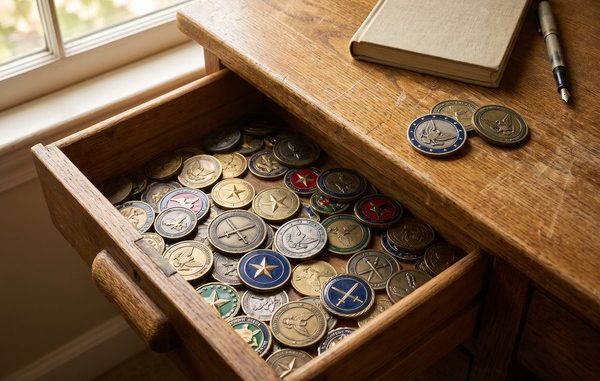
Walk into almost any team room in the special operations community and you will find them: a rack, a shelf, sometimes just a desk drawer heavy with metal. Challenge coins — traded, presented, won, and occasionally extorted over the price of a round — accumulate around special operations the way sand accumulates in a rucksack. Everyone has them. Almost no one can tell you, years later, exactly where each one came from.
That is a bigger loss than it sounds, because in this community the coins are more than souvenirs. They are records. Often, they are the only records.
A tradition the Regiment claims — with some justification
The origin of the challenge coin is contested territory. The most repeated version — a World War I aviator whose squadron medallion saved him from execution as a suspected spy — is best treated as lore: a good story, endlessly retold, with little documentation behind it. What is better supported is where the modern tradition took root. Many unit historians trace the practice of a commander minting and presenting a unit coin to the Special Forces community of the 1960s, with 10th Special Forces Group usually named as the earliest documented example. From there the practice spread through the SOF world and eventually the entire force, until today every headquarters element with a budget line seems to have a coin.
But there is a difference between the coin a base commander hands out at a town hall and the coin that changes hands in a team room. The conventional force adopted the artifact. Special operations kept the meaning.
What the coins record that the paperwork doesn’t
An operator’s official record is a strange document. It is precise about schools, dates, and evaluations, and nearly silent about the substance of a career spent mostly in places and task organizations that don’t advertise themselves. Awards citations are written to be releasable, which is another way of saying they are written to leave things out. Whole deployments compress into a line. Task forces that existed intensely for eighteen months and then dissolved leave behind almost nothing a family member could hold.
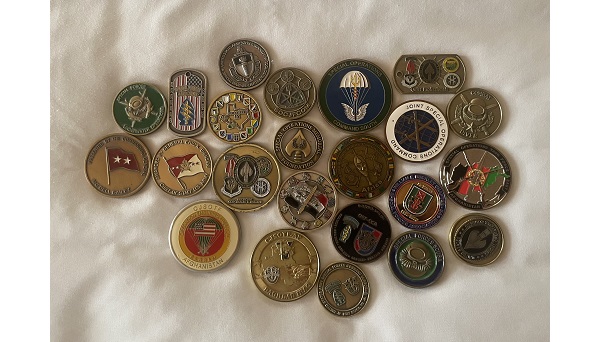
The coins fill that silence, in their own compressed dialect. A coin from a partner force — a foreign SOF unit’s crest, lettering in a language the operator’s kids can’t read — marks months of shared risk that no U.S. citation will ever fully describe. A task force coin with an insignia that appears in no official heraldry registry marks an organization that, formally speaking, barely existed. A team coin numbered by hand marks who was actually there, in that room, during that rotation. And the coin presented quietly — no formation, no citation, just a handshake and a look — often marks the exact thing an operator did that mattered most and will never be written down.
That is the quiet currency. Not the trading and the bar games, though those are real, but the way a drawer of metal becomes an unofficial service record: the deployments, the partnerships, the units that came and went, the moments someone in authority decided deserved permanent weight.
(Click here for a larger image)
The problem with quiet professionals
The trouble is that this record has a single point of failure: the person who remembers it.
Quiet professionals are, true to the name, quiet. The habit of not talking — professionally necessary for decades — does not switch off at retirement. So the coins sit in the drawer, and the context sits in one man’s or one woman’s memory, and the two are only connected as long as that memory is alive and willing. Ask the family of any deceased operator what they know about the coins they inherited. The usual answer: he never really said. They keep the metal because it obviously mattered. What it meant is gone.
Collectors know this failure mode well. Estate sales and online auctions regularly surface SOF unit coins — some rare, some numbered, some clearly presented rather than purchased — completely severed from their stories. The object survives; the record it was carrying does not. For a community that produces so little releasable history in the first place, that is not a small leak. It is the archive quietly draining out, one estate at a time.
Preservation is an unclassified act
Here is the part worth saying plainly: Preserving a coin’s story does not necessarily require disclosing sensitive information. In many cases, veterans can record who presented it, approximately when it was received, and why it mattered. The story a coin carries is almost always tellable at the unclassified level — who presented it, roughly when and where, what unit or partnership it represents, why it mattered. “This one came from the sergeant major after my third rotation. This one is from the partner unit we trained in-country; their commander gave it to me the day we left. This one, I can only tell you it was a good day.” Even that last sentence, recorded, is worth more to a family — and to future historians of this community — than silence.
The mechanics are straightforward, although contributors should observe applicable classification, operational-security, privacy, and prepublication-review requirements.:
Photograph the coins, both faces, while you can still remember which is which. Write down the story for each — a few sentences is enough. Who gave it, when, what it was for, at whatever level of detail is releasable and comfortable. Say the story out loud to someone. Spouses and kids remember what they’re told; they can’t remember what was never said. And keep the record with the coins, so the metal and the meaning travel together — whether that record is a card in the display case, a document in the safe, or a digital archive built for exactly this purpose.
Unit associations are well positioned to make this a habit rather than an individual virtue. Reunions already put the coins and the memories in the same room once a year. A table, a camera, and an hour of storytelling can capture more unit history than a decade of good intentions — and the older the community gets, the less patient the math becomes.
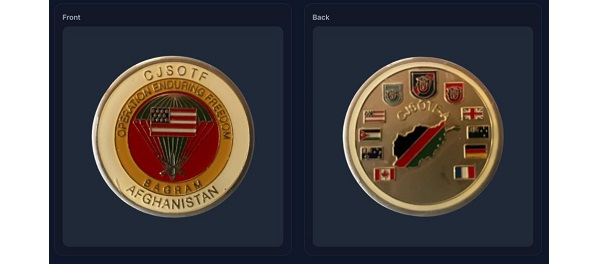
Image: Coin for Combined Joint Special Operations Task Force – Afghanistan (CJSOTF-A), 2002-2003 time frame. Each coin uploaded to the website displays front and back views. The entry can also display the date the coin was acquired, copyright information, notes about the history of the coin, and comments from website visitors. The coin’s ‘visibility can be set to ‘public’ or ‘private’, allowing uploaders to make their collections publically viewable or keep them private and share them selectively. View the coin depicted above online. (Image from AllCoin online collection)
The archive is already built
Special operations veterans sometimes say, with justified frustration, that their history disappears — that the nature of the work guarantees the fullest account of what they did will never be public. That is partly true and largely unfixable. But it makes the record they do control more valuable, not less.
The coins in the drawer are already an archive. They were minted as markers of real events, presented by real commanders, carried through real years. The community that created the modern challenge coin tradition — that turned a piece of struck metal into the most honest service record its members own — is the same community best equipped to keep those records legible. It only requires treating the drawer like what it is: not a pile of souvenirs, but the unofficial history of a career, waiting to be written down while the one person who can still read it is here to do it.
—
Disclosure: This article was submitted by the AllCoin team. AllCoin (allcoin.braav.co) is a free platform where veterans and service members digitize their challenge coins and preserve the stories behind them. Anna Redmond is the Founder & CEO of Braav/AllCoin.