
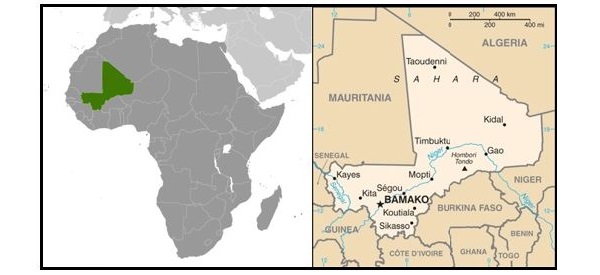
A major offensive was launched on Saturday, April 25, 2026, by the al-Qaeda-linked Jama’at Nasr al-Islam wal Muslimin (JNIM) and the Azawad Liberation Front (FLA) in Mali. They are attacking Malian Armed Forces (FAMa) and Russia’s Africa Corps across Mali. Major cities are experiencing fighting including the capital city Bamako, Kidal, Gao, and Sevare. The early stages of the offensive suggest a sustained and coordinated campaign.
Key Takeaways:
- JNIM conducting coordinated multi-region attacks targeting FAMa positions and supply lines
- Tuareg factions re-engaging in open conflict following collapse of 2015 peace framework
- Malian forces operating in reactive posture across dispersed fronts
- Combined pressure increasing risk of northern territorial fragmentation
Multiple major military sites have been attacked by the rebels across the country; primarily in the north. Fighting is also reported near the country’s Modibo Keita International Airport (Wikipedia) about 15 kilometers from the city center. Unconfirmed reports state that the major city in the north, Kidal, is under attack and may have fallen. (map on X) The home of the Malian Minister of Defense Sadio Camara has been attacked. The attack on his home was initiated with a car bomb (VBIED) and is reported to have died from injuries. Camara was considered a strong ally of the Russian Africa Corp in Mali.
JNIM is associated with al-Qaeda while the FLA is based on the Tuareg ethnic group. The history of the jihadist groups in Mali dates back to the early 2000s, when al-Qaeda in the Islamic Maghreb (AQIM) began operating in the Sahel region. It raised money through proceeds from smuggling routes and kidnappings. The Tuareg are based in northeast Mali; they are a diverse group united in a political coalition called the Coordination of Azawad Movements.
JNIM and Tuareg rebels are not formally allied as they are operationally deconflicted in some areas while in other areas are operating in parallel against Malian forces. JNIM, a Salafi-jihadist insurgency, is expanding their influence in rural and central Mali while Tuareg groups, an ethno-separatist rebellion, are present in the north of the country.
Situation on the Ground
The capital city Bamako is experiencing fighting with attacks on the nearby airport and some military garrisons. At this point, the capital is not threatened with falling to the rebels. The main military base in Kati is was under attack, and the main airfield in central Mali at Savare is threatened. Savare air base is one of the most important in Mali and serves as host to the Mali Air Force as well as Russian forces operating in Mali. There is fighting ongoing in another city – Gao.
Unconfirmed reports say that Kidal in the north may have fallen to the Tuareg separatists. Malian troops and Russian mercenaries are taking refuge from jihadists on the outskirts of the airport and the former United Nations base. There are reports that the Russians have been given ‘safe passage’ to withdraw from Kidal. Apparently, the Malian troops were not included in the ‘safe passage’ process.
The attack began with military assaults on government and military positions and installations, use of suicide car bombs, and kamikaze drones.
Jama’at Nasr al-Islam wal Muslimin (JNIM)
JNIM is a Sahel-based jihadist coalition formed in 2017 through the merger of several militant groups. It operates primarily in Mali but it has become increasingly active across Burkina Faso and Niger. The tactics of JNIM include complex attacks, IEDs, ambushes, and intimidation of local populations. JNIM seeks to expand influence and establish government structures based on its interpretation of Islamic law.
Tuareg
The Tuareg are a Berber (Amazigh) ethnic group found in the central and western Sahara. They are nomadic pastoralists and trans-Saharan traders. Their traditional territory spans parts of Libya, Algeria, Niger, Mali, and Burkina Faso. There have been Tuareg uprisings in 1990, 2006, 2012, and then 2023. As a people they have been marginalized and live in underdeveloped regions of Africa.
Military Coups
The country has recently experienced military coups in 2020 and 2021. The new leaders decided to seek security assistance from Russia. Russia has had a paramilitary presence since 2021. Assistance from France, the United States, and other nations was turned away. Mali’s military government, as in Niger and Burkina Faso, has severed ties with the former colonial ruler France and other Western countries. The autocratic junta had pledged to turn rule over to civilians but has now decided to stay in power.
International Presence
Over the past decade there have been several efforts by other nations to assist Mali in the fight against Jihadists. In January 2013, the French established Operation Serval, deploying over 4,000 troops to roll back a jihadist offensive. The deployment stabilized the situation but the insurgent movement survived. The United States provided significant support to the French with C-17s flying French troops and cargo into Mali; along with aerial refueling support as well.
The United Nations established the United Nations Multidimensional Integrated Stabilization Mission in Mali (MINUSMA). This UN peacekeeping mission established in 2013 was to help stabilize Mali after a coup and the armed insurgency in the country’s north. Over 60 troop- and police-contributing countries took part. The mission was terminated in 2023.
One of the more notable attempts was the establishment of Task Force Tukuba, where European SOF deployed to the Sahel region. The French-led force brought together special operations forces from Sweden, Estonia, and other nations to advise, assist, and accompany Malian units in combat – using a partner-force model. The United States also provided counterinsurgency assistance. However, during the 2022-2023 period, Mali pivoted away from Western partners. France ended Operation Barkhane (the follow on French operation to Operation Serval), Task Force Takuba was dissolved, and MINUSMA was disestablished.
Russian Paramilitary Presence
Western support was spurned in favor of Russian involvement in the security affairs of Mali. However, the presence of Russian paramilitary groups – first Wagner Group and then Africa Corps – has fueled the rise of jihadist groups in Mali. The country’s ability to fight the jihadists has diminished with the withdrawal of U.S. and French assistance.
The current offensive reflects a convergence of insurgent and separatist pressure rather than a unified campaign. JNIM’s objective remains expansion of influence and erosion of state presence, while Tuareg factions are pursuing renewed autonomy in northern Mali. The simultaneous timing, however, is forcing Malian forces into a multi-front defensive posture that reduces their ability to mass combat power or regain the initiative.
Mali ranked 5th in the Global Terrorism Index 2026 Report recently published in April 2026. The country has yet to restore civilian rule since the 2021 coup. Mali’s border with Niger and Burkina Faso continues to be the area most impacted by terrorism.
The U.S. Embassy in Mali issued a security alert on April 25, 2026:
“The U.S. Embassy continues to closely monitor the security situation in Mali following reported terrorist attacks. U.S. citizens should continue to shelter in place, remain alert, follow local news for updates, and avoid areas where security operations may be underway. For information about flight status or possible disruptions, travelers should contact their airlines directly.”
The last major offensive in Mali of this scale took place in 2012-2013. Should the Malian government fall the country could be the first fully Islamic Republic in west Africa. The risk of spillover into the region is rising. Southern Mali and the bordering states of Burkina Faso and Niger remain highly vulnerable. The Sahel-wide insurgent freedom of movement is increasing.
**********
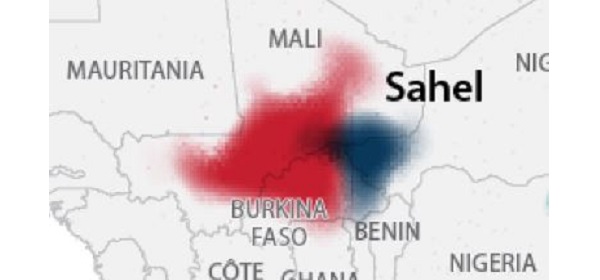
Image: Map derived from an image in Congressional Research Service publication entitled “U.S. Counterterrorism Priorities and Challenges in Africa”, December 2019, page 2, CRS TE10044. The map depicts operating areas of AQIM, JNIM, and affiliates in red and ISIS-Greater Sahara and affiliates in blue.
References:
“Mali – Facing the JNIM Threat”, SOF News, November 5, 2025
Interactive Map, European Council of Foreign Relations (ECFR)
https://ecfr.eu/special/sahel_mapping/jnim
Additional Background Sources:
“JNIM in 2025: A Tactical Assessment”, by Daniel Blanco Paz, Grey Dynamics, June 25, 2026.
MINUSMA mandate and withdrawal: United Nations, MINUSMA Fact Sheet and UN Security Council Resolution 2690 (2023).
“Mali asks United Nations to withdraw peacekeeping force”, Reuters, June 16, 2023.
Background on Tuareg movements and northern Mali conflict dynamics: International Crisis Group, Reversing Central Mali’s Descent into Conflict, 2019; PDF, 46 pages.
“Expanding Arsenals: Insurgent Arms in Northern Mali”, Small Arms Survey, 2015, PDF, 30 pages.
