
Interesting Field Exercises
As a previous uniformed member of staff with 1003 (Leighton Buzzard) Air Training Corps (now known as Royal Air Force Cadets) one of the most rewarding aspects of my aims was designing progressive training that stretched cadets beyond routine parade-ground and classroom work, and which may be have encouraged them to set their future towards a Special Forces career.
Over a concentrated series of exercises, I set out to introduce the principles, disciplines and decision-making required of Special Force operators—while remaining firmly within the safe, supervised framework of Air Cadet activities – not that a modern-day risk assessment would permit what I arranged back in the 90s!
The programme began with fundamental field craft held on station, which involved various multi-day scenarios that tested navigation, observation, teamwork and contingency planning under realistic pressure.
Building the foundations: basic field craft
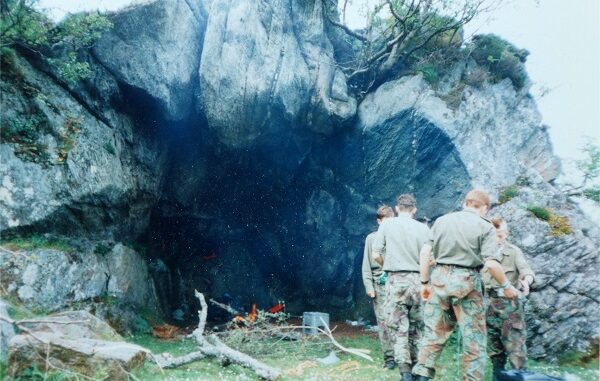
Starting with basic field-craft modules, cadets then practised camouflage and concealment, silent movement, basic navigation by map and compass, and the construction of simple hides (top image). Emphasis was placed on personal administration in the field, light-scale equipment packing, and the discipline of remaining undetected for extended periods. These skills formed the essential toolkit that later exercises would demand under more complex conditions.
Covert surveillance
A number of covert exercises were also undertaken, where cadets were transported to Holbeach air weapon range, then issued with a hand-held radio and the approaching fast jets callsigns. The cadets would then put into practise their JTAC training with a “9-line talk in”, without realising the transmit function had been disabled! A similar series of exercises were also held on the Salisbury Plain Training area ranges, where again cadets would “talk in” artillery fire, but from the rear of the guns.
Other exercises took place in and around Hereford, where cadets would conduct covert surveillance serials observing individuals associated with the Special Air Service, who were leaving their barracks. The aim was not to mimic operational tactics but to develop the patience, attention to detail, and situational awareness that underpin special-forces selection and employment.
Cadets also learned to maintain cover, report observations accurately, and extract without compromising their position—skills that translate directly into higher-level military thinking. I am not sure however what the targets would have thought, had they realised!
One series of exercises which always ended in a bang, was cadets being tasked to do a reconnaissance, then placing (fake) explosives around a disused Cold War underground bunker, which we had previously laid trip wires that activated blank 12 bore cartridges.
The Isle of Mull scenario
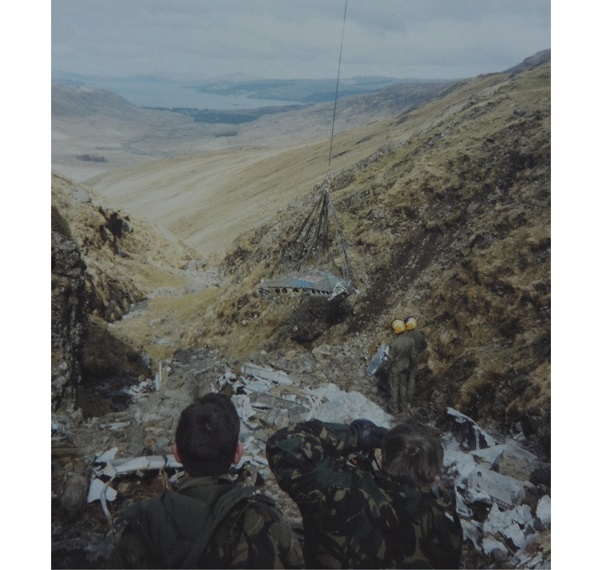
A more advanced annual exercise saw cadets transported to the Isle of Mull under a simple but effective fictional scenario: the islanders were at war with the United Kingdom. Cadets were tasked with locating the wreck of an RAF recon Tornado, which had come down in remote mountain terrain, recovering any surviving crew and securing sensitive equipment. In reality the “Tornado” was a Second World War RAF C-47 Dakota wreck, chosen for its authenticity as a tangible historical site and its demanding approach over rough ground.
The scenario required the full application of earlier lessons. Cadets planned and executed an approach under simulated threat, established a camp, then conducted a methodical search for the mountain wreck site. Then, with the aid of an RAF Search and Rescue Wessex helicopter (image below) would recover items which would eventually be presented to the island museum. Then, prepare for extraction. The physical and mental demands—navigation across difficult terrain, maintaining security, and handling the unexpected—again mirrored the kind of problem-solving expected of Special-Force personnel, but scaled to the age and experience of the cadets.
Extraction and the element of surprise
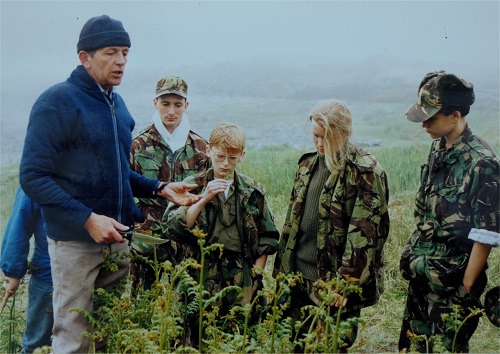
The final blow in the exercise came when the cadets reached the shore for extraction. On the journey to Mull, they had received breakfast and conducted a tour of a submarine at HM Naval Base Clyde (Faslane), as their expected recovery would be by submarine. However, each time and despite having been deliberately (incorrectly) briefed that the Isle of Mull was one hour ahead of UK time- a vital factor they forgot, therefore missing their submarine extraction. They then had to put into practise their foraging and cooking lessons (image below) until being rescued some days later. That was achieved by utilising the Tobermory Lifeboat during its weekly training sortie. The surprise tested adaptability and reinforced a core Special Forces principle: plans change, and operators must remain flexible. As for the actual 1945 C-47 (KK194) crash, that is another story on its own!
Other annual exercises
In addition to the Isle of Mull exercise, I organised other annual training exercises which tested the Cadets nerve and ability. In addition to abseiling, one favourite involved employing an SF instructor. After being transported to just off shore from the Isle of Scarba, but within reach of the shoreline, the cadets would have to swim ashore. They then had four days to travel the four miles from South to North, whilst evading the “enemy”. As their enemy were SAS troops, and to stop the Cadets from wanting to meet and chat to them, rather than hide from them, we told the cadets the enemy were convicted drug dealers and trouble makers from a Glasgow jail, who were receiving training just prior to their release from prison, and who were not at all friendly!
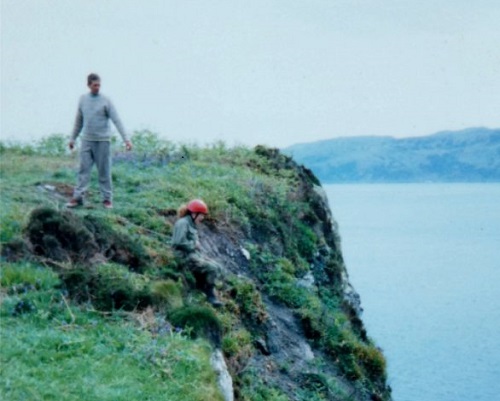
The four-day Scarba hike also involved crevasse rescue training (image below) where each cadet took it in turn to go over the edge of a cliff, whilst attached by rope to their colleagues, who would then recover them!
Outcomes and lasting impact
I feel my involvement and the series of training and exercises achieved its primary aim. Cadets left with a clearer understanding of the physical fitness, mental resilience, attention to detail and teamwork required of Special Forces personnel. Many reported a heightened interest in pursuing such careers, while all gained practical experience in field craft, surveillance and mission planning, that served them in their future, whether they joined the regular services, or finally became a member of the SF. Or just pursued civilian paths that valued the same attributes.
From the staff perspective, those programmes demonstrated how carefully designed, progressive exercises—grounded in real locations and supported by partner organisations such as the RAF, SAS, Royal Navy and RNLI—could deliver high-impact training, without leaving the then authorised boundaries of Air Cadet activity.
Whilst I hope those combinations of foundational skills, realistic observation tasks, and demanding island scenarios, provided a memorable and educational experience for the cadets, I feel it would also be nice if it had encouraged some to go down the Special Force pathway. In addition, if you are a current or ex member of SF, why not put some of your experience into practice and offer to arrange some similar training and exercises for current cadets, in conjunction with your local Cadet Force staff?
**********
Author: Pat Carty is a NATO accredited journalist who covers military news, events, operations, and exercises; including special operations forces. He is a contributor to SOF News as well as several other military defense publications.
All images by the author.