
By Jillian Butler.
Navy SEAL candidates regularly enter the Pacific Ocean off Coronado to prepare for some of America’s most dangerous military missions. Increasingly, their training has placed them in waters affected by sewage-contaminated flows from Mexico, creating a persistent health and readiness hazard.
The Tijuana River sewage crisis is often described as an environmental disaster. For the thousands of Navy personnel who train near its outflow, it is a national security issue.
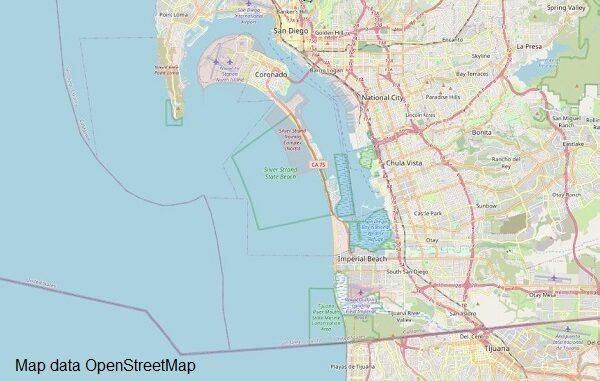
Though mostly known for its iconic hotel and white sand beaches, the city of Coronado is home to a Navy base. Naval Base Coronado’s eight geographically dispersed installations employ more than 36,000 military and civilian personnel. Several thousand of these individuals – including Navy SEALs, Special Warfare Combatant-craft Crewmen (SWCC), explosive ordnance disposal technicians (EOD), rescue swimmers, and others train – directly in the coastal waters affected by the pollution. This is one of the areas most affected by the crisis.
In early 2025, the Department of War Inspector General released a report suggesting that training for SEALs or SWCC be relocated, rescheduled, or canceled when water quality dips below state safety standards. This report indicated that between January 2019 and May 2023, the Naval Special Warfare Center diagnosed 1,168 cases of acute gastrointestinal illness (AGI), which is a common illness of exposure to water with high bacteria levels. Of those patients, 457 (about 39%) contracted AGI within seven days of training in water with bacteria levels higher than the state standard.
The report also indicated that from February to September 2024, approximately 75% of the water quality tests demonstrated bacteria exceeding state safety levels. Vice Adm. John Vincent Fuller, then the Naval Inspector General, wrote: “Naval Special Warfare (NSW) will have a challenge canceling or relocating 75 percent of their water training activities. Practically speaking, NSW operators would require systems or protocols that would enable them to both train and operate while managing preventable risk.”
For decades, untreated sewage and industrial pollution from Mexico’s rapidly growing Tijuana region have flowed across the border into the United States.
The Tijuana River originates in Mexico, crosses into California, and empties into the Pacific Ocean just south of Naval Amphibious Base Coronado, where thousands of special operations personnel train each year. Tens of millions of gallons of water can enter the river each day, a portion of which is raw sewage.
This has contaminated ocean water, leading one San Diego beach to be closed for over 1,000 consecutive days. The untreated sewage can also emit an airborne toxin called hydrogen sulfide that can lead to headaches, delirium, and respiratory distress. Extremely high concentrations can produce severe neurological effects and death. In a 2024 San Diego assessment conducted with CDC assistance, 69% of surveyed households living near the Tijuana River had a family member that experienced symptoms attributed to the sewage crisis.
In the words of retired Navy SEAL Robert Sweetman, “It’s a national security issue, it’s disgusting, it’s an abomination.” Sweetman also told the Washington Examiner that multiple SEALs contracted infections, including MRSA from the contaminated water.
One SEAL, Jeff Gum, grew seriously ill from the contaminated water. Gum said the illness left him unable to keep water down as he entered Hell Week. Combined with the extreme physical exertion, he said the resulting dehydration caused a severe medical crisis that he described as making his blood “toxic.”
Gum’s experience illustrates that this is an immediate operational hazard for candidates already undergoing one of the military’s most physically demanding training pipelines.
Navy SEALs conduct some of the military’s most sensitive missions, including counterterrorism raids, hostage rescue, special reconnaissance, and maritime operations. Their training depends on prolonged exposure to the ocean, leaving them uniquely vulnerable to contamination in the waters off Coronado.
Coronado has served as the home of Basic Underwater Demolition/SEAL (BUD/S) training for decades because of its unique combination of surf, tides, beaches, climate, and proximity to Naval Special Warfare facilities. Relocating large portions of the course would require significant logistical changes and could diminish training realism.
Despite Environmental Protection Agency (EPA) visits to the Tijuana River, the burden has fallen on the shoulders of local communities. For example, the Coronado City Council lobbied the state of California to unlock emergency funding to address the issue. Former Coronado Mayor Richard Bailey has raised concerns both to Congress and an international environmental conference. The Coronado Unified School District joined litigation against Veolia Water North America-West, the contractor operating the South Bay International Wastewater Treatment Plant. In a separate Clean Water Act case, San Diego Coastkeeper and the Coastal Environmental Rights Foundation sued USIBWC and Veolia over alleged permit violations at the plant.
The International Boundary and Water Commission is a binational organization that administers boundary and water treaties between the United States and Mexico. Its U.S. section also owns and oversees the South Bay International Wastewater Treatment Plant, which Veolia operates under contract.
The IBWC can implement and administer agreements between the two countries, but its ability to compel Mexico to complete infrastructure projects or prevent future discharges is limited. If Mexico does not complete a promised wastewater project, misses a deadline, or allows untreated sewage to continue crossing the border, there is no stipulation allowing America to impose fines, sanctions, or other legal penalties.
The most recent binational agreement, called IBWC Minute 333, was signed in December 2025. Since this agreement, transboundary wastewater releases have continued, with at least 200,000 gallons reported entering the Tijuana River system in subsequent incidents. In June 2026, a new BUD/S (SEAL training) class began, meaning that American service members will be routinely training off the San Diego coast.
The United States invests billions of dollars annually for preparing special operations forces to confront America’s adversaries abroad. Yet a preventable cross-border pollution crisis continues to expose some of its most elite warfighters to contaminated water before they ever deploy.
As another class of SEAL candidates trains in Coronado, Washington faces a difficult question: How long can America’s most elite warfighters continue training in contaminated waters before a diplomatic failure becomes a readiness failure?
*********
About the Author: Jillian Butler is a journalist with a focus on military and veterans, geopolitics, and corruption. She holds a bachelor’s in English and History from the University of Ulster in Northern Ireland and a master’s degree in International Relations with a focus in Security Studies from the University of San Diego. Before committing to a life of journalism, she worked in both academic research and private sector intelligence focusing on Middle Eastern security and the trafficking of drugs, arms, and humans. In a past life, she worked as a surf instructor in Northern Ireland, teaching both Catholic and Protestant children as part of a community bridge building initiative.
Image: © OpenStreetMap contributors.