
The first briefing of a multinational special operations task group sounds like one team. Everyone uses the same NATO terms, the same slide formats and the same acronyms. Then the questions start, and it becomes clear that several nations heard several slightly different plans.
Multinational task groups are now the normal way special operations forces work in Europe. Exercise Trojan Footprint 2026, the largest exercise of its kind on the continent, is one recent example. For many of those who take part in exercises like it, English is a second or third language.
I have sat in rooms like that one, in exercises and on operations, as an officer from a smaller nation. Leading and following there has taught me four things. Language costs more than we admit. Shared doctrine hides different habits. National limits must be on the table early. Trust has to be built in days.
The language tax
A staff that works in a second language loses precision in what people say, in what they understand and in how they confirm it. The loss is greatest when time is shortest. Fluency is rarely the problem. The officers and sergeants I have worked with studied English for years and think in it at work. The harder problem is meaning, because the same English word can carry a different weight for speakers from different armies.
I learned this at the start of a combined Romanian-Portuguese special operations task group. In the first days, before we knew one another and before each person’s responsibilities were clear, the hardest thing to find was a common vocabulary. The most telling case came while we were drafting the enduring concept of operations. Two of its elements, the task group’s mission statement and the commander’s intent, took far more discussion than they should have, because each of us read the same words differently. The debate was almost comic at the time. It was also useful, because it showed us early where our understanding differed.
The lesson I took from it is to settle what the key terms mean before debating the plan itself.
The tax also shows in meetings. Native speakers tend to talk faster as pressure rises, use idiom and humor, and fill the silences. Others ask fewer questions, because asking twice can feel like admitting a weakness. The group then loses the views of people who may know the problem best.
Three habits reduce the tax:
- Plain words. Short sentences and standard terms beat fluent English. Idiom, sports metaphors and national slang exclude half the room.
- Write it down. A sketch, a timeline or a one-page order survives accents and bad radios.
- Back-briefs. The question “Do you understand?” nearly always gets a yes. Asking team leaders to brief the task back in their own words shows what they heard.
Native speakers carry part of this responsibility. Slowing down for allies is a professional skill, and the best native-speaking officers do it without being asked.
Same doctrine, different habits
The second problem starts after the words are understood. NATO doctrine gives nations a common framework, but each staff applies it through its own planning habits and procedures. A “concept of operations” is a two-slide sketch in one unit and a 40-page document in another. Some staffs expect the commander to give direction first, while others expect the staff to bring options. Some teams challenge a plan openly in front of the group, and others raise concerns only in private.
Most of these habits work well at home. The friction starts when they meet and each nation assumes that the others share its own. A habit that slows a mixed staff has to be named and changed, whatever its origin. A leader who reads silence as agreement, or open disagreement as disloyalty, will misjudge the team in the first week.
Planning is where this matters most, because the plan is the one product the whole task group has to share. Allied special operations forces have a common tool for it, the special operations task group decision-making process, or SDMP, taught at schools such as the NATO Special Operations University and the International Special Training Center. Its practical value is simple. A mixed staff works through the same steps, produces the same products and calls them by the same names, so differences between nations show early, while there is still time to settle them. The course I attended at the university also included recent operational experience from Ukrainian special operations forces. That matters, because a common method stays useful only if it keeps absorbing what allies and partners learn on real operations.
The Romanian-Portuguese task group showed me how much this preparation is worth. We spent a full week on battle staff training before the exercise. By the end of that week, each of us knew what the others were responsible for, we planned with the same procedures and templates, and the whole staff understood the objectives and the commander’s intent. The week also built the motivation that a demanding exercise requires. When the exercise began, we had settled the vocabulary we had argued over in the first days. Language was never used as an excuse. Each person took individual responsibility for understanding and for being understood.
The same fix works when there is no week to spare: agree on the process before starting the plan. On day one, settle four things:
- Which products are expected, and in how much detail.
- Who decides what.
- When the rehearsals happen.
- How disagreement should be raised.
Time spent on these four points on day one usually pays off later in the planning.
National caveats: share them early
Every nation arrives with limits on what its forces may do. Caveats can cover rules of engagement, geography, types of mission, detention, and who approves what. They are a political fact of coalition work, and no tactical commander can remove them.
What a commander can influence is when partners learn about them. Late surprises are rarely the result of bad faith. They usually come from political decisions, from approval processes that take time, or from national guidance that changes during a deployment. It helps to separate three categories from the start: restrictions that are already known, authorizations that are still pending, and limits that may appear later as the situation changes. Partners can plan around all three if they are told which is which.
A restriction shared at the start, within what national disclosure rules allow, is a planning factor. The same restriction discovered the night before a mission damages trust even when nobody meant to hide it, and the team that has to cover the gap will remember it.
Smaller nations face a particular risk here. We often bring fewer people and fewer enablers, and it is tempting to say yes to everything to prove our worth. A clear statement works better: this is what we can do, what needs approval from our capital and how long that usually takes, and what we cannot do.
Building trust in days
Trust inside a national unit is built over years of selection and shared hardship. A multinational task group gets a few days. As a leader there, you stand in front of people who do not know you, who come from a different military culture and who remain under their own national command. The command arrangements may give you formal authority over them. That authority does not earn their trust by itself, so credibility has to do the rest.
Credibility shows in small things first: being on time, knowing your equipment and your subject, and giving an honest account of what your team does well and badly. Partners judge these long before the first mission. Working as hard as the team and listening before deciding count for more with strangers than with soldiers who already know you.
Rank helps less than expected. In special operations, experienced sergeants from one nation decide quickly whether an officer from another is worth listening to. They respect the rank, as professionals do. Recognizing competence is a separate judgment, and they have seen enough operations to know who understands the job. Speaking last, asking real questions and admitting what you do not know earn that recognition faster than a title.
Shared effort builds trust faster than words. Shooting on the same range, rehearsing together and eating together do more for confidence than any briefing.
Liaison officers are another shortcut to trust. Good ones anticipate misunderstandings before they reach the commander, explain their own nation’s procedures and tell partners plainly what their force can and cannot do. That takes judgment and credibility, which is why the best person a unit can spare is usually the right one to send.
Five things I would tell the next team leader
- Prepare your English before you deploy, especially radio procedure and briefing formats. Precision under stress comes from repetition.
- Agree on the key terms and the planning process before you start the plan.
- Tell partners early what your nation can do, what needs approval and what is off limits, within what your national rules allow you to share.
- Use back-briefs instead of asking whether everyone understands.
- Send your best people as liaison officers.
The human side of interoperability
Compatible radios and common procedures are the easier part of interoperability. The harder part is human: people from different nations have to understand the same thing, decide together and act as one.
That depends on the four things described here. Words have to mean the same thing to everyone in the room. Doctrine has to be applied as one process. National limits have to be known in time to plan around them. Trust has to be earned quickly by people who have just met. All four can be trained, and all four are a leader’s responsibility from day one of a multinational task group.
**********
About the author. “Marshall” (pseudonym) is an officer in the Portuguese Army who has served in its special operations forces since 2012. A trained sniper who has directed sniper courses and written technical articles on the craft, he has commanded special operations units at team, platoon and task unit level. He has served in multinational special operations task groups as a training officer in Iraq and as deputy commander on a NATO mission in Romania. The views expressed are his own and do not represent the Portuguese Army or the Portuguese Armed Forces.
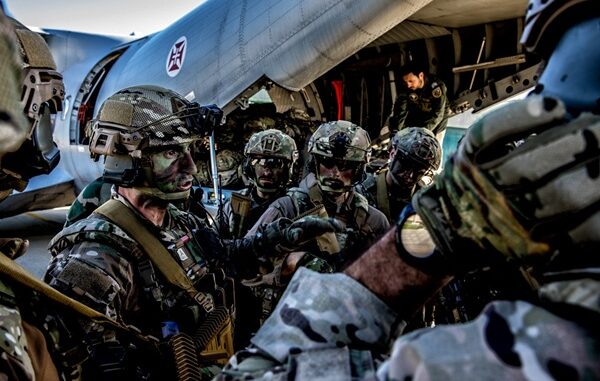
Photo. A Portuguese Army special operations soldier gives directions during multinational exercise Real Thaw 2018 (RT18). (photo by Joao Brito, Portuguese Air Force, Tancos, Portugal, January 29, 2018)