
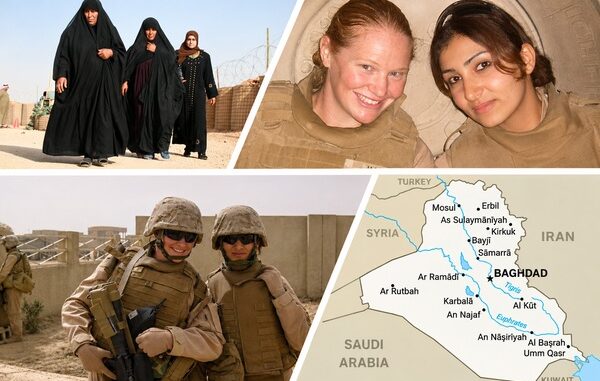
Story by Special Operations Association of America (SOAA).
When Athena Ives, Ph.D., first watched “Lioness,” a Taylor Sheridan television program that depicts women enlisted by the CIA to take on covert operations in the Global War on Terror (GWOT), she thought back to her own time in the U.S. Marine Corps’ Lioness Program.
She said that Sheridan accurately captured the operational concept behind the real Lioness Program: women accessing places and people men could not and operating in environments where their presence would attract less attention. However, Ives feels that the series overlooks much of the reality experienced by the women who carried that name into war, including the operational significance of their missions, the challenges they faced within their own units, and a longstanding lack of recognition that stands in striking contrast to the widespread acclaim generated by the television series.
Growing Up Different
As a child, Ives was so competitive in soccer that she played in the boys’ league with children several years her senior. As she grew older, she began to notice that boys had biological differences that gave them a leg up on the playing field, so she found ways to use their misconceptions about girls to her own advantage. For instance, Ives’ teammates always picked her to take penalty kicks once they found that facing off with a female would “totally psych out the goalie.” Finding her niche in that world taught her early on that “girls can do anything. We just have to do it a little bit differently.”
In 2006, Ives joined the Marine Corps, choosing the branch because it presented a challenge. With combat still closed to women at the time, she got as close to it as she could by picking a combat engineer military occupational specialty (MOS).
When she enlisted, Ives believed that only a few women had what it took to be part of combat operations. Not only did women need to be able to replicate male levels of performance standards, but she also felt that men needed to have the belief that women picked for combat would succeed so that they would not feel compelled to put themselves at greater risk to protect them.
While many members of the combat engineer MOS deployed with infantry units, Ives deployed with construction teams because of her gender. Regardless, she maintained peak physical condition while training for her first deployment to Iraq. She could outrun, outhike, and outshoot many of her male teammates, but her physical capabilities did little to change their attitudes. “I just didn’t have the right body parts for them,” she said. Some teammates told her daily that she did not belong, while the majority of her platoon made it clear through their words and actions that she was not welcome. Others “just didn’t speak up because they didn’t want to be the target,” she said.
During her unit’s predeployment training at Twentynine Palms, Ives was asked if she would volunteer for the Lioness Program. When she asked what it entailed, Ives was told that, as a Lioness, she would be attached to infantry units. That was all she needed to hear to say, “Sign me up.”
Lioness training was perfunctory. For 48 hours, Ives said she was attached to a platoon “and just fell into formation” as they went on a six-to-eight-mile hike with a full load of combat gear. “I totally kept up with them, didn’t fall out, didn’t complain,” she said. For the next phases of preparation, Ives was raiding targets, setting up cordons, and “basically just playing war.” Occasionally, the practicing platoon called up Ives to “go search the women and children” actors in the urban training environment.
Not long after arriving in Fallujah with Combat Logistics Battalion-1 in 2008, Ives was sent on her first Lioness mission. In what became a typical pattern, Ives had never met the team she was augmenting before. As they drove in a convoy towards their destination, Ives said she heard a massive explosion and was knocked unconscious when her head hit the top of her Mine-Resistant Ambush-Protected (MRAP) vehicle. When she awoke, Ives saw that all the young personnel in the MRAP in front of her in the convoy were dead.
As the deployment continued, Ives was sent out on Lioness missions five or six days a week, with “different units, different guys, different situations, [and] different missions every time.” Many times, Ives was working at checkpoints, doing security checks on women and children who passed through. The Lionesses also pulled security at medical clinics, or acted as the bodyguards for the wives of sheikhs because the women “would open up to us more than they would the men,” which was helpful for intelligence gathering. Sometimes, Ives also went on night raids with special operations personnel but “didn’t ask questions” after being told that “you weren’t here, you didn’t see this,” when she returned to base.
There was nothing to document Ives’ participation in Lioness missions, but the insurgents were aware of the presence of women in the battlespace; Ives was sometimes pulled off a mission at the last minute because intelligence warned of insurgent chatter specifically threatening Lionesses.
On top of the elevated threat environment, Ives was deeply aware that the stakes were high on every mission. “I didn’t want to fail all the women that came before me and then ruin it for all the women that came after me,” she noted.
A Woman’s Skill Set
During one Lioness mission in particular, Ives finally realized that women weren’t merely good to have on the battlefield, but that they “have to be there.”
Ives was at a checkpoint when an Iraqi woman walked up with her arms splayed out as she seemed to be praying. At the time, there had been a significant enough increase in female suicide bombers that the Marine Corps had released guidance about indications that a woman intended to detonate a hidden suicide vest in a strategic location. The woman approaching the checkpoint fit all the criteria, and as Ives began to mentally recall the escalation of force requirements, she called upon her combat engineering experience to examine the woman’s frame to mentally calculate how much explosive she might be packing on her body, and how wide of a damage radius it could create.
The safety on Ives’ weapon was off, and her finger was on the trigger when she noticed something strange: the woman was accompanied by a small child. After spending a significant amount of time with the civilian population, Ives knew how deeply Iraqi women cared for their children. The small detail gave her pause.
“I let her come forward,” Ives said, though she knew full well that she was putting her own life and her interpreter’s life at risk by doing so.
As the woman got closer, Ives’ interpreter began to translate the woman’s rapid-fire Arabic. “She’s asking for help. She’s praying for help from pain,” the interpreter explained.
Ives directed the woman into the hut and said she was “not prepared” for what she saw next. When the woman disrobed, her clothing “had been melted into her and her breasts were completely gone.” While sobbing and begging for help, the woman explained that her husband had burnt off her breasts because she refused to have sex with him.
Ives said that her exposure to Iraqi women through the Lioness Program, combined with her ability to recognize behavioral and cultural cues, helped her question her initial assessment of the woman as a threat. Because male service members often lacked the same access to Iraqi women, they did not always have the opportunity to develop that understanding of the population. “Women need to be here because we bring this balance and this other perspective that really saves lives,” she said.
Ives’ combat engineer platoon did not see the value in her Lioness work, however. Other women in Ives’ battalion had stopped volunteering for Lioness missions, making Ives one of the few women available to support operations. “I gained a reputation, so they started requesting me,” she said. But when she returned from those missions, Ives said that her male colleagues would make fun of her, asking if she was “on [her] little ‘roar’ mission,” or if she had been “feel[Ing] up some females today.” Though she longed to be able to fire back that she had held a dead child, picked up body parts, or been shot at in the course of duty, she was not able to talk about her work as a Lioness. Often, she retreated to her room to cry.
There was just one other person who knew what Ives’ job entailed: the female Iraqi interpreter who accompanied her on missions. About a month before Ives’ deployment ended, a Marine intelligence officer found Ives before a mission to inform her that her interpreter had been found dead the previous evening. The enemy had “raped her and left her naked in the wadi for helping [Americans],” the intelligence officer told Ives.
Around the same time that she learned about the loss of her interpreter, Ives had received troubling news from home about an assault on her sister that dredged up trauma from her own past. During the phone call, Ives had cursed out another female Marine trying to get phone time before a mission. Four hours later, that Marine died during an enemy attack.
Ives responded to the onslaught of tragedy by trying to extend her deployment, but she was not successful. “It was the most lonely, exciting, purposeful time in my life,” she said.
Much like the Cultural Support Teams, who were the first women trained to specifically augment special operations forces in combat in Afghanistan, there was no documentation of Ives’ support to combat operations. And like the Female Searchers, Army Lionesses, and Female Engagement Team members who also served alongside men during the GWOT, Ives was later dismissed by people who did not understand how important women had been in supporting ground operations.
The Show
When Ives first watched Taylor Sheridan’s “Lioness,” she was excited to see a concept rooted in the real Lioness Program brought to such a large audience. A huge fan of the series, she appreciates that Sheridan captured something fundamental about the missions: women were essential because they could access places men could not and could operate in environments where their presence attracted less attention.
For Ives, the show’s popularity presents an extraordinary opportunity to influence how the public understands women in combat. Just as “X-Files” character Dana Scully impacted women’s interest in science, technology, engineering, and mathematics (STEM), “Lioness” could create real-world change by challenging misconceptions about gender, highlighting women’s operational capabilities, and inspiring future generations.
To Ives, “Lioness” represents more than entertainment. It is an opportunity to connect millions of viewers with an important and often overlooked chapter of military history. She hopes that the show’s success will encourage greater recognition of the real women who served in combat roles.
Today, Ives has begun collecting stories to document the evolution of the Lioness Program, Female Engagement Teams, and Cultural Support Teams through firsthand interviews with the women who served and the men who worked with them. Her research seeks to preserve not only their operational contributions but also the human experiences that shaped their lives during and after the war.
*********
This article was provided by the Special Operations Association of America (SOAA). A non-profit organization, SOAA advocates for the special operations community, from the front lines to the halls of Congress. https://soaa.org/
Photos provided by Athena Ives, photo of Iraqi women by DVIDS, and map by CIA.