
By Jessica L. Walton.
The United States entered Afghanistan in 2001 with overwhelming advantages in military capability, technology, and resources. By every conventional measure, the Taliban was badly outmatched. Yet twenty years later, the Taliban had outlasted the world’s most formidable military and returned to power in Kabul.
Much has been written about how that happened. Congressional hearings, government investigations, and countless studies have examined the failures of strategy, intelligence, governance, institution-building, and military execution. Less attention, however, has been paid to another domain where the Taliban proved remarkably effective: the fight to control the story—and ultimately, the course of the war—both inside Afghanistan and beyond it.
Central to the Taliban’s effectiveness was its intimate understanding of its various audiences, an advantage its far more powerful adversary struggled to match.
Throughout the twenty-year conflict, the Taliban treated information as a weapon, exploiting a fundamental advantage of asymmetric warfare: a weaker force does not have to compete on its opponent’s terms. Unable to match the United States and its allies in conventional military power, the Taliban competed instead over perception, legitimacy, and public opinion. Military actions, civilian casualties, government corruption, night raids, and cultural missteps all became raw material for its message: Afghanistan was occupied, its government was illegitimate and corrupt, and the Taliban represented the resistance.
This information campaign did not operate in isolation. The Taliban benefited from an extensive support ecosystem beyond Afghanistan, particularly in Pakistan, where religious institutions, political movements, and media networks helped reinforce narratives of foreign occupation and resistance. Other U.S. rivals, including China, also operated within Afghanistan’s information environment, amplifying anti-Western narratives and conspiracy theories.
When Truth Becomes a Weapon
What made these narratives particularly effective was that they were not entirely false. Often, their most persuasive ingredients were real events, selectively presented and stripped of context until they told the story the propagandist wanted. It is a familiar technique in jihadist propaganda, from Hamas to al-Qaeda to ISIS: exploit legitimate grievances, place them within a larger narrative of oppression and resistance, and use that narrative to legitimize the movement and its actions.
For the United States and its partners, this exposed a particular vulnerability in operating within unfamiliar cultural and information environments, where actions, mistakes, and unintended consequences were often turned against the broader mission. New technologies and social media only magnified the challenge, giving weaker adversaries unprecedented reach.
The Taliban, by contrast, was operating within its own cultural terrain and understood how to exploit that advantage. It knew not only which messages resonated with Afghan audiences, but where people gathered, whom they trusted, and how information moved through their communities.
Messaging Delivered Through the Mosque
Dr. Haroon Hakimi, former deputy minister of information, culture, youth and tourism in the former Afghan government, remembers the mosque as one of the Taliban’s most important communications networks.
“The mosques were one of the Taliban’s most effective tools for recruitment and influencing the public,” Hakimi told me. “They understood the influence of the mullahs and imams, and they used them to carry their messages directly into Afghan communities.”
The Taliban cultivated or intimidated religious leaders into framing the war around Islam, foreign occupation, and resistance. This framing gave the Taliban’s messaging a powerful cultural and religious foundation. Foreign troops could be portrayed not simply as a military adversary, but as kuffar—foreign infidels occupying Muslim land—against whom resistance was a religious duty.
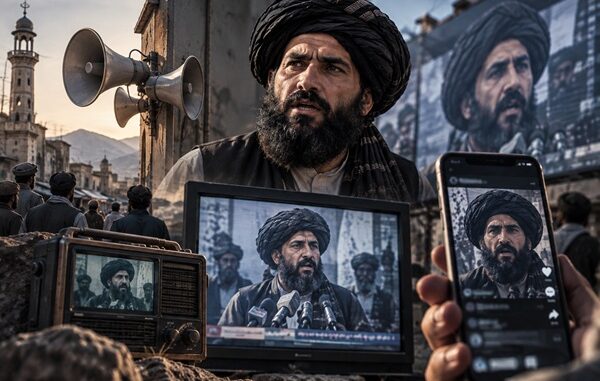
Mosques offered another advantage in a country with limited communications infrastructure: a ready-made broadcast system. Loudspeakers used for the call to prayer could carry Taliban messages beyond the congregation into homes and public areas.
The Taliban also reinforced their messaging beyond the mosque through traditional Afghan forms of communication. Taranas—religious or martial chants generally performed without musical instruments—celebrated fighters, condemned the Afghan government and foreign forces, and framed the conflict through religion, honor, and resistance. Recordings circulated through mobile phones and eventually social media, part of a wider Taliban effort to use emerging digital platforms to distribute propaganda and reach audiences beyond traditional networks.
Hakimi recalled that some Afghans even kept Taliban taranas on their phones, using them to appear sympathetic to the movement and reduce the risk of harassment at Taliban checkpoints.
Careful observers recognized the sophistication of this approach even during the war, although whether those insights consistently translated into coalition strategy and operations is another question. In 2009, Naval Postgraduate School researcher Thomas H. Johnson watched people in a Kandahar hotel exchange what he initially thought was music over Bluetooth. They were sharing Taliban taranas. Johnson and Ahmad Waheed, an Afghan research analyst at the Naval Postgraduate School, later described the chants as culturally familiar messages that drew on Afghan history, symbolism, and emotion to communicate the Taliban’s worldview.
In other words, the Taliban was not simply distributing content. It understood where people gathered, whom they trusted, which cultural forms resonated, and how information moved through Afghan communities.
Turning Tactical Mistakes into Strategic Narratives
Unfortunately for the Americans, the Taliban did not always have to manufacture its best propaganda. Sometimes U.S. and coalition forces inadvertently supplied the material themselves.
Hakimi points to night raids and searches of civilian homes as particularly damaging examples. When raids were based on faulty intelligence or resulted in civilian casualties or wrongful arrests, Taliban propagandists could use the resulting images, arrests, and accounts to portray coalition forces as abusive foreign occupiers.
The Taliban also exploited the Republic’s relatively open media environment, using outlets that could freely criticize the Afghan government and coalition while journalists who criticized the Taliban faced intimidation and violence.
Then there was another cultural vulnerability: the women.
Searching women inside conservative Afghan homes generated intense anger. Images or stories of foreign male soldiers entering private spaces or searching women provided the Taliban with propaganda that could be framed not merely as a security incident but as an assault on Afghan dignity, family honor, and Islam.
Over time, these narratives deepened hostility toward coalition forces, making it harder for U.S. troops to earn the local trust and cooperation essential to the war effort.
These episodes also illustrate a recurring paradox in irregular warfare: a tactical action can succeed according to its immediate military objective, while simultaneously producing strategic damage in the information environment.
None of this eliminates operational necessity. Militaries still have missions to accomplish, often under extraordinarily difficult conditions. But the information effects of an operation should be considered during planning, not treated as a communications problem to be managed after the fact.
The Credibility Gap
As noted, some of the Taliban’s most effective narratives worked because they contained an uncomfortable measure of truth. Corruption in the Afghan government was one such liability.
According to Hakimi, nowhere was this issue more apparent than in the justice system. Rural Afghans could travel long distances to government courts, wait months or years for decisions, and encounter demands for bribes. Taliban courts offered a competing system that was local and often considerably faster.
Even senior government officials sometimes turned to the Taliban system. Hakimi recalled that an Afghan senator who chaired the Senate’s complaints commission took his own land disputes to the Taliban for adjudication.
“Here was a senator leading a commission in the Afghan Senate,” Hakimi said. “Yet when he had disputes over his own land, he took his cases to the Taliban. What did that say to ordinary Afghans about the credibility of their own judicial system?”
Independent research documented the same credibility problem. A 2020 ODI study based on more than 200 interviews with people involved in Taliban civil cases found Taliban courts were often perceived as easier to navigate, quicker, and less corrupt than state courts.
For the Taliban, the propaganda argument practically wrote itself. If officials of the Afghan state did not trust their own institutions to deliver justice, why should ordinary Afghans?
This illustrates a fundamental limitation of strategic communications. Messaging can challenge lies and counter an adversary’s narrative. It cannot compensate for the failures people experience firsthand.
Fighting in the Wrong Language
Majeed Qarar, a former cultural attaché at the Afghan Embassy in Washington who has studied Taliban propaganda and political communication, points to a striking example of the government’s disconnect from rural Afghanistan. Until around 2014, he recalled, the Afghan Defense Ministry’s principal spokesman could not speak Pashto.
“How do you fight an enemy when you don’t know their language, and you are the spokesperson for the Defense Ministry?” Qarar said.
The problem extended beyond language. Qarar argues that the government focused on urban communities and narratives while much of the insurgency was being fought in rural Afghanistan. Even when the government delivered tangible results, it often failed to explain them.
“We built major infrastructure and development projects, but we never explained what those investments were doing for the Afghan people,” Qarar said. “We spent a lot of money on media, but there was no strategic framework.”
Nothing Says Authenticity Like a Paid-Ad Disclaimer
Some coalition communications problems were considerably less subtle. Hakimi remembers U.S.-funded television spots urging Taliban fighters to abandon the insurgency and join the government. The sternly delivered appeal was followed by a disclosure informing viewers that what they had just watched was a paid advertisement.
Nothing says grassroots persuasion quite like the advertising disclaimer.
The deeper problem was still credibility. Taliban messages reached Afghans through people and institutions already embedded in their communities: mullahs, mosques, local networks, and familiar cultural traditions. Coalition messaging could arrive through a television screen, sound foreign, and then explicitly identify the foreign money behind it. In trying to persuade Afghans, the advertisement actually reinforced one of the Taliban’s central narratives by suggesting that the government and the forces supporting it were instruments of foreign influence.
That credibility gap did more than blunt coalition messaging. It made it harder for the United States and its partners to build public support for the overall campaign. Over time, those failures made it harder for U.S. and coalition forces to earn local cooperation and weakened the legitimacy of the Afghan government they were fighting to sustain.
The Lesson Beyond Afghanistan
Afghanistan demonstrated how effectively a conventionally weaker enemy can use information warfare to complicate the operations of a vastly stronger military. Drawing on its own sophisticated propaganda strategies and a network of foreign support, the Taliban exploited tactical mistakes, cultural missteps, and failures of governance to erode confidence in Afghan institutions, fuel hostility toward coalition forces, and increase the political and operational costs of the war.
The Taliban could not match American conventional military power. It did not have to. It competed instead in an information environment where superior firepower and technology were significantly blunted. The Taliban demonstrated how American actions could be manipulated into different stories for different audiences. The consequences of those narratives rippled across the war, fueling resistance to coalition forces and increasingly pushing American military and political objectives out of reach.
For the United States, the Taliban’s ability to use propaganda to offset American military superiority should be viewed as one of Afghanistan’s most important lessons for future asymmetric conflicts.
A weaker adversary will always look for ways to turn American actions and vulnerabilities against the broader mission, particularly when it can draw on sympathetic regional networks, outside support, and narratives already embedded in the local information environment. Future U.S. forces should therefore treat the information fight not as an adjunct to the mission, but as integral to its success or failure.
*********
Author: Jessica L. Walton is a communications strategist and writer in the defense industry based in the Washington, D.C. area. She is also a writing instructor for professionals in government, national security, technology, and engineering. A former IDF soldier and security analyst, she specializes in information operations and asymmetric warfare. Learn more at www.jessicawaltonwriter.com.
Image: By author and AI.
Editor’s Note: This is the first installment of a two-part SOF News series on Taliban information warfare. Read Part 2, “From Jihad to Instagram: The Taliban’s New Playbook”