
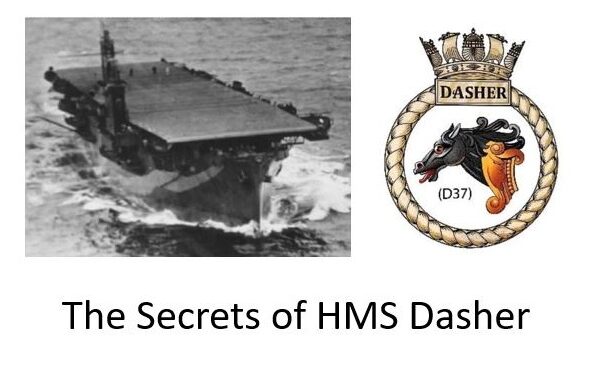
In the dark days of the Second World War, the UK’s Royal Navy needed more aircraft carriers to protect vital convoys across the Atlantic and to support operations against the Axis powers. One solution was the hurried conversion of merchant ships into small escort carriers. Among them was HMS Dasher (D37), an Avenger-class vessel originally built in the United States as a merchant hull and then adapted for British service as an aircraft carrier.
Dasher was hastily fitted with a flight deck, hangar, and the capacity to carry a small air group of Sea Hurricane fighters and Swordfish torpedo bombers. Her role was unglamorous but critical: hunting U-boats, escorting convoys, and providing air cover where larger carriers could not be spared. By early 1943, Dasher had taken part in the invasion of North Africa and had endured the brutal conditions of Arctic convoys.
On 23 March 1943, she arrived in the Firth of Clyde at Greenock in Scotland. Her flight deck had recently been lengthened by 42 feet. She carried five Sea Hurricanes and six Swordfish, and her crew numbered 528 men – Royal Navy ratings and officers, together with a handful of Merchant Navy and Royal Air Force personnel.
A Routine Day Turns to Disaster
At around 16:30 on Saturday, 27 March 1943, the ship’s captain, Lieutenant Commander G. N. Boswell, announced that shore leave would be granted once they berthed at Greenock around 18:00. Spirits lifted. Men off watch relaxed; others went about their duties as the ship turned towards home.
At approximately 16:42, a sudden, violent explosion shook the vessel. Almost immediately, a second, even more powerful blast tore through her. Witnesses on the bridge saw the ship’s aircraft hurled 60 feet into the air before they crashed into the sea. The flight deck buckled. Thick black smoke and flames belched from the exposed lift shaft. All engines stopped. Electrical power failed.
The hangar quickly became an inferno. Aviation petrol and diesel oil spilled from ruptured tanks, feeding the flames. Within minutes, Dasher was listing heavily, her stern sinking rapidly. By 16:48, the carrier had vanished beneath the waves of the Firth of Clyde, roughly five miles south of Cumbrae Island and between Ardrossan and Brodick.
Chaos in the Water
Many men never made it out of the sinking ship, trapped below decks as she went down. Others jumped or were blown into the sea. But horror awaited them there too. Escaping fuel from the carrier’s tanks spread across the surface and ignited. Burning oil and aviation petrol created a floating inferno that claimed dozens of lives. Those who avoided the flames faced the icy waters of the Clyde in March. Hypothermia set in quickly. Men coated in thick oil struggled to stay afloat; some rescuers later recalled oil-covered hands slipping from their grasp as they tried to pull survivors aboard.
Local vessels responded swiftly. One small coaster, the Cragsman, sailed straight into the flames and managed to save 14 men. Other ships and boats pulled in more. In total, 149 survived, including the captain and 36 officers, while 379 perished. It was one of the worst losses of life on a British warship in home waters during the entire war, and the highest in a single non-combat incident.
The Aftermath and the Silence
An official inquiry ruled out enemy action – no U-boat, mine, or aircraft was involved. The most likely cause was an internal petrol explosion, possibly sparked by leaking aviation fuel vapour ignited by a cigarette, static electricity, a spark from machinery, or even a mishap during refuelling. The converted merchant design of these escort carriers left much to be desired in fuel stowage and handling, and both British and American authorities pointed fingers at each other’s procedures.
The Admiralty imposed a strict blackout on the news. Next of kin were told only that their loved ones were “missing, presumed killed,” without details of where or how. Survivors were initially quarantined and ordered not to speak of the event. The government feared the impact on morale at a critical time. For decades, the full story remained largely hidden from the public.
Many of the dead were brought ashore, but only a small number received individual burials – some in Ardrossan cemetery. The wreck of HMS Dasher still lies in the Firth of Clyde, designated a protected war grave under the Protection of Military Remains Act. But there was more mystery to follow.
The Strategic Need
By early 1943, the Allies had nearly cleared enemy forces from North Africa. The next logical step was an invasion of southern Europe, to knock Italy out of the war and relieve pressure on the Soviet Union. The obvious target was the heavily defended Italian island of Sicily (codenamed Operation Husky), just a short hop across the Mediterranean from Allied bases in Tunisia.
German and Italian commanders fully expected an attack on Sicily. To give the real invasion the best chance of success and to save countless Allied lives, the British needed to convince Hitler that Sicily was merely a feint. The true targets, they hoped to suggest, would be Greece (and the Balkans) and Sardinia, followed perhaps by a push into southern France. This was the challenge handed to a small Special Forces team in the British “Twenty Committee” and in Naval Intelligence. The plan was finally masterminded by two intelligence officers working in a cramped basement office beneath Whitehall. They were supported by a network that included the novelist Ian Fleming (then working in Naval Intelligence) and various secretaries, forgers, and specialists who helped build the elaborate fiction. The final idea came from an earlier, wild suggestion: use a believable corpse that could plausibly have drowned after a plane crash at sea, and plant misleading documents on it!
In January 1943, with help from a London coroner, they obtained the body of Glyndwr Michael, a 34-year-old Welshman who had been living rough in London but had died after ingesting rat poison (likely a suicide). He had no known close relatives to claim him, and his emaciated condition was close enough to that of a man who had perished in the water. The team gave that dead man a complete fictional life:
- Name: Captain (Acting Major) William “Bill” Martin, Royal Marines.
- Identity documents: A forged ID card, military pay book, and theatre ticket stubs.
- Personal touches (to make him human and credible): Love letters from a fictitious fiancée named “Pam” (complete with a photograph of a young woman), a bill from a jeweller for an engagement ring, a letter from his father, and even a stern note from his bank manager about an overdraft.
- Uniform: He was dressed in Royal Marines battle dress, complete with appropriate insignia and rank badges. His boots were carefully chosen so the soles showed signs of London streets rather than shipboard life.
A black attaché case was chained to his wrist (a common security measure for couriers). Inside were the crucial “secret” documents:
- A personal letter from Lieutenant General Sir Archibald Nye (Vice Chief of the Imperial General Staff) to General Sir Harold Alexander in Tunisia. It casually mentioned that the main Allied assaults would target Greece (with operations in the Peloponnese and Crete) and Sardinia, while Sicily would be used only as a diversion to draw German reserves away.
- Other supporting papers reinforced the story, including references to a non-existent “Twelfth Army” preparing for the Balkans.
Everything was meticulously aged, stained with seawater, and made to look as though it had survived a crash. The body was then placed in a sealed steel canister (nicknamed “the Mincemeat”) filled with dry ice to preserve it and prevent bloating that might arouse suspicion.
The Delivery
On 17 April 1943, the canister was driven overnight from London to Scotland, then loaded aboard the submarine HMS Seraph, which had previously been involved in other secret missions and which was moored near the site of Dasher’s sinking. The Seraph then sailed south.
On the night of 29/30 April, while off the coast of neutral but German-leaning Spain and near the town of Huelva, the crew released the body into the sea. The tide and currents were calculated to carry it ashore. A dinghy and some wreckage were also planted to suggest a crashed aircraft.
Early the next morning, a Spanish fisherman found the body floating in the water and alerted the authorities. “Major Martin” was taken to Huelva, where Spanish officials performed a perfunctory autopsy and notified the British vice consul.
The Bait Is Taken
As the British had hoped, copies of the documents were secretly photographed and passed to German intelligence in Spain, before the originals were returned to the British.
The Germans examined the papers carefully. Forensic checks (including on the typewriter used, the paper, and even the salt stains) supported the story. Intelligence soon confirmed that the deception had reached the highest levels. Adolf Hitler himself was convinced. He believed the Allies planned to strike first in Greece and then in Sardinia. As a result, German reinforcements, including panzer divisions, aircraft, and naval forces, were diverted from Sicily to Greece and Sardinia. Even after the real invasion began, some units continued moving the wrong way.
The Payoff: Operation Husky
On 9/10 July 1943, the Allies launched the largest amphibious operation of the war up to that point. Over 160,000 troops, supported by thousands of ships and aircraft, landed on Sicily. The defenders were caught off-balance. Although fighting was fierce, the campaign ended in just 38 days – far quicker than expected. Mussolini’s regime collapsed shortly afterwards, and Italy eventually switched sides.
The Man Who Never Was
“Major William Martin” was buried with full military honours in the cemetery at Huelva. For decades, his true identity remained a closely guarded secret. Ewen Montagu later wrote The Man Who Never Was (1953), which revealed many details but still protected the real name of the corpse.
It was not until 1996, when amateur historian Roger Morgan examined newly declassified files, that Glyndwr Michael’s name emerged. In 1998, his real identity was added to the gravestone alongside the fictional Major Martin. The inscription read:
“William Martin, born 29 March 1907, died 24 April 1943, beloved son of John Glyndwyr Martin and the late Antonia Martin of Cardiff, Wales. Glyndwr Michael served as Major William Martin, RM.”
In the end, a Welsh tramp who died alone in London became, in death, one of the most important soldiers of the Second World War. He never fired a shot, but his silent journey changed history. However, that was not to be the end of the mystery!
The Dasher Connection Emerges
HMS Dasher had sunk in the Firth of Clyde just one month before Martin’s body had been placed in the sea off Spain, but the loss had been kept secret for morale and security reasons. However, in the early 2000s, local researchers and families connected to the Dasher disaster began to question the timeline and details of the Martin body story. Key points that fuelled their belief were:
- The short gap between the Dasher sinking and the body drop seemed convenient for obtaining a fresh corpse that had “drowned” in seawater.
- Glyndwr Michael had died in January and been stored for months. Critics argued that even with refrigeration, a body kept that long might show signs of decomposition or chemical traces from the rat poison that a Spanish autopsy could have detected, potentially ruining the entire plan.
- The body released from the Seraph needed to look like a recent victim of a plane crash at sea (with appropriate water damage, but not too advanced). A recently drowned sailor from the Clyde would fit that profile better than a month-old corpse.
- Some accounts also noted discrepancies in the number of recovered bodies from Dasher versus those officially buried, raising questions about whether one or more may have been quietly “repurposed”. The most prominent candidate put forward was that of John “Jack” Melville, a 37-year-old crew member from the Dasher.
In 2004, a memorial service was held aboard the modern HMS Dasher (a patrol vessel) in Cyprus. During the ceremony, the ship’s commanding officer publicly referred to Melville as the man who had served as “Major William Martin”, lending apparent official weight to the idea at the time.
The Secrets of HMS Dasher was published shortly afterwards, drawing on local research, survivor accounts, and the analysis of records. It argued strongly that intelligence officers had quietly taken one of the recovered bodies (likely Melville’s) from the Clyde area. They claimed the body was packed in ice, transported north to meet the HMS Seraph near Greenock in Scotland, and used instead of (or in place of) Glyndwr Michael’s remains. The book also suggested this explained both the tight timeline and why the Dasher tragedy was suppressed so heavily.
The theory gained traction in Scotland, particularly around Ardrossan, where the Clyde communities still mourned the Dasher’s dead, and saw the use of a serving sailor’s body as a pragmatic and cold wartime decision in the fight against Hitler.
The Official Rebuttal and Ongoing Debate
As far as the UK’s Ministry of Defence and Royal Navy are concerned, they have consistently rejected the Dasher theory. Numerous official Freedom of Information requests have been submitted, but almost all replies have contained either no useful information or a denial that any information is on file. Despite this, the theory refuses to die. Some researchers point to the secrecy surrounding both incidents, the Seraph’s route (which involved a detour that could have allowed a pickup), and the human desire for a more “heroic” story – a serving sailor from a tragic home waters accident who contributed silently to victory, rather than using an anonymous London tramp.
Whether or not the body was Glyndwr Michael or Dasher crewman John “Jack” Melville, the core truth remains unchanged: one dead man was given a false identity and used to deceive the Germans, helping to save thousands of Allied lives during the invasion of Sicily. Plus, there are still hundreds of Dasher crew members’ bodies still missing.
So, the Dasher theory adds a layer of poignant irony – linking two forgotten wartime tragedies in British home waters. One ship explosion in the Clyde and one man’s body floated silently towards Spain to turn the tide of war.
In the end, the “Man Who Never Was” continues to spark debate more than 80 years later, through a book, films, and a stage show, all produced about the mystery. However, official records still say it was Glyndwr Michael, despite many believing it was one of Dasher’s crew. Either way, the truth lies somewhere in the still-classified files, or may simply have been lost in the fog of war, like so many other Special Forces wartime secrets.
2026
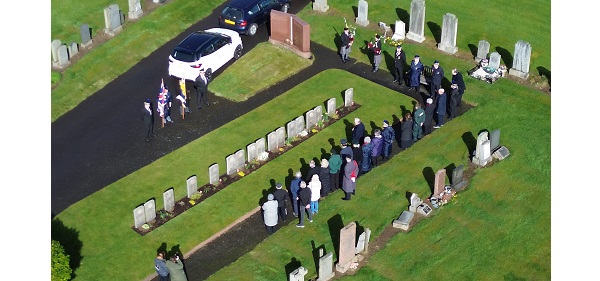
Photo: 2026 Ardrossan Cemetery service. By Pat Carty.
The Dasher story, whether merged or separate, still reminds us how the Second World War touched even the dead. So regardless of time, each year on the anniversary of the Dasher’s sinking, surviving relatives of the 379 missing crew members gather around the Dasher Memorial in Ardrossan, and also around the graves of the seventeen crew members buried in Ardrossan Churchyard. This year, I was present along with the King’s sister, Anne, The Princess Royal, who presented Arctic Star Medals to the surviving crew members’ relatives, who still long to know where their loved ones’ bodies ended up.
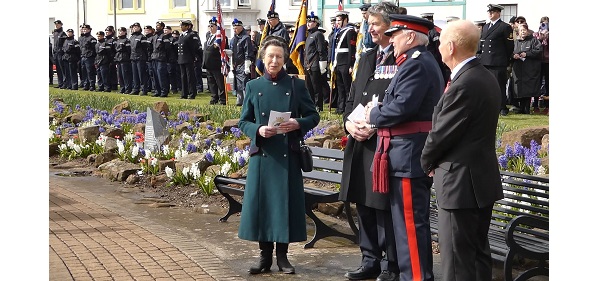
Photo: Princess Royal at HMS Dasher Memorial Service. By Pat Carty.
Where or why these bodies went missing is, for many, a big question – especially when it is recorded that up to 68 of those bodies had been identified prior to their burial. Some say the bodies may have been buried in a mass grave. However, a small-scale excavation of the Ardrossan cemetery in 2012 by GUARD Archaeology, disproved that. A privately funded non-invasive archaeological survey also took place in 2023 on Sanda Island, off the Mull of Kintyre. That identified a potential burial anomaly near the shoreline, and was also carried out on behalf of GUARD. It used more advanced Drone-mounted LiDAR (Light Detection and Ranging) equipment, and Emesent’s SLAM-based Hovermap system for high-resolution 3D mapping and terrain modeling. This survey remained non-invasive, but identified only “a potential” for graves. However, no follow-up excavation has confirmed or disproved human remains at the site. The Royal Navy have also maintained that no mass-grave was used.
Will time tell all? Despite attending this year’s service and talking to both relatives and experts on the matter, I sadly doubt it.
*********
Author: Pat Carty is a NATO accredited journalist who covers military news, events, operations, and exercises; including special operations forces. He is a contributor to SOF News as well as several other military defense publications.
Top Image: HMS Dasher (MoD) and HMS Dasher Emblem (MoD).