
By Shaun A. Chittick.
The Tanker War and Operation EARNEST WILL
Iran and Iraq were at war with each other from 1980-1988. During the chaos following the Iranian Revolution in 1979, Iraqi President Saddam Hussein saw an opportunity and invaded Iran, initiating a violent nine-year conflict. This war quickly spread from land to sea and involved attacks on each other’s oil tankers in the Persian Gulf using both missiles and mine warfare. Since this occurred in a strategic chokepoint, the Iran-Iraq conflict also affected the flow of all oil through the Strait of Hormuz. In December 1986, Kuwait asked the U.S. to reflag Kuwaiti oil tankers to protect their vessels transiting the region. In support of this, the U.S. Navy Central Command (NAVCENT) initiated Operation EARNEST WILL. Iran responded by stepping up harassing attacks using small boats and covertly emplaced sea mines.
Operation PRIME CHANCE and the Mobile Sea Bases
The newly formed U.S. Special Operations Command (USSOCOM) was tasked with conducting SOF operations in support of EARNEST WILL. East and west coast SEALs forward deployed in August 1987 to the Persian Gulf to stage aboard contract floating barges Hercules and Wimbrown VII, respectively. The SEALs were supported by TF-160 MH-6 and AH-6 “Little Birds”, USN SH-60 Seahawks, and Special Boat Unit MK III Patrol Craft from August 1987 to June 1989. The two Mobile Sea Bases (MSBs) and their embarked forces were declared operational in October 1987.
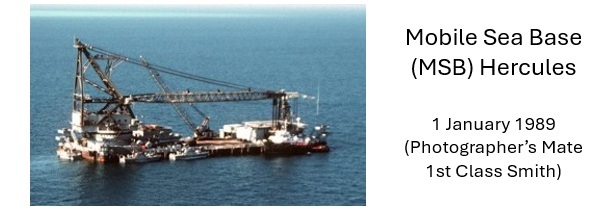
One SEAL platoon from SEAL Team Four and another from SEAL Team Five provided the VBSS personnel. TF-160 supplied two MH-6, four AH-6 “Little Birds”, and two MH-60 Blackhawks. NSW deployed six MK III coastal patrol craft from Special Boat Units 20 and 24; and 12 and 13, along with a 39-man task force deployed on a four-month rotation to provide Intelligence, Surveillance, and Reconnaissance (ISR) and maritime SOF combat capability in support of Rear Admiral Harold J. Bernsen, Commander of the newly minted “Middle East Force”. Included were two Marine Detachments armed with 81mm mortars, M2 .50 HMGs, MK19 Grenade Launchers, MK38 Bushmaster 25mm cannons, and Stinger MANPADs for defense against surface and air attacks.
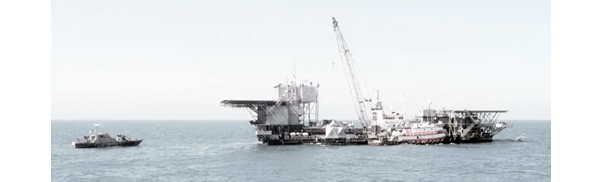
Photo: Mobile Sea Base (MSB) Winbrown VII in Persian Gulf during Operation Prime Chance (photo by PH1 DeWayne Smith)
The Target – Seizure of the Iran Ajr
The Iran Ajr was a former Japanese amphibious landing ship, purchased by the Islamic Republic of Iran and converted as a mine laying vessel during the tanker war between Iran and Iraq. The Iran Ajr was originally named Arya Rakhsh. The 614-ton, 54-meter ship, was powered by twin diesel engines and equipped with a bow ramp and a large deck space for carrying cargo. It also proved to be quite suitable as a mine laying vessel.
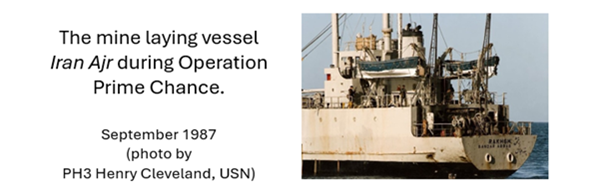
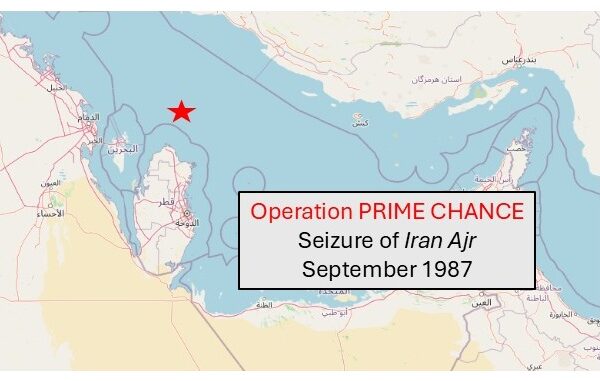
A U.S. Navy SH-60B Seahawk flying from the USS Jarrett (FFG-33) located the Iran Ajr in the Persian Gulf and gathered video evidence of mine-laying activity. On 21-22 September 1987, SEALs and elements of Task Force 160 Special Operations Aviation Group executed Operation PRIME CHANCE, a classified helicopter assault on the Iran Ajr. An MH-6 and two AH-6 “Little Birds” launched from the USS La Salle (AGF-3) and flew to intercept the Iran Ajr. Once they fixed the vessel’s location, they received a green light from Commander, Middle East Force Admiral Bernson, and made multiple gun and rocket runs on the target vessel. At first light, La Salle’s embarked SEAL platoon conducted a Visit, Board, Search, and Seizure (VBSS) on the crippled Iran Ajr.
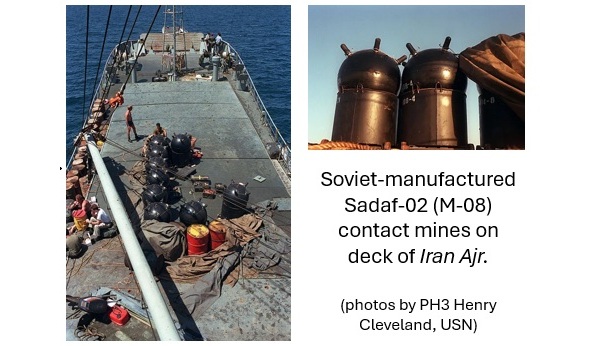
Nine mines were recovered aboard the Iran Ajr that matched unexploded mines recovered after USS Samuel B. Roberts (FFG-58) later struck a mine and almost sank in April 1988. The Iranian detainees were transferred to an airfield in Oman and flown out on an Iranian C-130. On 26 September, the SEALs scuttled the ship in an undisclosed location in international waters, according to a 22 July 1992 article in Newsweek.
As you read this 39 years later, we’ve come full circle back to the Strait of Hormuz. A U.S.-led coalition has all but removed Iraq as Iran’s primary competitor and stabilizer in the region. Iran is using Houthis as a proxy to do their dirty work, adding relatively cheap explosive-laden drones and ballistic missiles to their arsenal. Houthis are attacking global shipping from Yemen, which further complicates the situation. U.S. and coalition strikes are now directed at an extremist political faction but have inflicted casualties on the civilian populace. The U.S. Navy is tasked with maintaining open sea lanes and free trade around the globe, and now this strategic chokepoint is once again at the forefront of U.S. foreign policy.
**********
References:
“Operation Prime Chance”, WarHistory.org, September 27, 2017.
https://warhistory.org/article/operation-prime-chance
“Caught in the Act”, by Ed Magnuson, TIME, October 5, 1987.
https://time.com/archive/6710493/caught-in-the-act
“U.S. Says Attack Killed 3 Iranians: 26 Crewmen of Tehran Ship in Navy Custody”, by John M. Broder and Michael Ross, LA Times, September 23, 1987.
https://www.latimes.com/archives/la-xpm-1987-09-23-mn-6331-story.html
“U.S. Punches Back at Iran-Backed Houthi Terrorists in Yemen”, U.S. Department of War, March 17, 2025.
https://www.war.gov/News/News-Stories/Article/Article/4122757/us-punches-back-at-iran-backed-houthi-terrorists-in-yemen
About the Author: Commander (USN, retired) Shaun A. Chittick graduated from Basic Underwater Demolition/SEAL training in November 1985, and rose through the ranks to senior chief (E-8) during assignments to SEAL Team FOUR and the Naval Special Warfare Development Group (NSWDG). He was commissioned as a SEAL Officer in 2000 and completed assignments at SDV Team ONE, SDV Team TWO, NSWDG, Naval Special Warfare Group Four (NSWG-4), and retired out of SDV Team TWO in January 2021 after over thirty-six years of service. He currently works as a government employee for Naval Undersea Warfare Center Keyport.