
By Conner Huey.
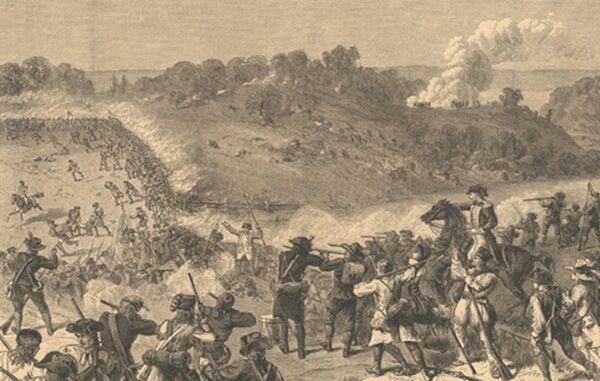
Image: “Battle of Harlem Heights” (c. 1860). Painted by Alonzo Chappel, engraved by J.C. Armytage.
Before dawn on September 16th, 1776, about 120 men headed south across upper Manhattan, leaving American lines under orders to scout British positions and report on Howe’s army. The plan did not include a battle. However, by the end of the day, the Continental Army had its first success in the field through the Battle of Harlem Heights, and the officer who led the patrol was dead.
The patrol belonged to Knowlton’s Rangers, whose short, costly service ended 250 years ago this fall, and whose service deserves a place in the semi-quincentennial celebration next to the generals and politicians who helped birth America. Indeed, raised by George Washington in 1776 as a specially designated unit for long-range reconnaissance behind enemy lines and other dangerous work ahead of his main Army, Knowlton’s Rangers laid the foundation for America’s present-day special operations forces centuries later.
A Farmer Who Knew the Trade
Thomas Knowlton, a prosperous farmer from Ashford, Connecticut, had served in the French and Indian War at age 15, where, according to historian David Price, he served alongside Robert Rogers’s rangers and learned their methods. Leveraging these lessons in the opening days of the Revolution, at Bunker Hill, his men belonged to the rear guard that covered the American retreat, while on the night of January 8th, 1776, he led a raid into British-held Charleston, burning eight of the houses that stood there and returning without losing a single man.
By the summer of 1776, Washington badly needed an officer with that kind of gumption, as the New York campaign was going poorly and he lacked the intelligence he needed on William Howe’s army. In late summer, around the time of defeat on Long Island, the newly promoted Lieutenant Colonel Knowlton raised a corps of roughly 130 men, all volunteers from the New England regiments. Their main work was reconnaissance and skirmishing, along with any other hazardous duty Washington required. For this portfolio, the Army would ultimately trace its eventual ranger and intelligence heritages to Knowlton’s Rangers.
The Volunteer
One of Knowlton’s captains was Nathan Hale, a twenty-one-year-old Yale-educated schoolmaster before the war, who was the sole volunteer when Washington wanted a man for a mission to go behind British lines on Long Island. He went with no training in espionage nor the tools one would expect for this type of mission. The British seized him on September 21 and hanged him the next morning.
Hale is rightly remembered for his courage, but his mission also demonstrated what it costs to send people on dangerous missions without sufficient training and resources. Washington appeared to have taken the lesson, for the spy network he organized in 1778 was far more careful and relied on tactics such as a numbered code and secret writing.
Harlem Heights
The Rangers’ defining day came six days before Hale went to the gallows, on the morning after the British landed at Kip’s Bay, dispersing the American defenders. Washington’s army had fallen back to Harlem Heights, and he sent Knowlton forward because he needed information on the British Army’s possible courses of action.
Near what is now West 106th Street, the Rangers ran into British light-infantry pickets, who fought from behind a stone wall and fired about eight rounds a man. Knowlton, by now heavily outnumbered, fought them off valiantly. As they went, a British bugler sounded a fox-hunting call, which Joseph Reed, Washington’s adjutant general, said “seemed to crown our disgrace.“
Washington noticed that the British advance party, about 300 strong by the Rangers’ estimate, had pushed well beyond its own lines. He decided to cut them off, ordering a feint to hold them in front while Knowlton’s Rangers and three Virginia companies under Major Andrew Leitch circled to envelop them.
The plan did not proceed as intended; two days later, Washington admitted to Congress that the flanking party “unluckily began their attack too soon,” striking the British “rather in flank than in Rear.” Leitch and Knowlton went down during the battle, with the latter being shot in the small of his back. Captain Stephen Brown reached Knowlton and asked whether he was badly hurt. In his response, Knowlton stated, “I do not value my life if we do but get the day.” He died within the hour, at age 35.
The Americans still won the day, largely because the Rangers and Virginians fought on while Washington fed in Maryland and New England troops. Together, they drove the British out of the woods and back to a field before Washington, wary of a larger fight, called them off.
By the standards of the war, it was a small affair, yet an army routed the day before had now driven some of the king’s best troops to flight, and Washington wrote that the fight had “greatly inspirited the whole of our Troops.” In general orders, he mourned Knowlton as an officer who “would have been an Honor to any Country.”
The End at Fort Washington
Despite their success at Harlem Heights, the Rangers outlasted their founder by only two months, during which Washington’s orders passed command to Captain Brown and later to other officers. The men remained on the lines around Fort Washington, where the garrison’s commander called them “the only security to his lines” and pleaded to keep them. The fighting at White Plains cut the post off from the rest of the army. When the fort fell on November 16th with about 2,800 defenders, the Rangers became prisoners of war. Many of the captives never came out of New York’s jails and prison ships, where the conditions were appalling.
What Carried Forward
Although the unit lasted less than three months and ended in captivity, its idea proved durable in shaping the future of US military doctrine. Washington picked his men for the work and used them to scout for the army before committing it. At Harlem Heights, their patrol showed how a hundred-odd soldiers, in the right place at the right time, can create an opportunity for thousands. American special operations forces do that kind of work, and that’s why Knowlton’s Rangers can rightly be called their predecessor.
Knowlton’s Rangers also left a second inheritance in military intelligence, one that the Army shared with the rest of the defense establishment and with the civilian agencies beside it. The CIA’s history of the period describes them as the first American military intelligence organization, while the Defense Intelligence Agency agreed that their creation constituted the birth of military intelligence. A statue of Hale has stood at CIA headquarters since 1973, where the agency honored him as “the country’s first intelligence officer.” The Army’s Military Intelligence Corps Association named Knowlton its hero in 1995, and he is now also the namesake of the Knowlton Award, the association’s highest honor for military intelligence professionals. What they all trace to 1776 is the longstanding notion that a commander needs collectors who can gather information to answer his questions and understand the operational environment.
The men who went out before dawn in 1776 would recognize almost none of the equipment their successors carry. They would recognize the job, however, since someone still has to lead the way and return with the information the commander needs to succeed on the battlefield.
*********
Author Biography: Conner Huey was a Fulbright Scholar in the Netherlands and a civic education researcher at the Allen Lab for Democracy Renovation at Harvard University, where he graduated with a Bachelor of Arts in Government and History in 2025.