
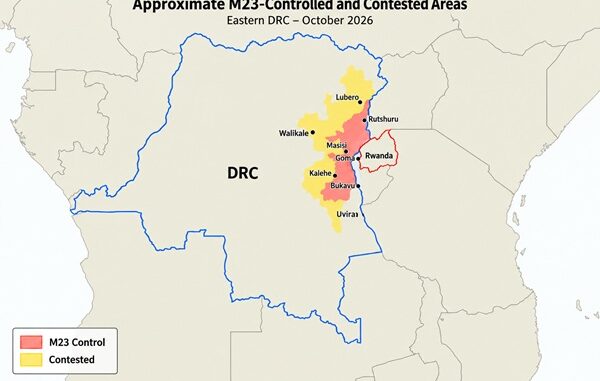
News reports are surfacing about killed and wounded personnel with a private military company (PMC), Vectus Global owned by Erik Prince (Wikipedia), who sources suspect were attacked by Rwandan forces supporting M23 on September 17, 2026 in South Kivu in eastern Democratic Republic of Congo. According to multiple news sources three ‘Westerners’ and several Congolese fighters were killed or wounded; totaling about 20 casualties during a vehicle ground movement between locations.
The March 23 Movement (M23) is a predominantly ethnic Tutsi armed rebel organization operating in eastern Democratic Republic of the Congo (DRC), particularly North Kivu and South Kivu provinces. Established in 2012 by former Congolese soldiers, the organization takes its name from a March 23, 2009, peace agreement that its founders claimed the Congolese government failed to implement. M23 was militarily defeated in 2013 but resumed its insurgency in late 2021.
M23 receives significant support from Rwanda and Rwanda SOF may be operating with M23 in Congo. The movement claims it is defending Congolese Tutsi communities from the Congolese government forces. In 2025, M23 captured Goma and Bukavu, two of eastern Congo’s most important cities.
Vectus Global was operating in support of the government of the DRC and likely working in coordination with the Forces Armées de la République Démocratique du Congo (FARDC). The PMC was awarded an $700 million contract to protect mining revenues, combat mineral smuggling, improve tax collection for the DRC government, and assist in the military campaign against M23. The PMC is also active in other African countries as well as in Haiti. The Congolese Ministry of Finance reportedly signed a five-year contract with Vectus Global in December 2024 with operations beginning in 2025. The Vectus contract dates to late 2024, was publicly disclosed in April 2025, and expanded into direct military support by January 2026. The company’s expanded role included a deployment of personnel to Uvira, a strategic town in South Kivu, following the withdrawal of M23 forces. The PMCs role may expand in the DRC with a $65 million military logistics deal.
A June 11, 2026, United Nations Group of Experts report (S/2026/466) revealed that Erik Prince’s Vectus Global contract with the Congolese government included a secret military component. In addition to mineral revenue collection, the agreement reportedly provided for strategic military advice, acquisition and deployment of aviation assets, and recruitment of former foreign military personnel. UN investigators also reported that Vectus personnel were deployed to eastern Congo in early 2026 to assist with planning military operations around Uvira. (see references below)
Prince is the founder of the now-defunct private military firm Blackwater that was established in 1997 (or 1996). It initially operated as a firearms and tactical training company before expanding into private military and security contracting. The firm provided services to the U.S. government in Iraq, Afghanistan, and other locations during the Global War on Terror (GWOT). The company underwent several name changes, reorganizations, and ownership transitions. Its principal corporate successors were Blackwater Worldwide, Xe Services, Academi, and Constellis.
The DRC has a long history of PMC activity in its conflicts. One of the more well known cases is when 290 foreign military contractors, mostly Romanians, surrendered after being surrounded by rebel forces in January 2025. The firm was hired to support the Congolese military with training, drone operations, medical instruction, and security operations. They sought refuge at a UN peacekeeper base before being evacuated through Rwanda (BBC) and repatriated.
Tim Kennedy, a U.S. Special Forces soldier who served with the 7th Special Forces Group and reportedly is a current MSG with the Maryland Army National Guard 19th Special Forces company was shot three times in the leg and evacuated to Walter Reed Hospital in Maryland. Kennedy was a former UFC martial arts fighter, book author, podcaster, and well-known ‘personality’ in the SOF community. Some social media reports state that he was likely evacuated by an air ambulance service via Burundi and Johannesburg, South Africa similar to Global Rescue, AMREF Flying Doctors, or International SOS to an airport in Maryland. Veterans are sometimes eligible for medical care at Walter Reed National Military Medical Center through the VA Community Care Referral program or through coordination with regional VA hospitals.. It is not unusual for members of the 19th or 20th Special Forces Groups (NG) to work contracts overseas for DoD, DoS, CIA, or other government agencies. Nor is it unusual for them to work overseas in conflict areas for private military companies (PMCs).
Justin Conaglen, a New Zealand Special Air Service veteran, was reported to be killed in the DRC, possibly in the same engagement as Kennedy; although the details are still unclear. Reportedly Conaglen had just recently left the SAS on leave in March and officially left the armed forces in August. He began his military career in the Royal New Zealand Air Force. He was an endurance athlete who competed in ultramarathons and was also a high peaks mountain climber.
A third ‘westerner’ was wounded in September as well. No further information is available on this person although some social media posts are speculating that he was also a former member of a U.S. SOF unit. There are also news reports stating that seven Colombian contractors working for Prince were killed in a separate clash earlier in the month.
Drones in the Congo. There are unconfirmed reports that the Prince PMC is using drones for surveillance and possibly attacks on M23 positions. The use of drones in conflicts in Africa is becoming widespread. While the drones provide a significant advantage to the side using them, the use of the drones could reveal information through various technical means or surveillance techniques that can be used against the drone user. In some cases, the launch site of the drones can be determined which can lead to a drone attack or some other type of military action.
Critical Minerals. Congo contains significant deposits of coltan, tin, tungsten, niobium, lithium, and gold as well as other strategically important minerals. These minerals are strategically significant because they support mineral supply chains important for global electronics, manufacturing, aerospace, and defense industries. Tantalum, tin, tungsten, and gold are found in eastern Congo. Critical minerals are a strategic concern of the United States; China has managed to gain a chokehold on the mining, processing, and sale of strategic critical minerals (SOF News). The exploitation of these minerals provides revenue generation via taxes on miners, traders, transporters, and others. Controlling the areas where the mining centers and transport corridors are provides economic leverage.
M23’s territorial expansion is not simply a security challenge; it also affects access to critical minerals needed by global technology and defense industries. However, access to mineral resources is one factor in the conflict, alongside ethnic tensions, regional security concerns, political competition, and Rwanda–DRC relations.
Last year, December 4, 2025, President Donald Trump hosted the signing of the Washington Accords for Peace and Prosperity between the Democratic Republic of the Congo (DRC) and Rwanda. The agreement was intended to end decades of conflict in eastern Congo, reduce support for armed groups, restore normal diplomatic relations, and establish a framework for regional economic cooperation, particularly involving critical minerals. A major American objective was to expand opportunities for U.S. companies and diversify mineral supplies in a market where China has substantial commercial influence.
In addition, also on December 4, 2025, the U.S.-DRC Strategic Partnership Agreement was signed that expanded U.S. investment in critical minerals, mining infrastructure, transportation, and economic development. A U.S.-DRC Security Memorandum of Understanding (MOU) was signed that expanded military cooperation, training, intelligence capabilities, border security, and protection of strategic infrastructure.
On March 2, 2026, the United States announced sanctions (U.S. Department of Treasury) on Rwanda’s military and several senior military commanders because of the support provided by Rwanda for M23. The US Treasury Department’s Office of Foreign Assets Control stated that Rwanda’s military is actively supporting, training, and fighting alongside the M23.
Summary. The deadly ambush of Vectus Global personnel highlights the growing involvement of private military contractors in the conflict in eastern Congo. As M23 continues to control significant territory and valuable mineral resources, the Congolese government increasingly relies on foreign security assistance. The incident underscores the risks facing military contractors operating in contested areas and raises questions about their expanding role in the conflict, particularly as the United States develops closer security and economic ties with the DRC.
*********
References:
“A Deadly Firefight Exposes Erik Prince’s New Shadow War in Congo”, by Declan Walsh, New York Times, October 9, 2026.
“Erik Prince’s forces suffer battlefield loss in Congo, former UFC fighter among wounded, sources say”, Reuters, October 9, 2026.
“Tim Kennedy Was Shot in Congo. Inside Erik Prince’s Shadow War”, by Guy D. McCardle, SOFREP, October 10, 2026.
United Nations Security Council, Final Report of the Group of Experts on the Democratic Republic of the Congo, S/2026/466, June 11, 2026, paragraphs 145–148. https://digitallibrary.un.org/record/4119763
Map: M23 controlled and contested areas in DRC (map by ChatGPT). Various news sources such as Critical Threats, IPIS, Wikipedia, and others were used to create this map.
